
Choose a Free Stock News API
for Your App为应用选择免费股票新闻 API
并完成首次调用
Compare ticker coverage, freshness, sentiment, history, JSON fields, and free-tier limits before connecting a stock news feed.
比较股票代码覆盖、更新速度、情绪字段、历史范围、JSON 结构与免费额度,再接入股票新闻源。
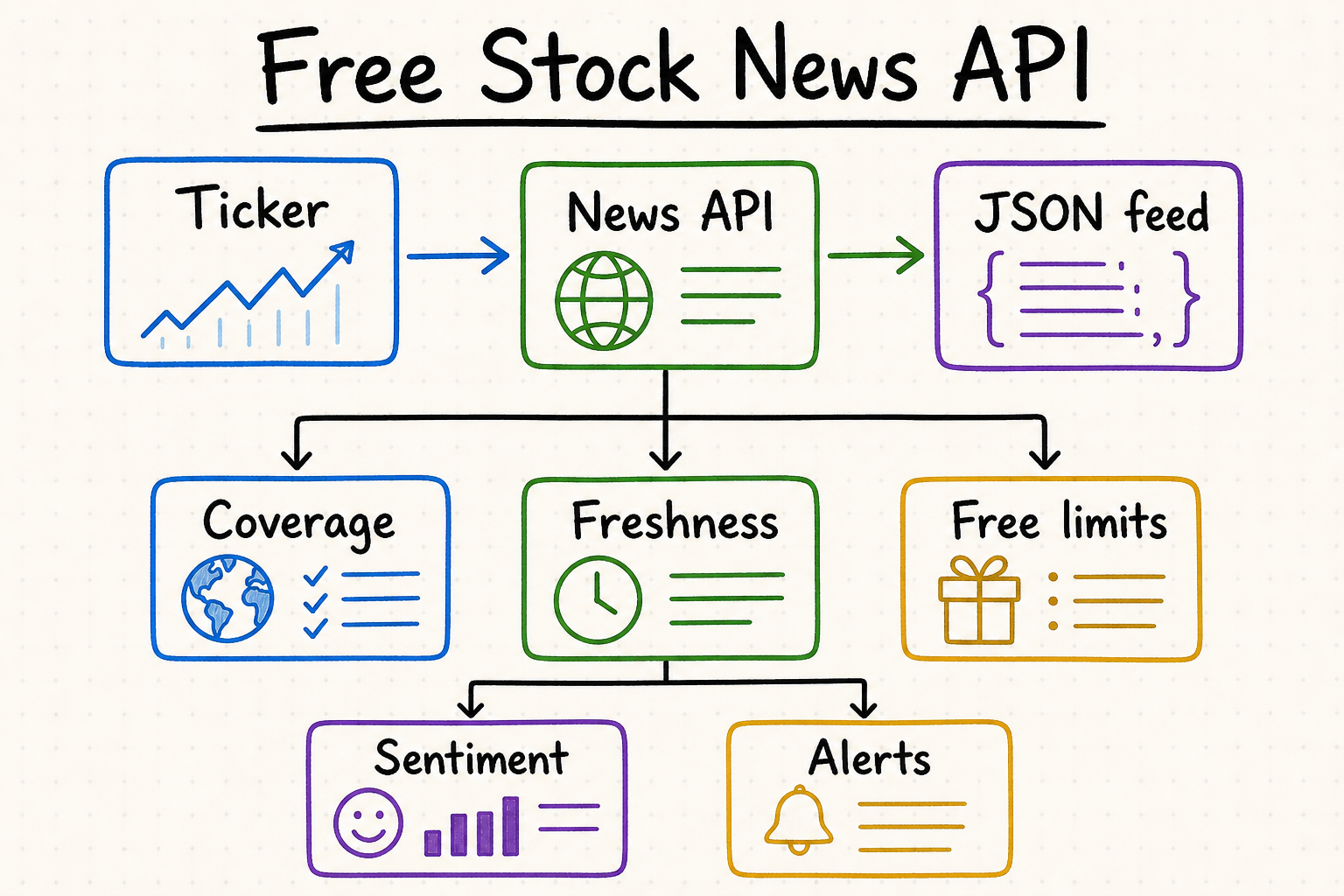
Free stock news API: the short answer免费股票新闻 API:先看结论
Expect request caps, delayed stories, short history, non-commercial terms, or restricted article text. Verify current plan terms before shipping.
A useful stock news API maps stories to symbols and exchanges instead of returning a broad business-news feed.
Measure publication-to-API delay and polling limits; a “real-time” label alone does not establish latency.
Keep title, URL, source, timestamp, symbols, and optional sentiment in a stable internal model.
常见限制包括调用次数、新闻延迟、历史范围、非商业条款或正文授权,上线前应核对当前套餐。
接口应把文章关联到股票代码和交易所,而不是只返回宽泛财经新闻。
测量发布时间到 API 可见时间,并结合轮询限制判断。
统一标题、URL、来源、时间、股票代码和可选情绪字段。
What users need from a free stock market news API用户真正需要怎样的股票新闻接口
The practical task is to find a free tier, confirm company or ticker filtering, inspect the JSON response, and decide whether the limits fit a dashboard, alert, research notebook, or trading app. General news, stock prices, and social posts are adjacent but different datasets.
实际接入时,开发者通常要先找到可试用的财经新闻 API,再确认能否按股票代码筛选、是否提供实时或历史新闻、返回哪些字段,以及额度能否支持看板、提醒或量化研究。
Coverage: exchanges, symbols, languages, and sources覆盖范围:交易所、代码、语言与来源
Check exchange-qualified identifiers, delisted-symbol behavior, countries, languages, publishers, and whether duplicate syndication is removed.
检查交易所标识、退市代码、国家、语言、新闻源以及转载去重方式。
Freshness, history, sentiment, and licensing更新速度、历史、情绪与授权
A free real-time stock news API may still delay content or restrict polling. Historical news, full text, redistribution, and sentiment often have separate limits.
免费实时股票新闻 API 仍可能延迟内容或限制轮询;历史新闻、全文、再分发与情绪分析通常有独立限制。
Calculate whether the free quota fits计算免费额度是否真的够用
Estimate requests from watchlist size, polling interval, active market hours, pagination, retries, and any per-symbol endpoint behavior. Polling one shared feed every minute is very different from calling 100 ticker endpoints every minute. Reserve quota for startup backfills and incident recovery, then test the provider's burst limit as well as its daily allowance. If the budget only works when every request succeeds and returns one page, it is not a sustainable free integration.
根据自选股数量、轮询间隔、活跃交易时长、分页、重试以及端点是否按单只股票计费来估算请求量。每分钟轮询一次共享新闻流,与每分钟分别调用 100 个股票端点完全不同。还应为启动回补和故障恢复预留额度,并同时测试突发限速与每日总量。如果预算只有在所有请求都一次成功且永远只有一页结果时才够用,这个免费方案就不具备可持续性。
Prefer stories tagged to the requested company and exchange, with the source URL preserved for verification.
Confirm stable cursors or page tokens, deterministic sorting, and clear published timestamps.
Record daily and per-minute quotas, response headers, overage behavior, and whether commercial apps are allowed.
Ticker-level sentiment, topic labels, entities, highlights, and historical search can reduce downstream processing.
Require an issuer or security identifier in addition to a bare ticker. Test symbols that are ordinary words, appear on multiple exchanges, changed after a merger, or were reused after delisting. Preserve the provider's match confidence and evidence instead of accepting every text mention as a company relationship.
Separate earnings, guidance, filings, analyst actions, corporate actions, M&A, litigation, and trading halts. Also distinguish an official filing or exchange notice from a press release, wire story, publisher analysis, or social repost so an agent can cite the strongest available evidence.
Store original publication time, provider ingestion time, update time, timezone, and the related trading session. A story published before the open, during regular trading, or after the close can support different alerts even when all three arrive on the same calendar date.
优先选择能关联公司与交易所,并保留来源 URL 供核验的接口。
确认游标或分页标记稳定、排序规则固定,且发布时间字段定义清晰。
记录每日与每分钟额度、响应头、超额行为以及商业使用条件。
股票级情绪、主题、实体、摘要与历史搜索能减少下游处理。
除了股票代码,还应要求返回公司或证券标识。要测试与普通单词重名、在多个交易所上市、并购后改名或退市后被重新使用的代码。保留供应商的匹配置信度与证据,不要把每一次文字提及都直接当成公司关联。
区分财报、业绩指引、监管文件、分析师动作、公司行动、并购、诉讼和停牌。还要区分官方文件或交易所公告、新闻稿、通讯社报道、媒体分析与社交转发,让 Agent 能优先引用证据强度更高的来源。
保存原始发布时间、供应商收录时间、更新时间、时区和对应交易时段。盘前、正常交易时段与盘后发布的消息,即使出现在同一自然日,也可能触发完全不同的提醒逻辑。
Model the complete news lifecycle记录完整的新闻生命周期
A single timestamp cannot explain how quickly information became usable. Preserve the event time when the source states it, the first publisher time, the API's first-seen time, each update or correction time, and your retrieval time. Event time may be absent or approximate; keep that uncertainty instead of copying the publication time into every field.
单一时间戳无法说明一条信息何时真正可用。若来源明确给出,应分别保存事件发生时间、媒体首发时间、API 首次收录时间、每次更新或更正时间,以及应用抓取时间。事件时间可能缺失或只能近似判断,此时应保留不确定状态,不能把发布时间复制到所有时间字段。
Event says when the underlying fact occurred; published and first seen measure delivery; updated tracks changing content; retrieved proves what the application knew.
Keep one canonical story ID plus article-version IDs. Syndicated copies belong to the same cluster, while a material correction must remain a new version with a link to the earlier claim.
Distinguish “no matching news” from an unknown ticker, unsupported exchange, expired history window, permission failure, quota exhaustion, and provider outage. These states require different user messages and retries.
事件时间表示事实何时发生;首发时间与首次收录时间用于衡量传递延迟;更新时间记录内容变化;抓取时间证明应用当时已经知道什么。
保留一个规范新闻簇 ID 和多个文章版本 ID。转载稿归入同一新闻簇;实质性更正则应保存为新版本,并关联到之前的表述。
要区分确实没有相关新闻、股票代码无法识别、交易所不支持、历史窗口超限、权限失败、额度耗尽和供应商故障;它们对应的提示与重试策略完全不同。
How to compare the best free stock news API options如何比较免费股票新闻 API 选项
| Requirement要求 | Verify验证内容 | Common free limit常见限制 | Test测试 |
|---|---|---|---|
| Ticker filtering股票代码筛选 | Symbol and exchange mapping代码与交易所映射 | Narrow market coverage市场覆盖有限 | Query an ambiguous symbol查询可能重名的代码 |
| Freshness时效性 | Published time vs API time发布时间与 API 收录时间 | Delay or low polling quota存在延迟或轮询额度较低 | Record latency for a week连续一周记录延迟 |
| JSON fieldsJSON 字段 | URL, source, time, symbolsURL、来源、时间、代码 | Missing body or images缺正文或图片 | Validate nulls and pages验证空值与分页 |
| Sentiment and history情绪与历史 | Score level and lookback评分粒度与历史回溯范围 | Paid add-on or short history需要付费或历史范围较短 | Inspect methods and dates检查计算方法与日期范围 |
Turn the comparison into an acceptance test. Build a small dated corpus of earnings releases, guidance changes, SEC filings, analyst actions, mergers, dividends, splits, and trading halts. Add negative cases: an ambiguous ticker, an unrelated article that only mentions the company, a syndicated duplicate, and a corrected headline. For each event, record the correct issuer and exchange, first publisher timestamp, first API appearance, duplicate group, later correction, and whether the article was materially about the company. Then measure missed-event rate, wrong-ticker rate, duplicate rate, correction latency, and publication-to-API latency at the median and 95th percentile. Report premarket, regular-session, and after-hours results separately; one daily average can hide the exact period when alerts matter most. A provider that returns many articles but misses high-impact events—or repeatedly assigns ambiguous symbols—should not win on volume alone.
把对比表转化为可执行的验收测试。准备一组带日期的固定样本,覆盖财报、业绩指引调整、SEC 文件、分析师评级、并购、分红、拆股和停牌,并加入负向案例:歧义股票代码、只顺带提到公司的无关文章、重复转载和被更正的标题。逐条记录正确的公司与交易所、首发时间、API 首次收录时间、重复分组、后续更正,以及文章是否真正以该公司为核心。随后计算事件漏报率、股票代码误关联率、重复率、更正延迟,并统计发布时间到 API 收录延迟的中位数与第 95 百分位。盘前、正常交易时段与盘后结果应分别报告,单一日均值可能掩盖提醒最重要时段的真实表现。若某个供应商返回的文章很多,却漏掉重要事件,或频繁把易混淆的代码关联到错误公司,就不应仅凭数量胜出。
Make your first stock news API JSON request完成首次股票新闻 API JSON 请求
Use the documented symbol parameter, a result limit of five, and server-side authentication. Never expose a private API key in browser code.
Require a title, canonical source URL, publisher, published timestamp, and exchange-aware symbol; handle nullable summaries and images.
Convert times to UTC and deduplicate by canonical URL plus title before saving or displaying articles.
Log quota headers and retry 429 and transient 5xx responses with bounded exponential backoff.
Rank by verified entity relevance, event type, novelty, source quality, and timing rather than sentiment alone. Set separate rules for first publication, material update, correction, and duplicate follow-up. Preserve the decision features so a reviewer can explain why an alert fired or was suppressed.
Keep stable article and story-cluster IDs, compare updated timestamps or hashes, and link every correction or retraction to the earlier version. If an alert was based on information later corrected, notify downstream users instead of merely replacing the stored headline.
使用文档规定的股票代码参数,将返回数量限制为 5 条,并在服务端完成鉴权。切勿在浏览器代码中暴露私钥。
至少验证标题、来源 URL、发布者、发布时间和带交易所的股票代码,并处理可空字段。
将时间统一为 UTC,并使用规范 URL 与标题的组合作为文章去重依据。
记录额度响应头,对 429 和临时 5xx 使用有限次数的指数退避。
排序应综合已验证的实体相关性、事件类型、新颖性、来源质量和时间,而不是只看情绪。首发、重大更新、更正与重复跟进需要不同规则,并保留决策特征,方便复核人员解释提醒为何触发或被抑制。
保留稳定的文章 ID 和新闻簇 ID,通过更新时间或内容哈希发现变化,并把更正或撤稿关联到早期版本。如果提醒所依据的信息后来被修正,应通知下游用户,而不是只在数据库中替换旧标题。
Use QVeris to discover stock news capabilities用 QVeris 发现股票新闻能力
QVeris helps agents discover and inspect callable capabilities. Open the QVeris tool details to review financial-news tools, inspect their declared inputs and outputs, and keep provider-specific choices separate from application logic.
QVeris 帮助 Agent 发现并检查可调用能力。可打开 QVeris 工具详情,查看财经新闻工具、检查其输入输出,并让供应商选择与应用逻辑解耦。
- Inspect tool schemas before calling a stock news capability.
- Keep source attribution and article URLs in every normalized record.
- See the Python implementation guide and news sentiment guide for adjacent intents.
- 调用股票新闻能力前先检查工具 Schema。
- 规范化记录中始终保留来源署名与文章 URL。
- 如需进一步了解相邻主题,可阅读 Python 实现指南与新闻情绪指南。
FAQ
Yes, but quotas, delay, history, fields, and commercial rights vary. Confirm the current official plan before relying on one.
Look for documented symbol or entity parameters and exchange-aware identifiers. Test ambiguous symbols.
Sometimes for testing or low volume, but ingestion delay and polling limits still apply. Measure end-to-end latency.
Some do. Check whether sentiment is article-level or ticker-level, its method, and free-plan availability.
有,但调用额度、延迟、历史、字段和商业使用权不同,应核对官方当前套餐。
寻找明确的 symbol 或 entity 参数与交易所标识,并用重名代码测试。
部分服务可用于测试或低调用量,但仍需实测采集延迟与轮询限制。
部分接口会提供情绪数据,但需要确认评分是文章级还是股票级、采用何种计算方法,以及免费套餐是否包含该字段。