
LangChain Alternative
for AI Agents
面向 AI Agent 的
LangChain 替代思路
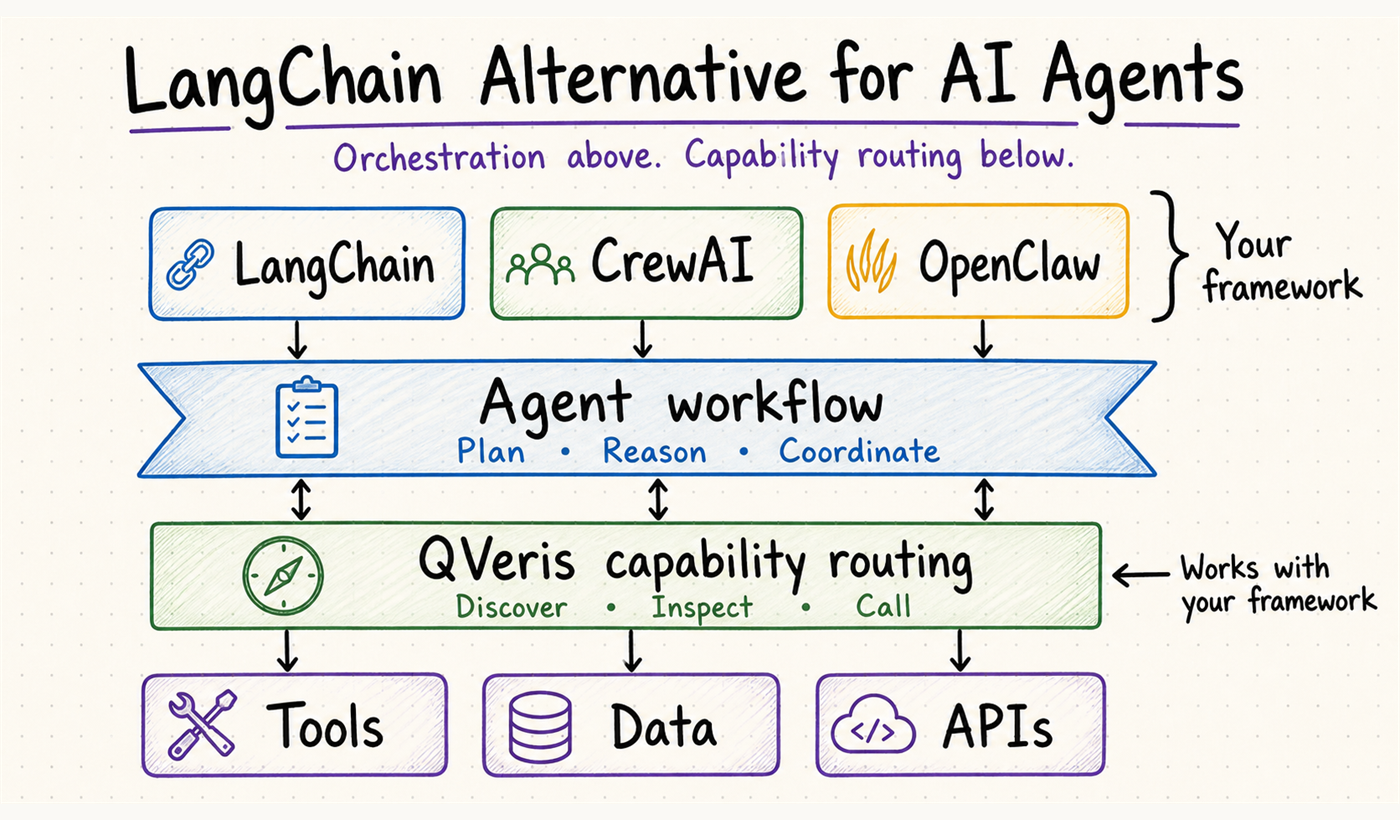
LangChain helps teams orchestrate agent workflows. QVeris solves a different production problem: how agents discover, inspect, route, and call external capabilities without brittle API wiring.
LangChain 帮助团队编排 Agent 工作流。QVeris 解决的是另一个生产问题:Agent 如何发现、检查、路由并调用外部能力,而不依赖脆弱的 API 手动接线。
Is QVeris a LangChain Alternative? QVeris 是 LangChain 替代方案吗?
QVeris is not trying to be another orchestration framework. LangChain is useful when teams need chains, agents, memory, retrieval, and workflow building blocks. QVeris is different: it acts as the capability routing layer underneath an agent framework. If your problem is tool discovery, MCP tool calling, financial data access, schema inspection, provider comparison, or fallback execution, QVeris can complement or replace parts of a hand-built LangChain tool layer.
QVeris 并不是想做另一个编排框架。LangChain 适合需要 chains、agents、memory、retrieval 和 workflow building blocks 的团队。QVeris 的定位不同:它更像 Agent 框架下面的能力路由层。如果你的问题是工具发现、MCP 工具调用、金融数据接入、schema 检查、provider 对比或 fallback 执行,QVeris 可以补充,甚至替代一部分手写的 LangChain 工具层。
Why Developers Search for LangChain Alternatives 为什么开发者会搜索 LangChain 替代方案
As agents connect to more APIs and MCP servers, teams need dynamic discovery instead of long static tool arrays.
当 Agent 接入更多 API 和 MCP Server 后,团队需要动态发现能力,而不是维护越来越长的静态工具数组。
Financial tools differ by ticker field, exchange format, date range, filing type, and authentication requirement.
金融工具在 ticker 字段、交易所格式、日期范围、文件类型和认证要求上都可能不同。
A production agent needs ranked alternatives, source metadata, and a way to understand why a tool was selected.
生产级 Agent 需要排序后的替代能力、来源元数据,以及解释为什么选择某个工具的机制。
LangChain vs QVeris: Different Layers LangChain 与 QVeris:不同层级
A fair comparison should not frame QVeris as a direct replacement for every LangChain feature. The better question is: which layer are you trying to fix? LangChain is usually part of the agent workflow layer. QVeris focuses on the capability layer: discovering available tools, inspecting schemas, routing to the right provider, and calling capabilities with structured output.
公平的对比不应该把 QVeris 说成能替代 LangChain 的所有功能。更好的问题是:你想解决哪一层?LangChain 通常处在 Agent 工作流层;QVeris 关注的是能力层:发现可用工具、检查 schema、路由到合适 provider,并以结构化输出调用能力。
| Layer 层面 | LangChain | QVeris |
|---|---|---|
| Workflow orchestration 工作流编排 | Strong for chains, agents, retrieval, and application logic. 擅长链、Agent、检索和应用逻辑编排。 | Works underneath or beside the workflow layer. 位于工作流层下方或与其协同工作。 |
| Tool discovery 工具发现 | Often developer-defined and static unless custom logic is added. 通常由开发者静态定义,除非额外编写自定义逻辑。 | Discover capabilities by intent across providers and domains. 按意图跨供应商和领域发现能力。 |
| Schema inspection Schema 检查 | Possible, but usually implemented per tool or integration. 可以实现,但通常要为每个工具或集成单独开发。 | Inspect parameters, examples, latency, cost, and source metadata before calling. 调用前检查参数、示例、延迟、成本和来源元数据。 |
| Finance data coverage 金融数据覆盖 | Depends on integrations the team wires manually. 取决于团队手动接入的数据源。 | Designed around financial capabilities, MCP tools, APIs, and provider routing. 围绕金融能力、MCP 工具、API 和供应商路由设计。 |
| Fallback routing 回退路由 | Custom application logic. 需要自定义应用逻辑。 | Route across candidate providers when quality, cost, or availability changes. 当质量、成本或可用性变化时,在候选供应商之间路由。 |
How QVeris Fits Into an Existing Agent Stack QVeris 如何接入现有 Agent 技术栈
You do not need to abandon your existing framework to use QVeris. A team can keep LangChain, CrewAI, LlamaIndex, OpenAI function calling, or a custom agent loop, while delegating capability discovery and execution to QVeris. The agent plans the task; QVeris finds and calls the right capability.
使用 QVeris 并不意味着必须放弃现有框架。团队可以继续使用 LangChain、CrewAI、LlamaIndex、OpenAI function calling 或自研 Agent loop,同时把能力发现和执行交给 QVeris。Agent 负责规划任务;QVeris 负责找到并调用正确能力。
# Keep your agent framework
task = "Analyze AAPL latest filing and price movement"

# Use QVeris as the capability layer
tools = qveris.discover(task)
schema = qveris.inspect(tools[0].id)
result = qveris.call(
    tools[0].id,
    params={"symbol": "AAPL"}
)
When QVeris Is the Better Fit 什么时候更适合用 QVeris
You need stock prices, filings, earnings, news, crypto, macro, or portfolio data.
你需要股价、文件、财报、新闻、加密、宏观或组合数据。
You want Claude, Cursor, or OpenCode to call real capabilities without manual wiring.
你希望 Claude、Cursor 或 OpenCode 调用真实能力,而不是手动接线。
Several providers can answer the same task, but cost, latency, and coverage differ.
多个 provider 都能回答同一任务,但成本、延迟和覆盖不同。
You need fallback, source metadata, and schema-aware execution.
你需要 fallback、来源元数据和 schema-aware 执行。
When LangChain Still Makes Sense 什么时候 LangChain 仍然合适
LangChain remains useful when a team needs a broad application framework, chains, memory abstractions, retrieval pipelines, integrations, and custom orchestration logic. The point is not that QVeris replaces every LangChain component. The point is that many teams do not need to rebuild financial tool discovery and MCP execution logic inside LangChain when a capability layer can do it more directly.
当团队需要完整应用框架、chains、memory 抽象、retrieval pipeline、集成和自定义编排逻辑时,LangChain 仍然有价值。重点不是 QVeris 替代 LangChain 的所有组件,而是很多团队没必要在 LangChain 里重新手写金融工具发现和 MCP 执行逻辑,因为能力层可以更直接地解决这个问题。
Questions to Ask Before Replacing an Agent Framework替换 Agent 框架前应该先问的问题
“LangChain alternative” can describe several different needs: a simpler application framework, better tool routing, lower operational overhead, stronger observability, or a domain capability layer. Identify the failing layer before choosing a replacement.
“LangChain 替代方案”可能代表多种不同需求:更简单的应用框架、更好的工具路由、更低运维负担、更强可观察性,或一个领域能力层。选择替代方案前,应先确定真正失效的是哪一层。
| Question问题 | If the answer is yes如果答案是“是” | Likely direction更可能的方向 |
|---|---|---|
| Is the pain mainly chains, state, memory, retrieval, or application orchestration?主要痛点是链、状态、记忆、检索还是应用编排吗? | The framework layer itself may be too heavy, too implicit, or a poor fit for the team框架层本身可能过重、过于隐式,或不适合团队 | Compare smaller frameworks, explicit code, graph runtimes, and migration cost比较更轻框架、显式代码、图运行时和迁移成本 |
| Is the pain finding, describing, and routing a growing catalog of external tools?主要痛点是发现、描述和路由不断增长的外部工具目录吗? | Replacing the orchestration framework may leave the capability problem unchanged替换编排框架可能仍无法解决能力层问题 | Add a discovery and routing layer such as QVeris while keeping useful orchestration保留有价值的编排,同时加入 QVeris 等发现与路由层 |
| Is reliability failing after a tool has already been selected?可靠性问题是否发生在工具已经选定之后? | Argument validation, permissions, retries, idempotency, or provider quality may be the root cause根因可能是参数校验、权限、重试、幂等或供应商质量 | Strengthen execution contracts and observability before a broad rewrite全面重写前,先加强执行契约和可观察性 |
| Can the proposed change be measured on representative tasks?能否用有代表性的任务衡量拟议变更? | The team can compare quality instead of choosing by abstraction preference团队可以比较实际质量,而不是按抽象偏好选择 | Benchmark completion, evidence, latency, cost, failures, and maintenance effort衡量完成率、证据、延迟、成本、失败和维护工作量 |
A Coexistence Architecture: LangChain and QVerisLangChain 与 QVeris 的共存架构
For many teams, the lowest-risk answer is composition rather than replacement. Keep the framework where it already expresses application flow well, and introduce a capability layer where static tool definitions or provider-specific integrations become difficult to manage.
对很多团队而言,风险最低的答案是组合,而不是替换。在框架能够清晰表达应用流程的地方继续使用它;当静态工具定义或供应商专属集成难以管理时,再引入能力层。
Use LangChain or the team’s preferred runtime for prompts, retrieval, state transitions, memory, human approval, and multi-step business logic. This layer owns when a capability is needed and how its result affects the wider application.
使用 LangChain 或团队偏好的运行时管理提示词、检索、状态转换、记忆、人工审批和多步骤业务逻辑。该层负责决定何时需要某种能力,以及结果如何影响整个应用。
Use QVeris when the agent must search a changing tool landscape, compare providers, inspect only the selected schema, or reach financial and other external capabilities without embedding a large static catalog in every prompt.
当 Agent 需要搜索不断变化的工具生态、比较供应商、只检查所选 Schema,或在每次提示词中不嵌入庞大静态目录的情况下访问金融等外部能力时,可使用 QVeris。
The application should still enforce permissions, data authority, budgets, review thresholds, retry policy, and final-answer evidence. A routing layer expands capability access; it does not remove responsibility for domain controls or user-facing correctness.
应用仍应执行权限、数据权威性、预算、复核门槛、重试策略和最终答案证据要求。路由层扩展了能力访问,但不会替代领域控制或面向用户的正确性责任。
LangChain Alternative FAQLangChain 替代方案常见问题
No. LangChain is a broad application and orchestration framework. QVeris focuses on discovering, inspecting, routing, and calling capabilities for AI agents. It can complement LangChain, replace a hand-built tool registry, or serve a narrower agent that does not need a large framework.
Consider replacement when the framework layer itself creates recurring complexity, unclear execution, unacceptable overhead, or poor fit—and when a benchmark shows another approach improves the team’s representative workflows after migration and maintenance costs are included.
Yes. An application can keep its model provider, prompts, retrieval system, state machine, and observability while delegating capability discovery and selected calls to QVeris. This enables incremental adoption instead of a full rewrite.
Build a task set that reflects production intent, then compare completion quality, source traceability, tool-selection accuracy, latency, cost, failure recovery, debugging effort, security boundaries, and the amount of custom integration code the team must own.
不能简单等同。LangChain 是广泛的应用与编排框架;QVeris 专注于为 AI Agent 发现、检查、路由和调用能力。它可以补充 LangChain、替代自建工具注册表,也可以服务于不需要大型框架的较轻 Agent。
当框架层本身持续造成复杂性、执行不透明、无法接受的开销或团队适配问题,并且基准测试证明另一种方案在计入迁移和维护成本后仍能改进代表性工作流时,才值得考虑替换。
可以。应用可以保留模型供应商、提示词、检索系统、状态机和可观察性,只把能力发现与选定调用交给 QVeris,从而渐进式采用,而不必全面重写。
建立能反映生产意图的任务集,然后比较完成质量、来源可追溯性、工具选择正确率、延迟、成本、失败恢复、调试工作量、安全边界,以及团队必须自建和维护的集成代码量。
External References 外部参考资料
For context on the framework ecosystem, see the official LangChain documentation. For protocol-level tool exposure, read the official Model Context Protocol documentation. QVeris sits in the capability layer where agents need discovery, inspection, routing, and reliable execution.
框架生态背景可以参考官方 LangChain 文档。协议层工具暴露可以阅读官方 Model Context Protocol 文档。QVeris 位于能力层,帮助 Agent 做发现、检查、路由和可靠执行。
Conclusion: Keep the Framework, Add a Capability Layer 结论:保留框架,增加能力层
The best LangChain alternative for AI agents is not always another framework. For teams building finance agents, market monitors, SEC filing analyzers, or MCP tool workflows, the missing piece is often capability routing. QVeris helps agents find, inspect, and call the right tools while letting teams keep the orchestration framework they already use.
对 AI Agent 来说,最好的 LangChain 替代方案不一定是另一个框架。对于构建金融研究 Agent、市场监控 Agent、SEC 文件分析 Agent 或 MCP 工具工作流的团队,真正缺的往往是能力路由。QVeris 帮助 Agent 找到、检查并调用正确工具,同时让团队保留已有的编排框架。