
LiteLLM vs Bifrost
Compatibility Breadth or Lean Data Plane?
LiteLLM 与 Bifrost:兼容广度,还是精简数据平面?
Language choice is only a proxy for the real decision. Compare protocol fidelity, routing behavior, governance, tail latency, resource use, upgrade risk, and the operational skill your team already has.
编程语言只是实际决策的一个代理变量。应比较协议保真、路由行为、治理、尾延迟、资源使用、升级风险,以及团队已有的运营能力。
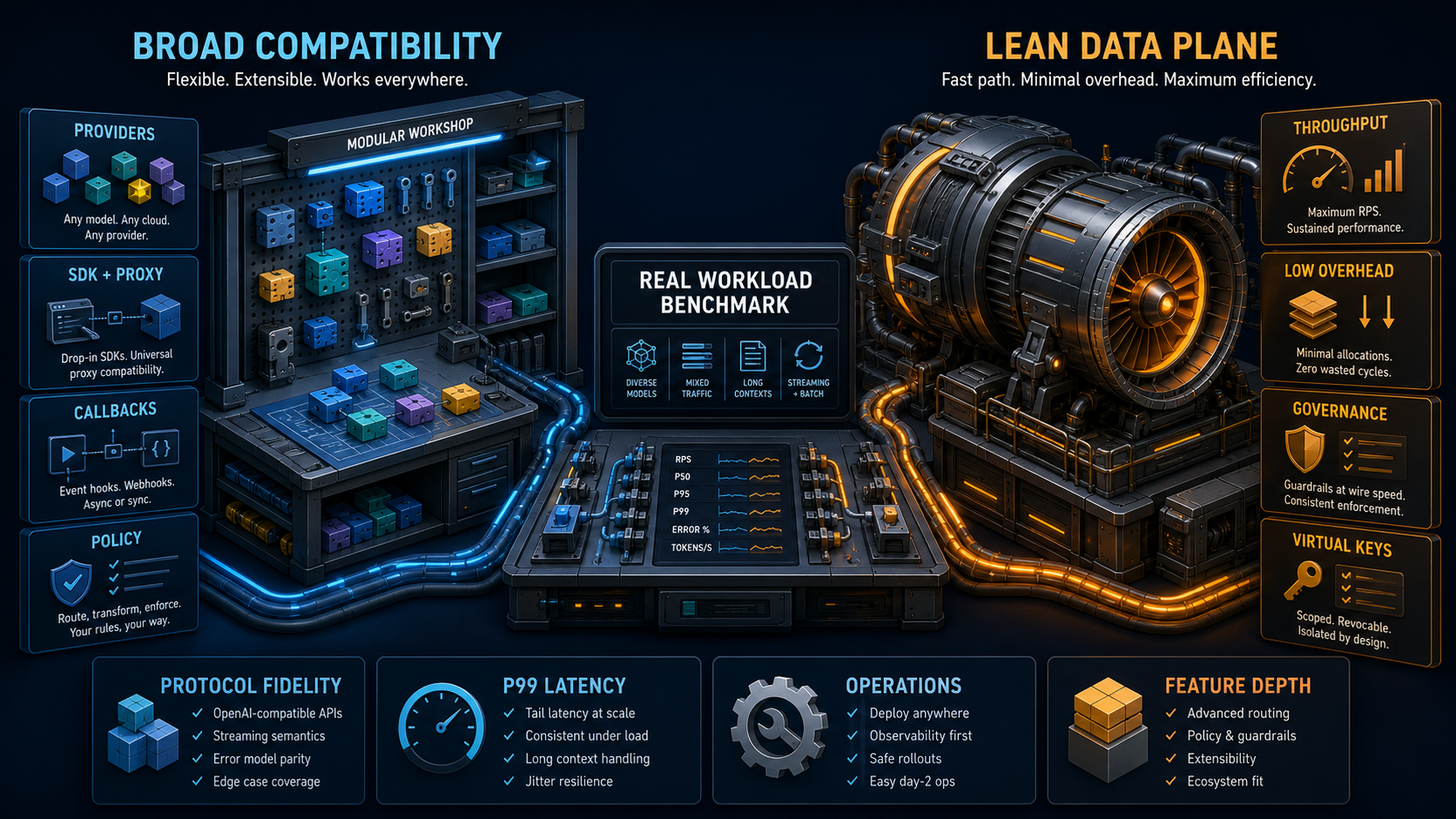
TL;DR
Its SDK and proxy surface, broad provider normalization, virtual keys, budgets, callbacks, and integrations favor compatibility-heavy teams.
Its current documentation emphasizes a Go data plane, base-URL migration, provider routing, fallbacks, governance, virtual keys, budgets, limits, and MCP filtering.
Published throughput is not a purchase decision. Reproduce streaming, long context, tool calls, provider errors, logging, and governance under your concurrency.
Configuration safety, storage, upgrades, on-call clarity, dashboards, and incident recovery may matter more than a microbenchmark.
其 SDK 与代理面、广泛供应商标准化、虚拟密钥、预算、回调和集成更适合兼容性优先的团队。
当前文档强调 Go 数据平面、基础地址(Base URL)迁移、供应商路由、回退、治理、虚拟密钥、预算、限额和 MCP 过滤。
公开吞吐不是采购结论,应在真实并发下复现流式、长上下文、工具调用、供应商错误、日志和治理。
配置安全、存储、升级、值班边界、仪表盘和事故恢复可能比微基准更重要。
Compare the full data-plane contract 比较完整的数据平面契约
LiteLLM is a broad compatibility layer. Its official documentation presents a Python SDK and Proxy Gateway with an OpenAI-style interface across many providers, centralized authentication and authorization, virtual keys, budgets, routing, fallbacks, caching, guardrails, spend tracking, and integrations.
LiteLLM 是广泛兼容层。官方文档提供 Python SDK 与代理网关,以 OpenAI 风格接口连接众多供应商,并提供集中认证授权、虚拟密钥、预算、路由、回退、缓存、护栏、支出追踪和集成。
Bifrost presents a focused gateway runtime. Current official documentation emphasizes drop-in base-URL migration, automatic fallbacks, weighted load balancing, virtual-key governance, provider and model filtering, hierarchical budgets and limits, routing rules, semantic caching, and MCP tool filtering.
Bifrost 把自己定位为聚焦的网关运行时。当前官方文档强调通过基础地址(Base URL)直接迁移、自动回退、加权负载均衡、虚拟密钥治理、供应商与模型过滤、分层预算与限额、路由规则、语义缓存和 MCP 工具过滤。
LiteLLM vs Bifrost side by side LiteLLM 与 Bifrost 并排比较
| Decision surface 决策面 | LiteLLM | Bifrost |
|---|---|---|
| Runtime orientation 运行时取向 | Python SDK plus proxy; wide integration surface Python SDK 加代理,集成面广 | Go gateway/data-plane emphasis 强调 Go 网关与数据平面 |
| Provider contract 供应商契约 | Broad normalized provider and protocol surface 广泛标准化供应商与协议面 | Drop-in OpenAI-style gateway with documented providers OpenAI 风格直连网关与文档化供应商 |
| Governance 治理 | Virtual keys, teams, budgets, spend, policy and callbacks 虚拟密钥、团队、预算、支出、策略与回调 | Virtual keys, provider/model filters, budgets, limits, teams/customers 虚拟密钥、供应商/模型过滤、预算、限额、团队/客户 |
| Routing 路由 | Retries, fallbacks, load balancing and model/provider strategies 重试、回退、负载均衡与模型/供应商策略 | Weighted routing, rules, fallbacks and capacity-aware governance 加权路由、规则、回退与容量感知治理 |
| Extensibility 扩展性 | Callbacks and a large integration ecosystem 回调与大型集成生态 | Focused configuration, API, UI and MCP controls 聚焦配置、API、UI 与 MCP 控制 |
| Operational proof 运营验证 | Measure breadth, memory, workers, storage and callbacks 测量广度、内存、Worker、存储与回调 | Measure tail latency, governance stores, routing rules and upgrades 测量尾延迟、治理存储、路由规则与升级 |
Choose for the contract, not the implementation language 按契约选择,而不是按语言选择
Provider breadth, SDK use, existing integrations, callbacks, and a mature proxy configuration surface outweigh a narrower data-plane focus.
A lean gateway runtime, explicit virtual-key governance, routing rules, MCP filtering, and a Go-oriented operational profile fit the platform team.
Protocol edge cases, persistence topology, upgrade compatibility, enterprise support, or recovery procedures have not been proven.
供应商广度、SDK 使用、现有集成、回调和成熟代理配置面比精简数据平面更重要。
精简网关运行时、显式虚拟密钥治理、路由规则、MCP 过滤和 Go 取向运营特征更匹配平台团队。
协议边缘情况、持久化拓扑、升级兼容、企业支持或恢复流程尚未验证。
Benchmark the complete request lifecycle 基准测试完整请求生命周期
Put each gateway in the same topology with identical upstream keys, region, TLS, logging, storage, policies, and retry budget. Generate unary and streaming traffic with short and long contexts, tool calls, structured output, multimodal payloads, cache hits, provider 429/5xx errors, and configuration reloads. Record CPU, memory, connections, queueing, first-token latency, total latency, errors, duplicate upstream calls, and recovery time.
把两套网关放在相同拓扑中,使用相同上游密钥、区域、TLS、日志、存储、策略和重试预算。生成短/长上下文、流式、工具调用、结构化输出、多模态、缓存命中、供应商 429/5xx 和配置重载流量;记录 CPU、内存、连接、排队、首 Token 延迟、总延迟、错误、重复上游调用和恢复时间。
Architecture rule: never compare a bare proxy with one that is also logging, enforcing budgets, and exporting traces.
架构规则:不要把裸代理与同时记录日志、执行预算并导出追踪的代理直接比较。
A fair gateway benchmark 公平的网关基准
- Freeze versions, instance sizes, regions, keep-alive settings, worker counts, and upstream provider quotas.
- Verify semantic parity for roles, tools, structured output, reasoning fields, streaming events, usage, and errors.
- Sweep concurrency until p99 latency, error rate, or resource saturation breaks the service objective.
- Force provider, storage, and configuration failures; inspect fallback, budget, audit, and rollback evidence.
- Repeat after an upgrade and include operator minutes in total cost.
- 冻结版本、实例规格、区域、Keep-alive、Worker 数量和上游供应商配额。
- 验证 Role、工具、结构化输出、Reasoning 字段、流式事件、用量与错误的语义一致性。
- 逐步提升并发,直到 p99 延迟、错误率或资源饱和突破服务目标。
- 强制供应商、存储与配置故障,检查回退、预算、审计与回滚证据。
- 升级后重复测试,并把运营人员时间计入总成本。
Preserve policy and evidence, not config syntax 保留策略与证据,而不是配置语法
Inventory models, aliases, keys, teams, budgets, limits, routing weights, retry conditions, cache rules, guardrails, callbacks, metadata, and dashboards. Convert them into a neutral policy matrix, then implement and dual-run the new gateway. Diff response semantics, upstream selection, usage and cost before moving traffic by application.
盘点模型、别名、密钥、团队、预算、限额、路由权重、重试条件、缓存规则、护栏、回调、元数据和仪表盘;先转成中立策略矩阵,再实现并双轨运行新网关。按应用切流前,对比响应语义、上游选择、用量与成本。
The gateway routes models; QVeris routes capabilities 网关路由模型,QVeris 路由能力
LiteLLM or Bifrost normalizes and governs model inference. QVeris complements that layer by helping agents discover and call external APIs, data, and tools under governed contracts and credentials. Carry the gateway trace ID into every downstream capability call.
LiteLLM 或 Bifrost 标准化并治理模型推理;QVeris 作为互补层,帮助智能体在受治理契约和凭证下发现并调用外部 API、数据和工具。应把网关调用链 ID 传入每次下游能力调用。
A Production Decision Scorecard for LiteLLM vs BifrostLiteLLM 与 Bifrost的生产决策评分卡
For LiteLLM vs Bifrost, the useful question is not which product has more checkmarks. It is which design gives the team the right boundary, evidence, operating model, and exit path for a defined workload.
针对“LiteLLM 与 Bifrost”,真正有价值的问题不是哪款产品拥有更多勾选项,而是哪种设计能为明确工作负载提供正确边界、证据、运营模式和退出路径。
Map proxy architecture, provider breadth, throughput, policy controls, deployment footprint, configuration portability, and operational maturity. Decide which component owns each decision, where policy is enforced, and whether the products are substitutes, complements, or overlapping layers.
梳理代理架构、供应商广度、吞吐、策略控制、部署形态、配置可迁移性和运营成熟度。明确每项决策由哪个组件负责、策略在哪里执行,以及两者究竟是替代、互补还是部分重叠。
To validate LiteLLM vs Bifrost, replay simple, long-context, streaming, structured-output, tool-calling, high-concurrency, and failure cases. Measure accepted-result quality, completion, p50 and tail latency, retries, trace completeness, and effective cost.
验证“LiteLLM 与 Bifrost”时,重放简单、长上下文、流式、结构化输出、工具调用、高并发和失败案例,衡量合格结果质量、完成率、常规与长尾延迟、重试、追踪完整性和实际成本。
When evaluating LiteLLM vs Bifrost, include hosting, regional capacity, data retention, identity integration, policy maintenance, upgrades, incident response, support, compliance evidence, and the custom adapters the team must keep current.
评估“LiteLLM 与 Bifrost”时,纳入托管、区域容量、数据留存、身份集成、策略维护、升级、事故响应、支持、合规证据,以及团队必须持续维护的自定义适配器。
Before rolling out LiteLLM vs Bifrost, version a neutral request and evidence envelope, shadow traffic, classify semantic differences, preserve trace identity, and prove a staged rollback. Prefer the option that keeps policy and workload contracts portable.
上线“LiteLLM 与 Bifrost”前,版本化中立请求与证据封装,运行影子流量,分类语义差异,保留追踪身份,并证明可分阶段回滚。优先选择能让策略和工作负载契约保持可迁移的方案。
FAQ
No. Architecture, serialization, networking, logging, storage, worker model, configuration, and workload determine the measured result.
Yes. Its official documentation presents both a Python SDK and a Proxy Gateway.
Current documentation covers virtual keys, model/provider filtering, budgets, rate limits, teams, customers, and routing rules.
Choose the one the team can operate and upgrade while meeting protocol, reliability, and evidence requirements; benchmark first.
不一定。架构、序列化、网络、日志、存储、Worker 模型、配置和负载共同决定实测结果。
有。其官方文档同时提供 Python SDK 与代理网关。
当前文档覆盖虚拟密钥、模型/供应商过滤、预算、限流、团队、客户和路由规则。
应选择团队能运营和升级、且满足协议、可靠性与证据要求的方案;先做基准。