
MCP Tool Calling
for AI Agents with QVeris
面向 AI Agent 的
MCP 工具调用
MCP tool calling gives AI agents a standard way to reach external tools. QVeris adds the missing production layer: discovery, schema inspection, routing, fallback, and reliable JSON results.
MCP 工具调用让 AI Agent 能用标准方式连接外部工具。QVeris 在此之上补齐生产层:工具发现、schema 检查、路由、fallback,以及可靠的 JSON 结果。
Why MCP Tool Calling Needs More Than a Server List 为什么 MCP 工具调用不只是服务器列表
MCP gives agents a common interface for tools, resources, and prompts. That is a major step forward, but a production AI agent still needs to decide which MCP tool to call, which parameters are required, whether the source is fresh, whether the call is allowed, and what fallback should run if the tool fails. This is the problem QVeris addresses in the blog Stop Wiring Up MCP Tools Yourself. Use QVeris.
MCP 为工具、资源和 prompt 提供了通用接口,这是重要进步。但生产级 AI Agent 仍然需要判断应该调用哪个 MCP 工具、需要哪些参数、数据是否新鲜、调用是否被允许,以及工具失败时应该如何 fallback。QVeris 在 Stop Wiring Up MCP Tools Yourself. Use QVeris. 这篇 blog 中讨论的正是这个问题。
What Is MCP Tool Calling? 什么是 MCP 工具调用?
MCP tool calling is the process where an AI agent uses the Model Context Protocol to request an external capability from an MCP server. The server exposes callable tools and schemas; the client sends arguments; the server returns structured results. In a small demo, one MCP client can call one tool directly. In real workflows, agents often need multiple MCP servers, provider-specific schemas, authentication, rate limits, and observability.
MCP 工具调用,是指 AI Agent 通过 Model Context Protocol 向 MCP Server 请求外部能力的过程。Server 暴露可调用工具和 schema;Client 发送参数;Server 返回结构化结果。在小型 demo 中,一个 MCP client 可以直接调用一个工具。但在真实工作流里,Agent 往往需要多个 MCP Server、provider 特定 schema、认证、限流和可观测性。
Claude, Cursor, OpenCode, or a custom agent sends a tool request.
Claude、Cursor、OpenCode 或自定义 Agent 发送工具请求。
The MCP server exposes tools, resources, prompts, and schemas.
MCP Server 暴露工具、资源、prompt 和 schema。
The agent passes arguments and receives structured output.
Agent 传入参数,并接收结构化输出。
The result must be checked before the agent continues reasoning.
Agent 继续推理前,需要验证返回结果。
Where MCP Tool Calling Breaks in Production MCP 工具调用在生产环境中哪里容易出问题
A client can call tools only after they are exposed. It still needs a discovery layer when the available tool universe is large or changing.
Client 只能调用已经暴露的工具。当工具数量很大或经常变化时,仍然需要发现层。
Financial tools may use ticker, symbol, CIK, exchange, date ranges, or filing types differently. The agent needs inspection before calling.
金融工具可能对 ticker、symbol、CIK、交易所、日期范围和文件类型有不同要求。Agent 需要先检查再调用。
If a provider returns 429, stale data, or missing fields, the agent needs ranked alternatives instead of a single brittle call path.
如果 provider 返回 429、过期数据或缺失字段,Agent 需要排序后的替代能力,而不是单一路径。
How QVeris Improves MCP Tool Calling QVeris 如何增强 MCP 工具调用
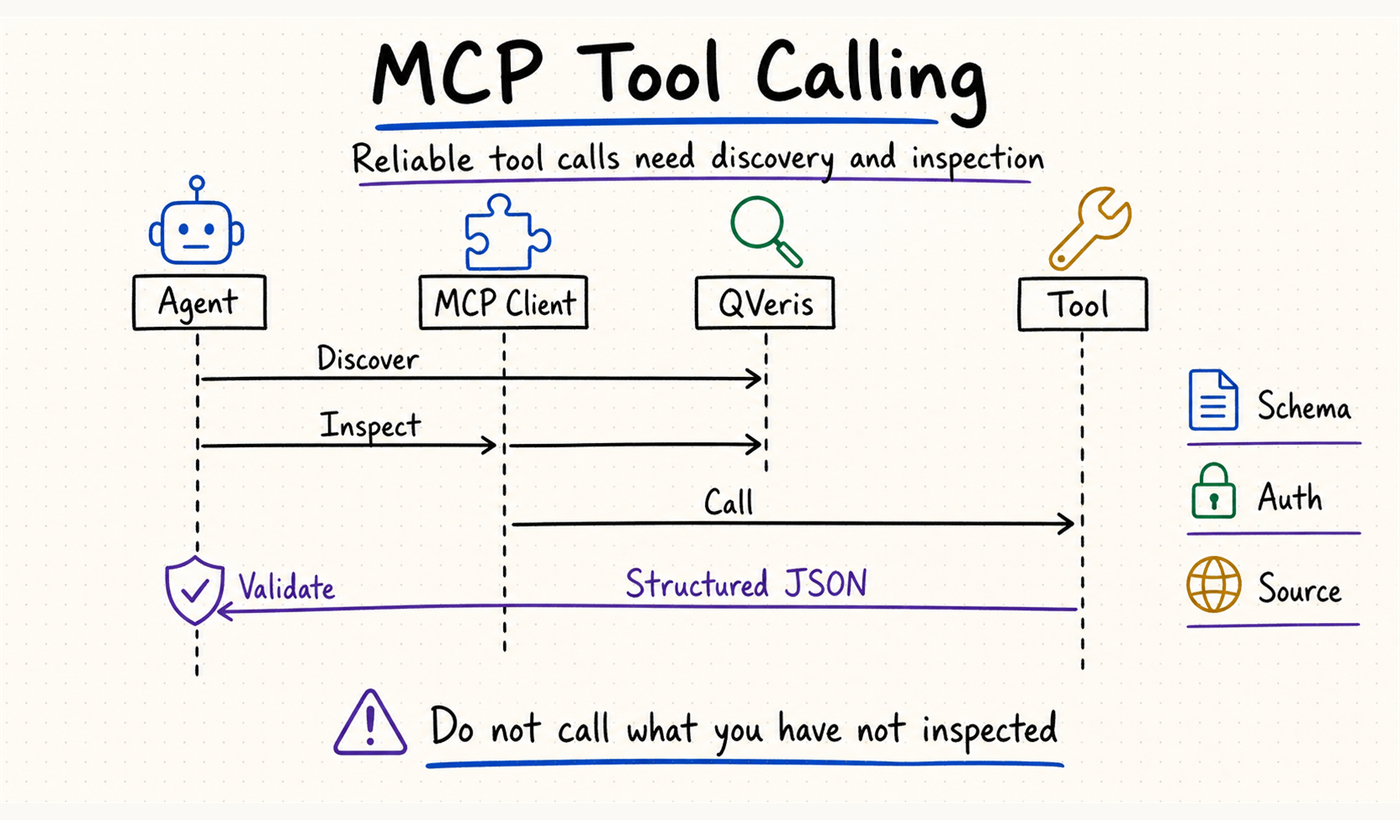
QVeris does not replace MCP. It helps agents decide what to call before and around the MCP interface. The QVeris workflow is built around Discover → Inspect → Call. Discovery finds candidate capabilities by intent. Inspect shows parameters, examples, cost, latency, success signals, and source metadata. Call executes the selected capability and returns machine-readable output.
QVeris 并不是替代 MCP,而是在 MCP 接口前后帮助 Agent 判断应该调用什么。QVeris 的流程围绕 Discover → Inspect → Call。Discover 根据意图找到候选能力;Inspect 展示参数、示例、成本、延迟、成功信号和来源元数据;Call 执行选定能力并返回机器可读结果。
| Need 需求 | MCP alone 仅使用 MCP | QVeris layer QVeris 层 |
|---|---|---|
| Find the right tool 找到正确工具 | Tools are exposed by servers, but discovery can stay local or manual. 服务器会公开工具,但发现过程仍可能停留在本地或依赖人工。 | Search capabilities by intent across providers and domains. 按意图跨供应商和领域搜索能力。 |
| Understand parameters 理解参数 | Schema is available, but agents still need selection context. 虽然已有 Schema,Agent 仍需要选择上下文。 | Inspect schema, examples, cost, latency, and source notes before calling. 调用前检查 Schema、示例、成本、延迟和来源说明。 |
| Choose a provider 选择供应商 | MCP does not automatically rank equivalent providers. MCP 不会自动为同类供应商排序。 | Route by quality signals, coverage, cost, and reliability. 按质量信号、覆盖范围、成本和可靠性进行路由。 |
| Recover from failure 从失败中恢复 | Fallback is usually custom application logic. 回退通常需要自定义应用逻辑。 | Use ranked alternatives when a tool fails or returns incomplete data. 当工具失败或数据不完整时,使用已排序的替代能力。 |
Example: Calling a Financial MCP Tool 示例:调用金融 MCP 工具
A finance agent might need the latest AAPL earnings data, analyst expectations, and SEC filing context. Instead of hardcoding one provider, the agent should discover candidate capabilities, inspect schemas, and call the best source for each subtask. The code below shows the idea: connect QVeris through MCP, search for a capability, inspect it, and execute the selected call.
一个金融 Agent 可能需要 AAPL 最新财报、分析师预期和 SEC 文件上下文。与其写死某一个 provider,不如先发现候选能力,检查 schema,再为每个子任务调用最合适的数据源。下面的代码展示了思路:通过 MCP 接入 QVeris,搜索能力,检查能力,然后执行调用。
{
  "mcpServers": {
    "qveris": {
      "command": "npx",
      "args": ["-y", "@qverisai/mcp"]
    }
  }
}

# Agent task
discover: "latest AAPL earnings and analyst estimates"
inspect: market.earnings_snapshot
call: market.earnings_snapshot({ "symbol": "AAPL" })
MCP Tool Calling vs Function Calling MCP 工具调用与 Function Calling 的区别
Function calling usually describes how a model emits structured arguments for a developer-defined function. MCP tool calling describes a broader protocol layer where tools, resources, and prompts can be exposed to clients. In practice, teams often need both: structured argument generation from the model and a protocol for exposing tools. QVeris adds a third layer: discovery, inspection, routing, and execution quality signals.
Function calling 通常指模型如何为开发者定义的函数输出结构化参数。MCP tool calling 则是更宽的协议层,让工具、资源和 prompt 可以暴露给客户端。实际团队往往两者都需要:模型生成结构化参数,也需要协议来暴露工具。QVeris 增加的是第三层:发现、检查、路由和执行质量信号。
| Concept 概念 | Best for 最适合 | Missing piece 缺失环节 |
|---|---|---|
| Function calling 函数调用 | Structured arguments for known functions. 为已知函数生成结构化参数。 | Tool discovery and provider selection. 工具发现与供应商选择。 |
| MCP tool calling MCP 工具调用 | Standard access to tools and resources across clients. 让不同客户端以标准方式访问工具与资源。 | Ranking, routing, cost awareness, and fallback. 排序、路由、成本感知与回退。 |
| QVeris capability routing QVeris 能力路由 | Finding and calling the right capability across financial tools. 在金融工具中发现并调用正确能力。 | Requires clear task intent and permission boundaries. 需要明确的任务意图和权限边界。 |
Best Practices for Reliable MCP Tool Calls 稳定 MCP 工具调用的最佳实践
Validate required fields, enum values, date formats, and supported identifiers before execution.
执行前验证必填字段、枚举值、日期格式和支持的标识符。
For finance agents, source URL, timestamp, provider coverage, and data freshness matter as much as the answer.
对金融 Agent 来说,来源 URL、时间戳、覆盖范围和数据新鲜度与答案本身同样重要。
A fallback path should use known quality signals instead of picking another tool by name similarity.
Fallback 路径应该使用质量信号,而不是按名称相似度随便选另一个工具。
The Production MCP Tool-Call Lifecycle生产级 MCP 工具调用生命周期
A server connection proves reachability, not task reliability. Production MCP tool calling needs a controlled lifecycle that starts with user intent and ends only after the result or side effect has been verified.
服务器能够连接只证明“可以访问”,并不证明任务可靠。生产级 MCP 工具调用需要受控生命周期:从用户意图开始,直到结果或副作用得到验证后才结束。
Resolve entities and define required capability, output form, freshness, source authority, latency, budget, privacy, and permission level. Ask for clarification when the missing detail could change the selected tool or create a material side effect.
解析实体,并定义所需能力、输出形式、新鲜度、来源权威性、延迟、预算、隐私和权限等级。如果缺失信息可能改变工具选择或产生重大副作用,应向用户澄清。
Search by intent and constraints, not only tool names. Consider provider coverage, observed quality, availability, cost, and policy. Limit the shortlist so overlapping descriptions do not consume context or encourage arbitrary selection.
根据意图与约束搜索,而不只匹配工具名称。考虑供应商覆盖、已观察质量、可用性、成本和策略,并限制候选数量,避免重叠描述占用上下文或诱发随意选择。
Load the exact schema, validate types, units, identifiers, limits, permissions, and confirmation requirements, then execute with timeouts and idempotency appropriate to the action. Preserve structured errors rather than compressing them into generic failure text.
加载准确 Schema,校验类型、单位、标识符、限制、权限和确认要求,再根据动作设置合适的超时与幂等机制。应保留结构化错误,而不是压缩成泛化的“调用失败”。
Validate completeness, freshness, and expected state changes before the agent reports success. Attach source metadata and execution evidence, record the selection path, and route conflicts or high-impact ambiguity to a human reviewer.
Agent 宣布成功前,应验证完整性、新鲜度和预期状态变化。附上来源元数据与执行证据,记录选择路径,并把冲突或高影响歧义交给人工复核。
MCP Tool Calling FAQMCP 工具调用常见问题
MCP tool calling is the process by which an AI client discovers or receives tool definitions from an MCP server, constructs arguments, invokes a capability, and uses the returned content in a wider task. Production systems add routing, policy, validation, observability, and recovery around that exchange.
Function calling usually describes the model-facing mechanism for selecting a function and producing structured arguments. MCP defines a broader protocol for connecting clients and servers around tools and other context. A system may use model function calling internally while exposing capabilities through MCP.
The wrong tool may have been selected, valid parameters may encode the wrong entity or unit, the result may be stale or incomplete, or the downstream answer may ignore source limitations. Transport success is only one checkpoint in end-to-end task reliability.
QVeris helps agents discover capabilities from intent, inspect the most relevant schema and provider signals, and route calls through a unified workflow. This is useful when the available MCP landscape is larger or more dynamic than a prompt-sized static server list.
MCP 工具调用是指 AI 客户端从 MCP 服务器发现或接收工具定义、构造参数、调用能力,并把返回内容用于更大任务的过程。生产系统还会在这次交互周围加入路由、策略、校验、可观察性和恢复机制。
Function calling 通常指模型选择函数并生成结构化参数的机制;MCP 定义了客户端与服务器围绕工具和其他上下文连接的更广协议。一个系统可以在内部使用模型 function calling,同时通过 MCP 暴露能力。
可能选错了工具;参数格式有效但实体或单位错误;结果已经过期或不完整;也可能下游答案忽略了来源限制。传输成功只是端到端任务可靠性的一个检查点。
QVeris 帮助 Agent 从意图发现能力、检查最相关的 Schema 与供应商信号,并通过统一工作流路由调用。当可用 MCP 生态大于提示词可承载的静态服务器列表,或变化更频繁时,这种能力尤其有用。
External References 外部参考资料
For protocol background, read the official Model Context Protocol documentation. For model-side tool use patterns, see Anthropic’s tool use documentation. QVeris builds above those foundations by helping agents discover, inspect, route, and call the right capability.
协议背景可以阅读官方 Model Context Protocol 文档。模型侧工具使用模式可以参考 Anthropic 的 tool use 文档。QVeris 在这些基础之上,帮助 Agent 发现、检查、路由并调用正确能力。
Conclusion: MCP Connects Tools, QVeris Helps Choose Them 结论:MCP 连接工具,QVeris 帮助选择工具
MCP tool calling is becoming a core pattern for AI agents, but reliable production workflows need more than a protocol. Agents need to discover tools, inspect schemas, compare providers, recover from failures, and return structured results. QVeris gives finance and developer teams a capability routing layer around MCP so agents can call tools with more context and less brittle wiring.
MCP 工具调用正在成为 AI Agent 的核心模式,但可靠的生产工作流不只需要协议。Agent 还需要发现工具、检查 schema、对比 provider、从失败中恢复,并返回结构化结果。QVeris 为金融和开发者团队提供围绕 MCP 的能力路由层,让 Agent 在更多上下文、更少脆弱接线的情况下调用工具。