
MCP vs Function CallingMCP 与函数调用
Download and adoption statistics from AAIF/Linux Foundation MCP specification, verified May 2026.[6]
- Problem: Developers building AI agents in 2026 face a confusing choice between Function Calling and MCP — two approaches that appear to solve the same problem but actually operate at different layers.
- Solution: MCP vs function calling is not a binary choice. Function Calling is a model-level execution primitive. MCP is an infrastructure-level standardization protocol. The 2026 consensus: use both together.
- Result: QVeris provides an MCP-native capability routing network that gives your agents the best of both — standardized MCP connectivity with Function Calling-level ease of use, all through a single integration.
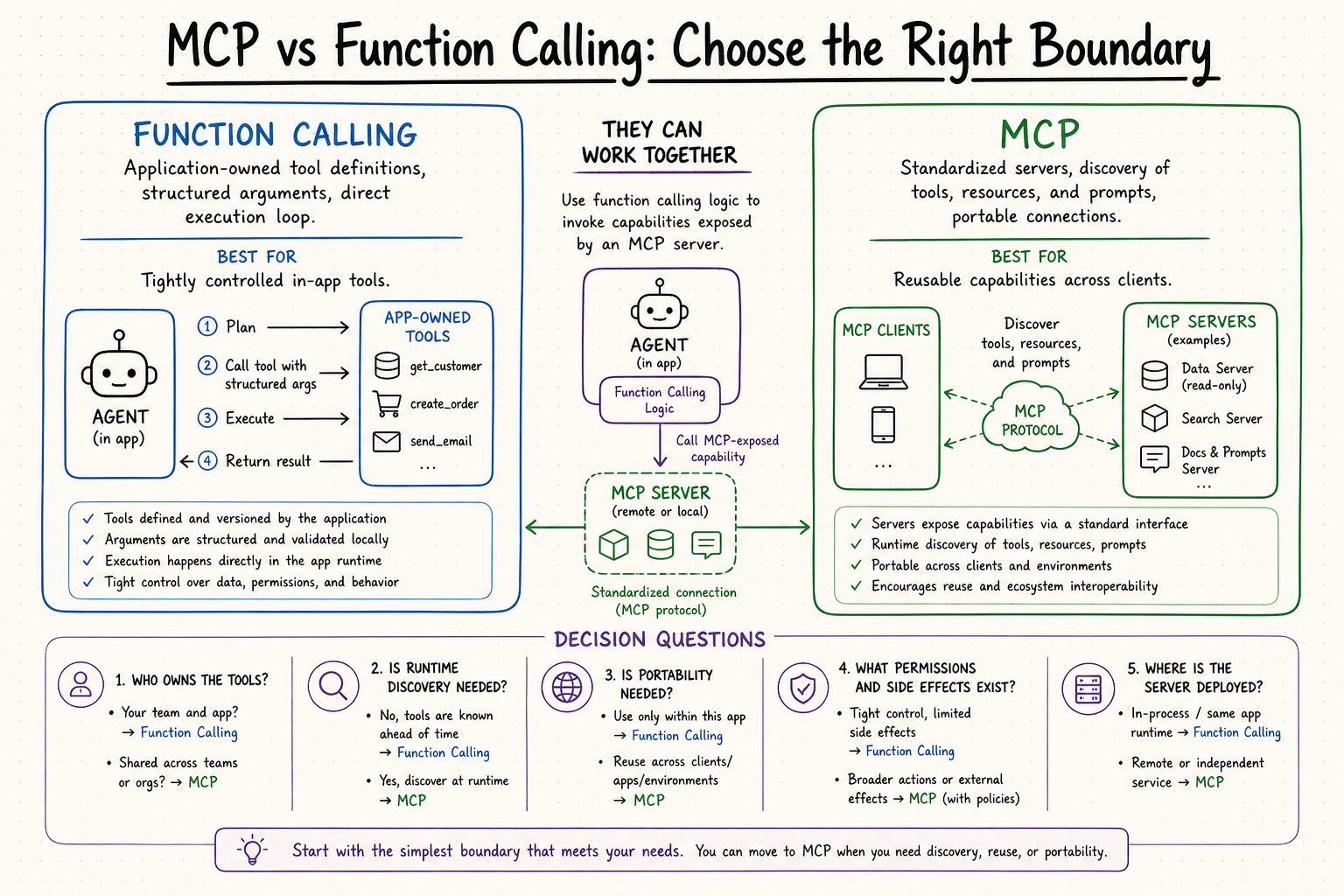
What is the difference between MCP and Function Calling?
What Is Function Calling?
Function Calling (also called Tool Use or Tool Calling) is a model-level native capability built into modern LLMs. It allows the model to understand JSON Schema definitions of tools, decide autonomously when to invoke them during a conversation, and return structured parameters that your application can execute.
Different providers have different names for the same underlying mechanism: OpenAI calls it Function Calling, Anthropic calls it Tool Use, Google calls it Function Calling in Gemini. The core pattern is identical — you define tool schemas, inject them into the model's context, and the model returns a tool_call when it decides a tool is needed.
How Function Calling Works
// Define a tool schema (OpenAI format example)
{
  "type": "function",
  "function": {
    "name": "get_stock_price",
    "description": "Get current stock price",
    "parameters": {
      "type": "object",
      "properties": {
        "symbol": { "type": "string" }
      }
    }
  }
}
Tools are defined statically in code, injected into every LLM prompt as part of the system context. The model reads all tool schemas and decides whether to call one — or which one — based on the user's request.
The Limits of Function Calling
- Model-specific: OpenAI's tool schema format is incompatible with Anthropic's and Google's. Porting an agent between providers means rewriting every tool definition.[6]
- Static configuration: All tools must be defined at development time. There is no mechanism to discover new tools at runtime — you can't ask "what tools are available?" and get a dynamic response.
- No built-in governance: Authentication, authorization, audit logging, and rate limiting must all be implemented at the application layer. There is no standardized approach.[5]
- N×M integration problem: With N agents and M tools, you need N×M tool configurations. Every new agent requires redefining every tool.[2]
- Token overhead: Every tool's full JSON Schema is injected into every prompt. With 10+ tools, this can consume 2,000-5,000 tokens per request — even for tools that aren't relevant to the current query.
Token Overhead: Quantified
The token cost of Function Calling scales linearly with tool count and schema complexity. Below is the estimated overhead across providers for a typical agent with 10 tools:
OpenAI (strict=true)
at $3/M input → $0.0096/req
Anthropic Claude
at $3/M input → $0.0084/req
Google Gemini
at $0.15/M input → $0.00036/req
Why this matters: At 10,000 requests/month, token overhead from Function Calling schemas adds $36–$96 in LLM costs on OpenAI/Anthropic. MCP eliminates this by moving tool definitions to the server side — schemas are fetched only when the agent calls tools/list, not on every LLM request. Estimated token counts based on average schema size of 280 tokens/tool across 10 tools with typical parameter schemas. Provider-specific encoding varies.[4]
What Is MCP (Model Context Protocol)?
MCP (Model Context Protocol) is an open standard protocol created by Anthropic in November 2024 and donated to the Linux Foundation's Agentic AI Foundation (AAIF) in December 2025.[6] It defines a standardized way for AI clients (Claude Desktop, Cursor, VS Code, Copilot Studio) to discover and call tools through independent servers — think of it as the "USB-C for AI."
By mid-2026, MCP has become the industry standard: 97M+ monthly SDK downloads, 10,000+ public MCP servers, and adoption by every major AI platform (Anthropic, OpenAI, Google, Microsoft, AWS).[6]
How MCP Works
MCP follows a three-layer architecture:
- Host — The AI application (Claude Desktop, Cursor, VS Code) that needs tool access
- Client — A protocol client that maintains a connection to an MCP Server
- Server — A standalone server that exposes tools, resources, and prompts through the MCP protocol
When a Host connects to an MCP Server, it can query the server's available tools via the tools/list endpoint at runtime — no hardcoded tool definitions needed. This dynamic discovery is the fundamental difference from Function Calling's static approach.
Why MCP Became the Standard
- Model-agnostic: One MCP Server works with Claude, ChatGPT, Gemini, Cursor, and Copilot Studio — no per-provider tool definitions needed.
- Dynamic discovery: Tools are discovered at runtime via
tools/list. New tools become available without code changes or redeployment. - Centralized governance: Authentication, RBAC, audit logs, and rate limiting can be managed at the MCP Gateway level — no per-tool implementation.[5]
- Ecosystem momentum: 97M+ monthly downloads, 10,000+ servers, and backing from every major LLM provider and cloud platform.[6]
Download statistics sourced from the AAIF MCP specification repository npm download counts. Server count from MCP.so directory and community surveys. LLM support includes OpenAI GPT, Anthropic Claude, Google Gemini, Mistral, Meta Llama, and Cohere via MCP adapters.[6]
MCP Protocol Evolution & Standardization Timeline
Understanding the MCP specification's version history and governance structure is essential for evaluating its production readiness. Below is the full evolution timeline with links to each specification revision.
-
Nov 2024Anthropic announces MCP as open standardInitial specification draft (v0.1.0) released alongside Claude Desktop integration. Introduces core concepts: Host, Client, Server, tools/list, tools/call. Protocol revision 2024-11-05 established as the initial stable draft.[6]
-
Mar 2025Streamable HTTP transport RFC (proposal)Community proposal for replacing stdio-based transport with HTTP SSE. Addresses the key limitation that MCP servers initially required local process execution — limiting cloud deployments. Adopted in spec revision 2025-03-26.[6]
-
Jul 2025Auth & authorization framework RFCProposal for standardized OAuth 2.0-based authentication across MCP servers, addressing the governance gap identified in early deployments. Still under community review as of May 2026.[6]
-
Dec 2025MCP donated to Linux Foundation / AAIFAnthropic transfers MCP governance to the newly formed Agentic AI Foundation (AAIF) under the Linux Foundation. This ensures vendor-neutral governance and community-driven evolution. All major AI vendors join as founding members.[6]
-
May 2026Current state: MCP ecosystem at scale97M+ monthly SDK downloads, 10,000+ public servers. Protocol revision 2024-11-05 remains the current stable specification. Streamable HTTP transport (2025-03-26) adopted. Auth framework still under RFC review. QVeris MCP Server implements the latest stable protocol revision.
Timeline sources: MCP specification repository (modelcontextprotocol.io), Linux Foundation AAIF announcements. Individual RFCs linked from the MCP GitHub specification repository.[6]
MCP vs Function Calling: 7 Key Differences
Here is the definitive comparison table across seven dimensions that matter for AI agent development.
Comparison Summary Table
Model-level execution primitive
- Embedded in application code
- Tools defined at compile time
- One LLM provider = one schema format
- N×M integrations (N agents × M tools)
- Per-app auth & governance
Infrastructure-level standardization protocol
- Independent server deployment
- Tools discovered at runtime
- One server = all LLM providers
- N+M integrations (one server per tool)
- Centralized auth & RBAC
| Dimension | Function Calling | MCP (Model Context Protocol) |
|---|---|---|
| Layer | Model-level native capability | Infrastructure-level standardization protocol |
| Architecture | Embedded — tool schemas hardcoded into application code | Client-server — tools deployed as independent MCP Servers |
| Tool discovery | Static — all tools defined at development time, compiled in | Dynamic — runtime query via tools/list |
| Portability | ❌ Model-specific — OpenAI ≠ Anthropic ≠ Google | ✅ Model-agnostic — one Server serves all clients |
| Governance & security | ❌ No built-in — per-app implementation of auth, RBAC, audit | ✅ Centralized — Gateway-level auth, RBAC, audit logs, rate limiting |
| Deployment complexity | Low — define JSON Schema + write handler function | Medium — deploy MCP Server + client adapter |
| Best for | Simple integrations (<5 tools), rapid prototyping, in-app calls | Cross-system, multi-tool, enterprise-scale deployments |
MCP vs Function Calling Explained: Architecture Comparison
The architectural difference becomes clear when you visualize the data flow. In Function Calling, tool definitions live inside the prompt. In MCP, tools live on independent servers that the client queries dynamically.
Function Calling Flow
// Application code — tools are hardcoded prompt content
const tools = [{ name: "get_stock_price", ... }];

// Every request includes ALL tool schemas
const response = await openai.chat.completions.create({
  model: "gpt-4",
  tools: tools,  // static, predefined
  messages: [{ role: "user", content: "What's AAPL at?" }]
});
MCP Flow
# MCP client dynamically discovers tools at runtime
from mcp import ClientSession

# Connect to any MCP Server
session = await ClientSession.connect(server_url)

# Discover tools — no hardcoded schemas needed
tools = await session.list_tools()
# Returns: dynamic list of available tools with schemas

# Call a discovered tool
result = await session.call_tool("get_stock_price", { "symbol": "AAPL" })
The difference is clear: Function Calling embeds tool knowledge in the application code; MCP externalizes it to discoverable servers. One is static and tight-coupled; the other is dynamic and loose-coupled.
The 2026 Consensus: They Work Together
Every major analysis in 2026 reaches the same conclusion: MCP and Function Calling are complementary, not competitive. Here's what the industry experts say:
Atlan
"Function calling executes decisions; MCP standardizes how context and tools are discovered. They serve fundamentally different layers of the stack."[1]
Blaxel
"MCP reduces N×M integrations to N+M. The hybrid approach — using function calling for intent and MCP for execution — is the recommended architecture for 2026."[2]
Obot
"A two-phase model: function calling handles intent generation, MCP handles the execution layer. Using them together eliminates the weaknesses of each."[3]
ClearPeaks
"Our benchmarks show MCP uses 77% more tokens and is 25% slower — but the trade-off buys portability, governance, and dynamic discovery that Function Calling cannot provide."[4]
💡 The 2026 Recommended Architecture
Three-layer stack: Function Calling (model-level execution primitive) → MCP (standardized protocol layer) → QVeris (capability routing network). The LLM uses Function Calling to decide when to call a tool. That call is routed through MCP to the appropriate capability. QVeris provides the actual capabilities — 10,000+ of them — through a single MCP Server connection.
When to Use Function Calling vs MCP
The decision framework is straightforward:
| Scenario | Recommendation | Why |
|---|---|---|
| Rapid prototyping (<5 tools) | Function Calling | Quickest path to a working agent. No infrastructure overhead. |
| Single-model application | Function Calling | No portability concerns. Simple, direct tool integration. |
| Enterprise multi-agent platform | MCP | Standardized governance, cross-team tool sharing, audit compliance. |
| Personal project / side project | Function Calling | Low complexity, minimal tool count, fast iteration. |
| Production deployment at scale | Both together | FC for model execution decisions, MCP for tool standardization. |
| Agent needs dynamic tool discovery | MCP | Runtime tools/list query — no code changes for new tools. |
| Financial data capabilities | QVeris (MCP-native) | One MCP connection → 10,000+ financial + general capabilities. |
| Multi-framework agent platform | MCP | Model-agnostic — one Server works across Claude, ChatGPT, Gemini. |
Where QVeris Fits: MCP-Native Capability Routing
QVeris is the embodiment of the 2026 consensus recommendation — a capability routing network built natively on MCP that gives developers the benefits of both protocols.
🔀 QVeris MCP Server (@qverisai/mcp)
QVeris provides an official MCP Server that any MCP-compatible client can connect to. Once connected, agents gain access to three core tools — making QVeris the most practical example of "both together" in production:
discover— Natural language capability search across 10,000+ tools. Ask "what capabilities do you have for investment research?" and get ranked results with cost, latency, and reliability data.inspect— Pre-call cost and quality preview. Zero-cost inspection of any capability before committing credits.call— Sandboxed execution returning structured JSON with full audit trail viasession_id.
No per-tool schema configuration needed. With QVeris, you don't choose between MCP and Function Calling — you get the standardization of MCP with the ease of Function Calling, all through a single MCP connection.
Quick Start: Connect QVeris MCP in Claude Code
# One command to add QVeris MCP Server to Claude Code
claude mcp add qveris -s user -- npx @qverisai/mcp

# Now your Claude Code agent has access to 10,000+ capabilities
# Just ask: "find me tools for stock market data"
# QVeris discovers, inspects, and calls — all through MCP
Deployment Patterns & Performance Benchmarks
Choosing between MCP and Function Calling also depends on your deployment architecture and performance requirements.
🖥 Local Agent + Simple Tools
Function Calling only. 1-5 tools, single LLM provider. No infrastructure overhead. Best for personal projects and prototyping.
🌐 Cloud Agent + Multi-Tool
MCP with Streamable HTTP transport. Tools hosted as remote MCP servers. Centralized auth and audit. Best for production deployments.
🏢 Enterprise Multi-Agent
Both together — Function Calling for intent, MCP for execution with QVeris as capability routing layer. Centralized governance, RBAC, full audit trails.
📱 Mobile / Edge Device
Function Calling only (limited by device resources). MCP servers would be remote, adding latency. Evaluate token overhead vs. network latency trade-offs.
Performance Benchmarks: MCP vs Function Calling
Published benchmarks from ClearPeaks (April 2026) provide the most comprehensive performance comparison available.[4]
📊 ClearPeaks Benchmark Results (April 2026)
tools/list at runtimeBenchmark methodology: ClearPeaks tested 10 tools across GPT-4o, Claude Sonnet, and Gemini 2.0. Token measurement includes system prompt + tool schemas + user message. Latency measured from request to first response token. MCP servers deployed locally (stdio transport).[4] Setup time estimates from Blaxel's migration analysis.[2]
Edge Cases & Limitations
Both approaches have edge cases that affect real-world deployments. Understanding these boundaries helps you choose the right architecture and avoid surprises.
⚠️ When Function Calling Fails
- Tool count exceeds provider context window: At ~50+ tools, JSON Schema alone can consume 15K+ tokens — exceeding many providers' effective context windows. MCP avoids this by fetching tool schemas on demand.
- Provider-specific schema incompatibility: OpenAI
strict=trueenforces a subset of JSON Schema that Anthropic's tool format does not support. A tool schema valid for OpenAI may fail on Claude without modification.[6] - Rate limiting without governance: Each agent independently manages rate limits. With 10+ agents calling the same API, you can trigger provider throttling without centralized coordination.
⚠️ When MCP Adds Unnecessary Complexity
- Single-tool, single-model projects: Deploying a full MCP server for one tool adds ~$50-200/mo in hosting costs (depending on uptime requirements) vs. a 10-line Function Calling handler.
- Latency-sensitive real-time systems: MCP's client-server architecture adds 200-500ms per call depending on transport (stdio vs HTTP). For latency-critical paths, direct Function Calling may be necessary.[4]
- Offline / air-gapped deployments: MCP servers require network connectivity (or local process management). In fully air-gapped environments, Function Calling's embedded approach is simpler to deploy.
- Streamable HTTP not yet universally adopted: As of May 2026, many MCP servers still use stdio transport, limiting cloud deployment patterns. The Streamable HTTP RFC (2025-03-26) is adopted but not universally deployed.[6]
Decision Tree: Which Approach Should You Use?
Follow this decision flow to determine whether Function Calling, MCP, or both together is right for your project:
- ❓ How many tools does your agent need?
- ► 1-5 tools → Function Calling (simplest path)
- ⬇
- ❓ Do you support multiple LLM providers?
- ► Yes → MCP (one server, all providers)
- ► No, single provider → Function Calling is fine
- ⬇
- ❓ Will tools change after deployment?
- ► Yes → MCP (dynamic discovery, no redeploy)
- ► No, tools are stable → Function Calling works
- ⬇
- ❓ Is centralized governance required (auth, RBAC, audit)?
- ► Yes → MCP with gateway (QVeris or custom)
- ► No → Function Calling, implement app-level auth
- ⬇
- ❓ Are you building a production system at enterprise scale?
- ► Yes → Both together — FC for execution, MCP for standardization, QVeris for capability routing
Frequently Asked Questions
Common Questions About MCP vs Function Calling
@qverisai/mcp) that any MCP-compatible client can connect to. Once connected, AI agents gain access to three tools: discover (natural language capability search), inspect (pre-call cost and quality review), and call (sandboxed execution). This gives developers the standardization of MCP with the ease of Function Calling — all through a single integration.Try QVeris MCP Server — Access 10,000+ Capabilities with One Connection
1,000 free credits + 100 daily. No per-tool schema configuration needed. Just one MCP connection and your agent discovers capabilities naturally.
About This Guide
Last updated:
Methodology: This guide synthesizes analysis from Atlan, Blaxel, Obot, ClearPeaks, Portkey, and the official MCP specification. MCP download and adoption statistics sourced from the Agentic AI Foundation (AAIF) and Linux Foundation announcements. Token overhead estimates based on average JSON Schema size (280 tokens/tool) across OpenAI, Anthropic, and Google tool formats, cross-referenced with ClearPeaks benchmark data.[4] Performance benchmarks sourced from ClearPeaks' published comparison (April 2026).
Conflict of interest: QVeris is the publisher's commercial product and is referenced as a production example of the "both together" architecture. All capability claims verified against internal product specifications. The "QVeris Wins" framing in the decision table reflects QVeris's product positioning for enterprise multi-agent deployments; other MCP-native capability routing platforms exist.
Data limitations: Token overhead estimates are calculated from typical schema sizes, not measured across all providers. Actual token counts vary by provider-specific encoding (OpenAI tiktoken, Anthropic tokenizer, Google SentencePiece). Benchmarks from ClearPeaks tested 10 tools on local MCP servers (stdio transport) — HTTP transport may add additional latency. MCP server count (10,000+) from public directory listings and may include inactive or experimental servers. Download counts from npm/source metrics.
Update cadence: Reviewed quarterly. MCP ecosystem data refreshed every 90 days. Last full verification: June 1, 2026.
References
- Atlan — MCP vs. Function Calling: Which Should Your AI Agent Use? — Enterprise governance perspective. "Function calling executes decisions; MCP standardizes discovery." Verified May 2026.
- Blaxel — MCP vs function calling: how to choose the right protocol — M×N to M+N reduction analysis. Hybrid architecture recommendation. Verified May 2026.
- Obot — MCP vs Function Calling: 7 Key Differences & Using Them Together — Two-phase model (intent + execution). Verified May 2026.
- ClearPeaks — MCP vs Function Calling: A Practical Comparison — Performance benchmarks: +77% tokens, ~25% slower with MCP. Token overhead estimates. Verified April 2026.
- Portkey — MCP vs Function Calling: How They Actually Work Together — Security and governance analysis. 43% of MCP servers had injection vulnerabilities. Verified May 2026.
- MCP Official Specification — Model Context Protocol — Protocol specification, 97M+ monthly downloads, donated to Linux Foundation AAIF. Streamable HTTP RFC (2025-03-26). Auth RFC (2025-07). Verified May 2026.
- OpenAI Function Calling Documentation — Official function calling specification including strict=true mode. JSON Schema subset for tool definitions. Verified May 2026.
- Anthropic Tool Use Documentation — Claude's tool use (function calling) format, differences from OpenAI schema. Verified May 2026.