
Multi-Model AI API
Unify Access Without Flattening Capabilities
多模型 AI API:统一访问,但不抹平能力差异
A multi-model API reduces integration overhead, but catalogs differ in supply, modalities, metadata, routing, billing and control. Choose the platform whose normalized contract preserves the exact features and evidence your workloads require.
多模型 API 能降低集成开销,但各平台在供给、模态、元数据、路由、计费与控制上不同。应选择能够保留负载所需具体功能与证据的标准化契约。
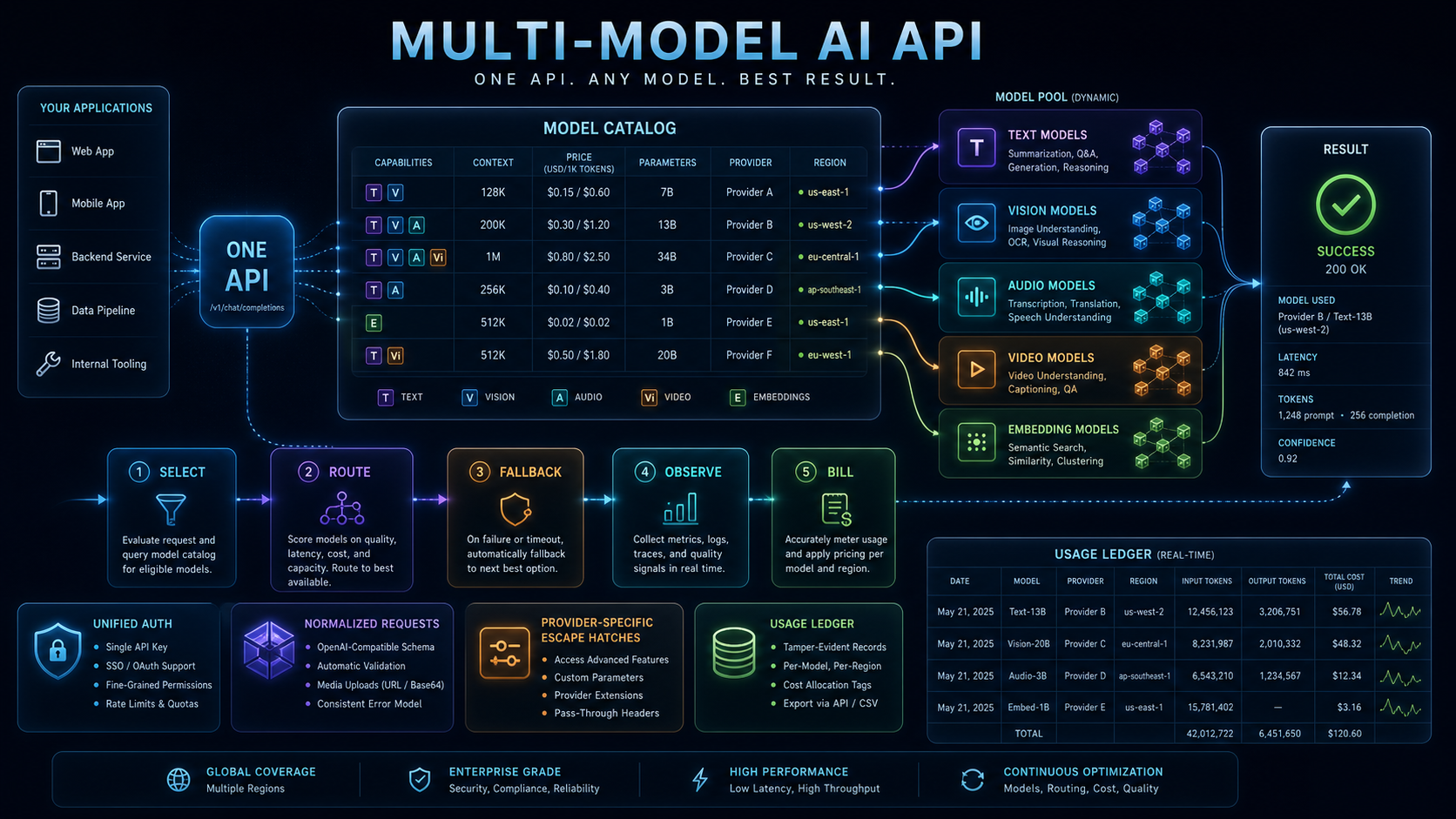
TL;DR
Model count is weak evidence without capabilities, context, parameters, modality, endpoint, region, price, data policy, release and deprecation metadata.
Normalize identity, routing, usage and errors, but keep explicit adapters for tools, reasoning, images, audio, video, embeddings and provider extensions.
A hosted aggregator, hosted inference platform, managed gateway and self-hosted proxy offer different provider contracts, markups, controls and failure ownership.
Compare retries, rejected outputs, latency, engineering, provider markup, idle capacity and support—not only token list price.
如果没有能力、上下文、参数、模态、端点、区域、价格、数据策略、发布与弃用元数据,模型数量意义有限。
可统一身份、路由、用量与错误,但工具、推理、图像、音频、视频、Embedding 与供应商扩展仍需显式适配。
托管聚合器、托管推理平台、托管网关与自托管代理的供应商合同、加价、控制与故障责任各不相同。
比较重试、拒绝输出、延迟、工程、供应商加价、闲置容量与支持,而不只是 Token 标价。
Multi-model platforms differ by supply and control 多模型平台按供给与控制区分
Hosted aggregators provide one account and API across external model providers. Hosted inference platforms run models or dedicated endpoints. Managed gateways unify access and operations around provider accounts. Self-hosted proxies translate and route while your team owns infrastructure and secrets.
托管聚合器用一个账户与 API 连接外部模型供应商;托管推理平台运行模型或专属端点;托管网关围绕供应商账户统一访问与运营;自托管代理负责转换与路由,但基础设施和密钥由团队承担。
Some platforms go deep on language-model routing; others span text, image, audio, video, OCR or translation. The right breadth is the set of production tasks with verified schemas, quality, latency, data terms and support—not the largest public catalog.
有些平台深入语言模型路由,有些覆盖文本、图像、音频、视频、OCR 或翻译。真正的广度是那些结构定义、质量、延迟、数据条款与支持均经验证的生产任务,而不是最大公开目录。
Multi-model API options by product shape 按产品形态比较多模型 API
| Platform 平台 | Best fit 最适合 | Verify before choosing 选择前验证 |
|---|---|---|
| OpenRouter OpenRouter | Hosted access to broad model/provider supply with catalog metadata, routing, fallbacks and one billing relationship. 托管访问广泛模型/供应商供给,并提供目录元数据、路由、回退与统一账单关系。 | Validate endpoint provenance, supported parameters, privacy filters, provider substitutions, markup and model lifecycle. 验证端点来源、参数支持、隐私过滤、供应商替换、加价与模型生命周期。 |
| Together AI Together AI | Hosted inference, serverless or dedicated serving, model catalog and platform services for teams needing compute supply. 为需要计算供给的团队提供托管推理、无服务器或专属 Serving、模型目录与平台服务。 | Validate exact model versions, quantization, capacity, cold behavior, endpoint lifecycle, customization, support and economics. 验证模型版本、量化、容量、冷行为、端点生命周期、定制、支持与经济性。 |
| Eden AI Eden AI | One integration across multiple AI service categories and providers, useful beyond language-model chat. 跨多个 AI 服务类别与供应商的一次集成,适用于语言模型对话之外。 | Verify category-specific schemas, asynchronous jobs, provider options, quality metrics, data storage and price units. 验证类别特定结构定义、异步任务、供应商选项、质量指标、数据存储与计价单位。 |
| LiteLLM LiteLLM | Self-hosted proxy and Python SDK translating broad provider APIs into common formats with routing and budgets. 自托管代理与 Python SDK,把广泛供应商 API 转为共同格式,并提供路由与预算。 | Own deployment, adapter freshness, protocol fidelity, database, HA, telemetry, secrets and upgrades. 承担部署、适配器新鲜度、协议保真、数据库、高可用、遥测、密钥与升级。 |
| Portkey Portkey | Managed gateway suite combining universal model access with routing, guardrails, observability, prompts and administration. 托管网关套件,把统一模型访问与路由、护栏、可观测性、提示词与管理结合。 | Validate managed versus self-host scope, edition, data path, synchronous policy latency, provider parity and pricing. 验证托管/自托管范围、版本、数据路径、同步策略延迟、供应商一致性与价格。 |
| Vercel AI Gateway Vercel AI 网关 | Managed model/provider catalog and routing integrated with AI SDK, budgets, usage monitoring and fallbacks. 与 AI SDK、预算、用量监控和回退集成的托管模型/供应商目录与路由。 | Validate supported protocols, model and provider availability, BYOK behavior, routing depth, data terms and coupling. 验证支持协议、模型/供应商可用性、BYOK 行为、路由深度、数据条款与耦合。 |
A useful catalog is executable metadata 有用的目录必须包含可执行元数据
Input/output modalities, tools, structured output, reasoning, context, files, embeddings, batch, fine-tuning and provider extensions.
Model creator, serving provider, endpoint version, region, quantization, context, data policy, release and deprecation.
Allowlist, order, price, latency, throughput, quality, privacy, capacity, fallback, timeout, cache and pinned routes.
Native usage, normalized usage, reasoning/cache tokens, retries, markup, credits, provider receipt and cost allocation tags.
Request IDs, selected endpoint, decision policy, fallback chain, stream events, errors, latency, quality scores and accepted result.
Catalog updates, new-model lead time, deprecation notice, migration path, version pinning, support, capacity and incident communication.
输入/输出模态、工具、结构化输出、推理、上下文、文件、Embedding、批处理、微调与供应商扩展。
模型创建者、Serving 供应商、端点版本、区域、量化、上下文、数据策略、发布与弃用。
Allowlist、顺序、价格、延迟、吞吐、质量、隐私、容量、回退、超时、缓存与固定路由。
原生/标准化用量、Reasoning/缓存 Token、重试、加价、Credits、供应商回执与成本标签。
请求 ID、所选端点、决策策略、回退链、流事件、错误、延迟、质量评分与可接受结果。
目录更新、新模型上线速度、弃用通知、迁移路径、版本固定、支持、容量与事故沟通。
Prove the catalog with real workloads 用真实负载验证目录
- Select chat, extraction, tools, long context, embeddings, vision, audio, image and video tasks actually used in production.
- Pin exact endpoints and compare normalized versus native payloads, outputs, streams, errors, usage and bills.
- Test provider failure, endpoint retirement, rate limit, slow stream, missing parameter, schema drift and credit exhaustion.
- Score quality per task and calculate cost per accepted output including retries and engineering overhead.
- Canary one workload, reconcile request counts and spend, test direct-provider rollback, then expand.
- 选择生产真实使用的对话、抽取、工具、长上下文、Embedding、视觉、音频、图像与视频任务。
- 固定具体端点,比较标准化与原生请求数据、输出、流、错误、用量与账单。
- 测试供应商故障、端点退役、限流、慢流、参数缺失、结构定义漂移与 Credits 耗尽。
- 按任务评分质量,并计算包含重试与工程开销的每个可接受输出成本。
- 灰度一个负载,核对请求数与支出,测试供应商直连回滚,再逐步扩大。
Separate the model catalog from the application contract 把模型目录与应用契约分离
Maintain an internal model registry with stable aliases and versioned capability metadata. Applications request an alias and declare required features; a routing layer filters eligible endpoints and records the decision. Provider adapters translate only after eligibility. Preserve native identifiers and raw usage beside normalized evidence so billing and incidents remain reconcilable.
维护内部模型注册表,使用稳定别名与版本化能力元数据。应用请求别名并声明所需功能;路由层过滤合格端点并记录决策;只有资格判断后才由供应商适配器转换。原生标识与原始用量应与标准化证据并存,以便账单与事故可核对。
Production rule: do not let a public catalog update silently change a production endpoint behind a stable model alias.
生产规则:不要让公开目录更新在稳定模型别名之后静默改变生产端点。
Model catalogs and capability catalogs are different 模型目录与能力目录不同
A multi-model API supplies inference. QVeris supplies capability discovery and execution across APIs, tools, services and live data. An agent can use a multi-model platform to reason, then use QVeris to select and invoke the real-world capability that completes the task.
多模型 API 提供推理供给;QVeris 提供跨 API、工具、服务与实时数据的能力发现和执行。智能体可以先用多模型平台推理,再用 QVeris 选择并调用完成任务的现实能力。
Define the Production Contract for a multi-model AI API定义多模型 AI API的生产契约
For Multi-Model AI API, protocol similarity lowers integration effort, but it does not guarantee behavioral parity. Put a versioned application contract between product code and the provider path so change remains testable and reversible.
针对“多模型 AI API”,协议相似可以降低集成工作量,却不能保证行为等价。应在产品代码与供应商路径之间建立版本化应用契约,让变更保持可测试、可回滚。
Document catalog freshness, model aliases, capability flags, modalities, native parameters, provider selection, quotas, price source, deprecation, and output normalization. Mark each item as required, optional, provider-native, or unsupported, and assign an owner for any transformation that changes its meaning.
记录目录新鲜度、模型别名、能力标记、模态、原生参数、供应商选择、配额、价格来源、弃用和输出规范化。把每一项标记为必需、可选、供应商原生或不支持,并为任何改变语义的转换明确负责人。
To validate Multi-Model AI API, create fixtures for short and long prompts, Unicode, streaming, JSON schema, parallel tools, refusals, cancellation, malformed input, and rate limits. Check required fields and event order instead of accepting one plausible text answer.
验证“多模型 AI API”时,为短与长提示词、Unicode、流式、JSON Schema、并行工具、拒绝、取消、畸形输入和限流建立 Fixture,检查必需字段与事件顺序,而不是接受一个看似合理的文本答案。
When operating Multi-Model AI API, trace internal request ID, resolved model and provider, model version, transformations, retries, latency, token classes, cost source, policy result, and output validation. Redact secrets without deleting the context needed to reproduce failure.
运营“多模型 AI API”时,追踪内部请求 ID、解析后的模型与供应商、模型版本、转换、重试、延迟、Token 类别、成本来源、策略结果和输出校验,在脱敏密钥的同时保留复现失败所需上下文。
Before rolling out Multi-Model AI API, shadow representative traffic, classify semantic differences, canary by reversible workload, monitor task completion and tail behavior, and keep the previous route available until rollback and return-to-primary have been rehearsed.
上线“多模型 AI API”前,运行代表性影子流量,分类语义差异,按可逆工作负载进行金丝雀发布,监控任务完成与长尾行为,并在演练回滚和恢复主路径之前保留原有路由。
FAQ
It exposes multiple models, providers or AI service categories through one authentication and request surface, often with routing and billing.
No. Prefer verified coverage for your tasks, regions, parameters, data terms, SLOs and support requirements.
Aggregators reduce account and supply work; self-hosted proxies increase control but move reliability, adapters and operations to your team.
No. Normalize cross-cutting operations, then retain typed modality and provider extensions for features that are not truly portable.
它通过统一认证与请求面暴露多个模型、供应商或 AI 服务类别,通常还包含路由与计费。
不是。应优先选择经过验证、符合任务、区域、参数、数据条款、SLO 与支持要求的覆盖。
聚合器减少账户与供给工作;自托管代理增加控制,但把可靠性、适配器与运维转给团队。
不应。统一横切运营字段,同时为无法真正移植的功能保留类型化模态与供应商扩展。