
Nango Alternatives
for AI Agents in 20262026 年面向 AI Agent 的
Nango 替代方案
Compare Nango with agent-first tool platforms, unified APIs, and vertical capability layers—without confusing MCP with an integration runtime.
从 Agent 工具平台、统一 API 与垂直能力层三个方向评估 Nango,
并厘清 MCP 协议与集成运行时的边界。
TL;DR
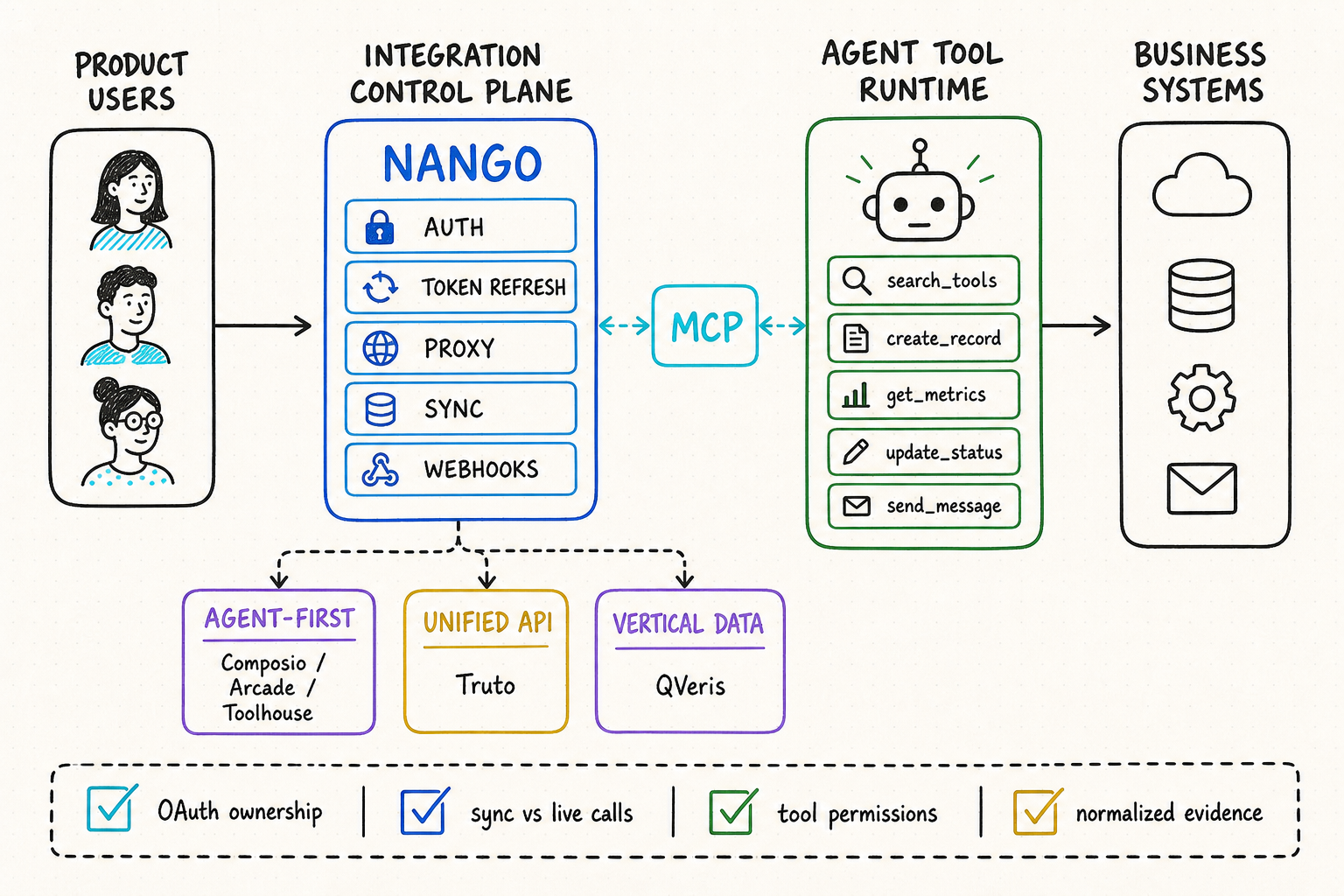
Nango is no longer just an OAuth proxy. Its current platform spans authentication, credential refresh, proxy calls, custom functions, syncs, webhooks, unified models, tool calling, and a hosted MCP server. A credible “alternative” must therefore replace the layer you actually use—not merely publish more connectors.
Nango 已不再只是 OAuth 代理。当前平台覆盖鉴权、凭证刷新、Proxy、Functions、Sync、Webhook、统一模型、Tool Calling 和托管 MCP Server。真正的替代方案必须替代你正在使用的那一层,而不是只比较连接器数量。
You need embedded customer integrations with auth, syncs, webhooks, custom code, and MCP on one runtime.
Your center of gravity is per-user tool execution, in-chat authorization, permissions, and agent frameworks.
Your agent mainly needs governed financial data, market evidence, and domain-specific tools—not hundreds of SaaS OAuth flows.
需要把客户侧 Auth、Sync、Webhook、自定义代码与 MCP 放在同一个集成运行时。
重点是按用户执行工具、会话内授权、权限控制与 Agent Framework 适配。
Agent 更需要受治理的金融数据、市场证据和领域工具,而不是大量 SaaS OAuth 流程。
Who this Nango alternatives guide is for这份 Nango 替代方案指南适合谁
You let each customer connect systems such as CRM, ticketing, HR, accounting, or collaboration tools and must own tenant mapping, scopes, credential lifecycle, and support.
You expose a curated set of read and write tools to an LLM and need per-user authorization, tool discovery, confirmation boundaries, retries, and execution logs.
You need normalized, timely, source-aware domain data. A general SaaS connector platform may still be useful, but it is not the full answer.
让每个客户连接 CRM、工单、HR、会计或协作系统,并负责租户映射、Scope、凭证生命周期与支持。
向 LLM 暴露经过筛选的读写工具,需要按用户授权、工具发现、确认边界、重试和执行日志。
需要标准化、及时且带来源的数据。通用 SaaS 连接平台可能有用,但不能单独解决领域数据问题。
Prerequisites before comparing Nango alternatives比较 Nango 替代方案前的前置条件
A vendor matrix is meaningless until the workload is explicit. Prepare these inputs before requesting demos or estimating migration effort; they turn “integration platform” into a testable architecture decision.
如果工作负载没有说清楚,供应商矩阵就没有意义。在预约 Demo 或估算迁移工作量前先准备以下输入,把“集成平台”变成可测试的架构决策。
Define whether a connection belongs to a user, workspace, organization, or customer installation. Choose the stable internal ID that must appear in every auth event, tool call, webhook, and log.
Separate live reads, cached reads, scheduled syncs, provider webhooks, and writes. A platform that excels at live tools may not satisfy history or delete propagation.
List OAuth apps, required scopes, bring-your-own credentials, re-consent behavior, regional constraints, and who may approve a write-capable connection.
Classify tools as read-only, reversible write, irreversible write, or privileged administration. Define confirmation, idempotency, and human-approval rules.
Decide which raw response, request ID, schema version, timestamp, and normalized record must be retained so an agent answer can be reproduced.
Estimate active connections, calls, executions, compute time, records, webhooks, environments, retention, support, and self-hosted operations—not only requests.
明确 Connection 属于用户、Workspace、组织还是客户部署,并确定必须出现在授权事件、Tool Call、Webhook 和日志里的稳定内部 ID。
区分实时读取、缓存读取、定时 Sync、供应商 Webhook 与写入。擅长实时工具的平台不一定能满足历史数据和删除传播。
列出 OAuth App、所需 Scope、自带凭证、重新授权行为、区域约束,以及谁可以批准具备写权限的连接。
把工具分为只读、可逆写入、不可逆写入和特权管理,并定义确认、幂等与人工批准规则。
确定要保留哪些原始响应、Request ID、Schema 版本、时间戳和标准化记录,保证 Agent 答案可以复现。
估算活跃连接、调用、执行、计算时间、记录、Webhook、环境、保留期、支持和自托管运维,而不只是请求量。
Start with the current Nango baseline先建立当前 Nango 的能力基线
An old comparison that treats Nango as “OAuth plus proxy” is now misleading. The official platform describes a broader integration runtime. Evaluate these primitives separately because many teams use only two or three of them.
如果仍把 Nango 写成“OAuth 加 Proxy”,比较就会失真。官方平台已经扩展为更完整的集成运行时。应逐项评估这些能力,因为很多团队实际上只使用其中两三项。
| Primitive能力 | Production responsibility生产职责 | Migration dependency迁移依赖 |
|---|---|---|
| Auth / Connect | OAuth, API keys, token refresh, connection identity, tenant mapping.OAuth、API Key、Token 刷新、连接身份与租户映射。 | Apps, scopes, callbacks, stored connection IDs.应用、Scope、Callback 与已存 Connection ID。 |
| Proxy | Inject credentials into live vendor API calls without exposing tokens to the agent.向实时供应商请求注入凭证,避免 Agent 接触 Token。 | Headers, base URLs, retries, vendor error semantics.Header、Base URL、重试与供应商错误语义。 |
| Functions / Tools | Typed action logic, validation, execution, retries, logs, and MCP exposure.类型化动作逻辑、验证、执行、重试、日志与 MCP 暴露。 | Schemas, tool names, idempotency, side-effect policy.Schema、工具名、幂等性与副作用策略。 |
| Syncs / Records | Incremental reads, cursors, schedules, stored records, and change delivery.增量读取、Cursor、调度、记录存储与变更交付。 | Cursor state, history, backfills, delete semantics.Cursor 状态、历史数据、回填与删除语义。 |
| Webhooks | Receive provider events, validate, retry, transform, and fan out.接收供应商事件,完成验证、重试、转换与分发。 | Signing secrets, ordering, deduplication, replay.签名密钥、顺序、去重与重放。 |
Verified against Nango’s current product, tool-calling, proxy, self-hosting, limits, and pricing documentation on July 31, 2026.
以上能力依据 2026 年 7 月 31 日核验的 Nango 产品、Tool Calling、Proxy、自托管、限制与定价文档。
MCP is an interface, not a full Nango replacementMCP 是接口,不是完整的 Nango 替代品
MCP standardizes how a client discovers and calls tools. It does not automatically create OAuth apps, map your product users to vendor accounts, refresh tokens, operate sync jobs, replay webhooks, or define your normalized data contract. Nango can expose action functions through MCP, so the protocol may sit on top of the runtime.
MCP 标准化客户端如何发现和调用工具,但不会自动创建 OAuth App、把产品用户映射到供应商账户、刷新 Token、运行 Sync、重放 Webhook 或定义统一数据契约。Nango 可以通过 MCP 暴露 Action Function,因此协议往往位于运行时之上。
| Layer层级 | Owns负责 | Does not guarantee不保证 |
|---|---|---|
| MCP | Tool schemas, discovery, transport, invocation messages.工具 Schema、发现、传输与调用消息。 | Tenant auth, provider correctness, data quality, safe writes.租户鉴权、供应商正确性、数据质量和安全写入。 |
| Integration control plane集成控制平面 | Connections, credentials, environments, functions, syncs, webhooks.连接、凭证、环境、Functions、Sync 与 Webhook。 | That an LLM selects the right tool or interprets output correctly.LLM 一定选择正确工具或正确解释结果。 |
| Agent runtimeAgent 运行时 | Tool selection, context, confirmation, policy, answer composition.工具选择、上下文、确认、策略与答案编排。 | Fresh or normalized upstream data.上游数据一定新鲜或已标准化。 |
| Vertical capability layer垂直能力层 | Domain identity, units, provenance, validation, specialized access.领域身份、单位、来源、验证与专门访问。 | General SaaS OAuth coverage.通用 SaaS OAuth 覆盖。 |
Nango alternatives by the job you need done按真实任务选择 Nango 替代方案
| Option方案 | Center of gravity核心定位 | Best fit最适合 | Check carefully重点核验 |
|---|---|---|---|
| Nango | Embedded product integrations as code: auth, proxy, functions, syncs, webhooks, MCP.代码化产品集成:Auth、Proxy、Functions、Sync、Webhook、MCP。 | Customer-facing SaaS or AI products with custom integration logic.需要自定义集成逻辑的客户侧 SaaS 或 AI 产品。 | Which features exist in Cloud, Enterprise self-hosted, or free self-hosted.Cloud、企业自托管与免费自托管的功能差异。 |
| Composio | Agent sessions, toolkits, per-user connected accounts, hosted MCP.Agent Session、Toolkit、按用户连接账户与托管 MCP。 | Agents that need many prebuilt SaaS actions and in-chat auth.需要大量预置 SaaS 动作和会话内授权的 Agent。 | Tool versioning, custom logic, sync/data requirements, pricing units.工具版本、自定义逻辑、同步/数据要求与计费单位。 |
| Arcade | Authenticated MCP tools, permission-aware execution, custom tool servers.带鉴权的 MCP 工具、权限感知执行与自定义 Tool Server。 | Teams whose main problem is secure agent actions.主要问题是安全 Agent 动作的团队。 | Long-running syncs, embedded product integration UX, connector breadth.长周期 Sync、嵌入式集成体验与连接器覆盖。 |
| Toolhouse | Agent backend with MCP, RAG, memory, code execution, and deployment.包含 MCP、RAG、Memory、代码执行与部署的 Agent Backend。 | Teams choosing a broader agent runtime rather than only integrations.需要更完整 Agent Runtime,而不只是集成平台的团队。 | Portability, per-user credential model, and product integration depth.可移植性、按用户凭证模型与产品集成深度。 |
| Truto | Unified and proxy APIs with normalized category models and embedded Link.统一 API、Proxy API、类别数据模型与嵌入式 Link。 | Products that want one normalized CRM, ATS, or similar API surface.希望获得统一 CRM、ATS 等 API 形态的产品。 | Write semantics, remote fields, live-call latency, model coverage.写入语义、远端字段、实时调用延迟与模型覆盖。 |
| QVeris | Discoverable finance and real-world capabilities with evidence-aware access.可发现的金融与真实世界能力,以及证据感知访问。 | Financial research, market intelligence, live data, and auditable agents.金融研究、市场情报、实时数据与可审计 Agent。 | It is not a general-purpose OAuth integration platform.它不是通用 OAuth 集成平台。 |
Nango vs Composio: compare product integration to agent sessionsNango vs Composio:产品集成与 Agent Session 的区别
This is the most common comparison, but it becomes useful only after naming the caller. If your product backend owns long-lived customer integrations, syncs records, receives provider webhooks, and runs custom TypeScript integration functions, Nango maps naturally to that architecture. If an agent session needs to select tools for a specific user and initiate authorization inside the conversation, Composio’s session model is closer to the immediate problem.
这是最常见的比较,但必须先明确“谁在调用”。如果产品后端维护长期客户连接、同步记录、接收供应商 Webhook 并运行自定义 TypeScript 集成函数,Nango 更自然;如果 Agent Session 要为特定用户选工具并在会话内发起授权,Composio 的模型更贴近当前任务。
Do not decide from connector count alone. Run one read, one write, one expired-token recovery, one rate-limit event, and one provider schema change through each platform.
不要只看 Connector 数量。至少在两个平台上分别跑一次读取、一次写入、一次 Token 过期恢复、一次限流和一次供应商 Schema 变化。
Keep the agent outside the credential boundary让 Agent 留在凭证边界之外
Nango’s official tool-calling pattern resolves a connection for the current product user, then triggers a named action. The model receives a tool schema and result—not the provider token. Keep the integration ID, connection ID, action name, and validated input explicit in your application.
Nango 官方 Tool Calling 模式先解析当前产品用户对应的 Connection,再触发命名 Action。模型只接收工具 Schema 与结果,不接触供应商 Token。Integration ID、Connection ID、Action Name 与已验证输入应在应用侧保持显式。
import { Nango } from '@nangohq/node';

const nango = new Nango({
  secretKey: process.env.NANGO_SECRET_KEY
});

export async function executeCustomerTool({
  integrationId,
  connectionId,
  actionName,
  input
}) {
  assertAllowedTool(integrationId, actionName);
  const validated = validateInput(actionName, input);

  return nango.triggerAction(
    integrationId,
    connectionId,
    actionName,
    validated
  );
}
If you migrate, preserve this boundary behind a small adapter instead of importing provider-specific SDKs throughout the agent code.
迁移时应保留这条边界,用小型 Adapter 隔离平台,而不是让 Agent 代码到处依赖供应商 SDK。
Production requirements that product pages rarely compare产品介绍页很少比较的生产要求
- Tenant identity: prove that every connection, tool call, log, webhook, and record maps to the correct internal user or organization.
- Scope drift: detect when a provider adds, removes, or reinterprets OAuth scopes; re-consent must not silently break the workflow.
- Write safety: require idempotency, confirmation, replay protection, and a stable external object identifier.
- Sync correctness: test cursor loss, duplicate pages, deletes, late updates, backfills, and schema evolution.
- Observability: correlate the agent request, tool name, connection, provider request, retries, cost, and final answer.
- Exitability: know what connection metadata, code, record state, and history can be exported before committing.
- 租户身份:证明每个 Connection、Tool Call、日志、Webhook 和记录都映射到正确的内部用户或组织。
- Scope 漂移:检测供应商新增、删除或重解释 OAuth Scope 的情况,重新授权不能悄悄破坏工作流。
- 写入安全:要求幂等、确认、重放保护和稳定的外部对象 ID。
- 同步正确性:测试 Cursor 丢失、重复分页、删除、延迟更新、回填和 Schema 演进。
- 可观测性:关联 Agent 请求、工具名、Connection、供应商请求、重试、成本与最终答案。
- 可退出性:采购前确认 Connection 元数据、代码、记录状态与历史能导出什么。
Troubleshooting common integration and agent failures常见集成与 Agent 故障排查
Do not collapse every failed tool call into “the provider is down.” Start from the identity and execution boundary, preserve the raw error, and classify the failure before retrying.
不要把所有 Tool Call 失败都归结为“供应商宕机”。应从身份与执行边界开始,保留原始错误,并在重试前完成故障分类。
| Symptom现象 | Likely cause可能原因 | First checks优先检查 | Safe response安全处理 |
|---|---|---|---|
| 401 / 403 | Expired token, missing scope, wrong OAuth app, revoked connection.Token 过期、Scope 缺失、OAuth App 错误或连接被撤销。 | Connection ID, provider account, scopes, refresh event, raw response.Connection ID、供应商账户、Scope、Refresh 事件和原始响应。 | Stop blind retries; refresh once or request explicit re-consent.停止盲目重试;仅刷新一次或明确要求重新授权。 |
| 429 | Provider quota, platform limit, burst concurrency, shared tenant budget.供应商配额、平台限制、突发并发或共享租户预算。 | Retry-After, provider request ID, connection traffic, queue depth.Retry-After、供应商 Request ID、连接流量和队列深度。 | Back off with jitter, cap retries, queue writes, surface delay.带抖动退避、限制重试、写入排队并说明延迟。 |
| Duplicate write重复写入 | Timeout after provider commit, webhook replay, non-idempotent action.供应商已提交后超时、Webhook 重放或 Action 不幂等。 | Idempotency key, external object ID, attempt history, completion event.幂等 Key、外部对象 ID、尝试历史和完成事件。 | Reconcile before retrying; a client timeout is not proof of failure.重试前先对账;客户端超时不能证明写入失败。 |
| Missing or stale records记录缺失或陈旧 | Cursor loss, filter mismatch, delayed update, delete semantics.Cursor 丢失、Filter 不一致、更新延迟或删除语义。 | Last cursor, source time, retrieval time, page boundaries, tombstones.最后 Cursor、来源时间、获取时间、分页边界与 Tombstone。 | Run a bounded backfill and compare identities before replacing state.执行有边界的回填,并按身份比较后再替换状态。 |
| Wrong customer account调用错误客户账户 | Mutable user key, reused connection, missing tenant check.可变用户 Key、复用 Connection 或缺少租户校验。 | Tenant ID, connection tags, authorization subject, audit log.租户 ID、Connection Tag、授权主体和审计日志。 | Block execution, revoke the mapping, investigate as a security incident.阻止执行、撤销映射,并按安全事件调查。 |
| Wrong tool selected选择错误工具 | Overlapping descriptions, too many tools, stale schema, weak policy.描述重叠、工具过多、Schema 陈旧或策略过弱。 | Presented toolset, schema version, description, model trace.暴露工具集、Schema 版本、描述和模型 Trace。 | Reduce the visible toolset, clarify names, gate privileged writes.缩小可见工具集、明确命名,并限制特权写入。 |
Self-hosting is a feature matrix, not a checkbox自托管是一张能力矩阵,不是一个勾选项
Nango documents a limited free self-hosted path for Auth and Proxy and a broader Enterprise self-hosted platform. The full architecture introduces multiple Node services plus Postgres, Redis, object storage, and Elasticsearch. That changes the decision from “Can it run in our cloud?” to “Which capabilities, operational dependencies, encryption controls, upgrades, and support obligations do we accept?”
Nango 文档区分了面向 Auth 与 Proxy 的有限免费自托管路径,以及能力更完整的企业自托管平台。完整架构包含多个 Node 服务,以及 Postgres、Redis、对象存储和 Elasticsearch。因此问题不应只是“能否跑在我们的云里”,而应是“接受哪些能力、运维依赖、加密控制、升级和支持责任”。
| Question问题 | Evidence to request需要的证据 | Failure if ignored忽略后的失败 |
|---|---|---|
| Credential encryption凭证加密 | Key ownership, rotation process, backup restore test.密钥归属、轮换流程与备份恢复测试。 | Tokens unreadable after key change or exposed at rest.换 Key 后 Token 无法读取,或静态凭证暴露。 |
| Persistent state持久状态 | Database topology, record store, retention, disaster recovery.数据库拓扑、记录存储、保留期与灾备。 | Lost cursors, duplicated syncs, missing audit history.Cursor 丢失、Sync 重复、审计历史缺失。 |
| Operations运维 | Release cadence, Helm/ECS path, alerts, capacity test, rollback.发布节奏、Helm/ECS 路径、告警、容量测试和回滚。 | Integration outages become your on-call problem.集成故障完全转化为内部 On-call 问题。 |
Run one shared workload before choosing选型前跑一套共享工作负载
Marketing comparisons are not benchmarks. Create one test tenant and run the same sequence on every candidate. Capture raw responses, timestamps, log IDs, provider request IDs, retries, and final normalized output.
营销对比不是 Benchmark。建立一个测试租户,在所有候选方案上运行完全相同的序列,并保存原始响应、时间戳、日志 ID、供应商请求 ID、重试和最终标准化输出。
{
  "workload": "customer-crm-agent",
  "steps": [
    "authorize with minimum scopes",
    "read 100 records with pagination",
    "refresh an expired token",
    "create one idempotent record",
    "receive and replay one webhook",
    "resume an incremental sync",
    "revoke access and verify cleanup"
  ],
  "acceptance": {
    "cross_tenant_access": 0,
    "duplicate_writes": 0,
    "unattributed_tool_calls": 0,
    "reproducible_evidence": true
  }
}
Go-live validation checklist上线验收清单
A successful demo proves only the happy path. Approve production use only when the same tenant-aware workload passes identity, recovery, data, safety, observability, cost, and exit tests.
Demo 成功只证明理想路径。只有同一套租户感知工作负载通过身份、恢复、数据、安全、可观测性、成本和退出测试后,才应批准生产使用。
- Identity: every connection and tool call resolves to the expected internal tenant and external account.
- Recovery: expired tokens, 429 responses, provider 5xx errors, timeouts, and webhook replay recover without duplicate writes.
- Data contract: pagination, timestamps, deletes, optional fields, and provider-specific extensions remain explicit.
- Action safety: privileged tools require the intended confirmation, scope, policy, idempotency, and audit evidence.
- Observability: one trace links the agent request, selected tool, connection, provider request, retries, output, and answer.
- Cost: a representative month fits the budget under normal traffic and at least one realistic burst scenario.
- Exit: connections, code, records, cursors, logs, and deletion evidence can be exported or reconstructed.
- 身份:每个 Connection 与 Tool Call 都解析到预期的内部租户和外部账户。
- 恢复:Token 过期、429、供应商 5xx、超时和 Webhook 重放能够恢复且不产生重复写入。
- 数据契约:分页、时间戳、删除、可选字段与供应商扩展保持显式。
- 动作安全:特权工具具备预期的确认、Scope、策略、幂等和审计证据。
- 可观测性:一条 Trace 能关联 Agent 请求、所选工具、Connection、供应商请求、重试、输出与答案。
- 成本:代表性月份在正常流量和至少一个真实突发场景下都符合预算。
- 退出:Connection、代码、记录、Cursor、日志与删除证据可导出或重建。
Migration checklist: replace contracts before vendors迁移清单:先替换契约,再替换供应商
List auth configs, scopes, environment keys, connection IDs, proxy endpoints, functions, syncs, record models, webhook subscriptions, and operational dashboards.
Define stable interfaces for connect, disconnect, execute, proxy, sync state, webhook events, and audit evidence. Keep vendor identifiers behind the adapter.
Reads reveal pagination, normalization, timestamp, and deletion differences without risking duplicate writes. Compare by business object identity, not array order.
Validate payloads and permissions in shadow mode. Cut over one tenant cohort at a time with an explicit rollback and connection reauthorization plan.
Confirm webhook drain, sync convergence, credential deletion, log retention, billing closure, and a signed migration report.
列出 Auth Config、Scope、环境 Key、Connection ID、Proxy Endpoint、Functions、Sync、记录模型、Webhook 订阅和运维面板。
为 Connect、Disconnect、Execute、Proxy、Sync State、Webhook Event 与审计证据定义稳定接口,把供应商 ID 隔离在 Adapter 后。
读取能够暴露分页、标准化、时间戳和删除语义差异,同时不会造成重复写入。按业务对象身份比较,而不是按数组顺序。
先在 Shadow Mode 验证 Payload 与权限,再按租户批次切换,并准备显式回滚和重新授权方案。
确认 Webhook 排空、Sync 收敛、凭证删除、日志保留、账单关闭,并输出签字确认的迁移报告。
Where QVeris fits—and where it does notQVeris 适合什么,以及不适合什么
QVeris should not be positioned as a drop-in replacement for Nango’s general OAuth, sync, and webhook control plane. It fits when an agent needs to discover, inspect, call, normalize, and cite financial or real-world capabilities. A product may use Nango for customer SaaS connections and QVeris for market data and evidence-aware research in the same architecture.
QVeris 不应被描述为 Nango 通用 OAuth、Sync 与 Webhook 控制平面的直接替代。它更适合 Agent 发现、检查、调用、标准化并引用金融或真实世界能力。一个产品完全可以同时用 Nango 管理客户 SaaS 连接,用 QVeris 提供市场数据和证据感知研究。
- Use Nango or a similar control plane for customer-owned SaaS credentials and long-lived product integrations.
- Use an agent-first platform when tool execution, per-user permissions, and session orchestration dominate.
- Use QVeris when domain coverage, financial identity, freshness, provenance, and answer evidence dominate.
- 客户持有的 SaaS 凭证与长期产品集成,使用 Nango 或同类控制平面。
- 工具执行、按用户权限和 Session 编排占主导时,使用 Agent-first 平台。
- 领域覆盖、金融身份、新鲜度、来源和答案证据占主导时,使用 QVeris。
Nango alternatives FAQNango 替代方案常见问题
Choose by the missing layer: Composio or Arcade for agent-first tools and auth, Truto for unified APIs, and QVeris for finance and real-world data capabilities.
No. MCP defines a tool interface. Nango can still own credentials, connections, functions, syncs, webhooks, and tool execution beneath that interface.
It is source-available under the Elastic License and supports self-hosting, but free and Enterprise self-hosted editions have different feature sets.
No. They overlap, but Composio centers agent sessions and per-user tools while Nango also centers embedded product integrations and integration functions.
Choose it when a normalized category-level API is the primary requirement and its model covers the resources and writes you need.
Not as a general OAuth platform. It can replace or complement the vertical data and capability access an agent needs for finance and research.
Test auth, scopes, token refresh, reads, writes, sync cursors, webhook replay, retries, logs, tenant isolation, and data contracts.
Model active connections, requests, executions, compute, stored records, webhooks, environments, support, and self-hosting operations. Recheck live pricing.
按缺失层选择:Agent 工具与鉴权可看 Composio 或 Arcade;统一 API 可看 Truto;金融与真实世界数据能力可看 QVeris。
不能。MCP 定义工具接口,底层的凭证、连接、Functions、Sync、Webhook 与执行仍需要运行时负责。
它采用 Elastic License 的 Source-available 方式并支持自托管,但免费版与企业版的能力不同。
不是。两者有重叠,但 Composio 更围绕 Agent Session 与按用户工具,Nango 也强调嵌入式产品集成和 Integration Functions。
当类别级统一 API 是主要需求,并且其数据模型覆盖所需资源和写入场景时。
不能替代通用 OAuth 平台,但能替代或补充 Agent 在金融和研究场景所需的垂直数据与能力访问。
测试 Auth、Scope、Token 刷新、读写、Sync Cursor、Webhook 重放、重试、日志、租户隔离与数据契约。
同时计算活跃连接、请求、执行、计算时间、存储记录、Webhook、环境、支持与自托管运维,并重新核验实时价格。
Official sources and verification date官方资料与核验日期
Product capabilities and plan boundaries change quickly. The following primary sources were reviewed on July 31, 2026; verify them again before architecture or purchasing decisions.
产品能力与套餐边界变化很快。以下官方资料已于 2026 年 7 月 31 日核验;在架构或采购决策前请再次确认。