
COMPETITOR COMPARISON
QVeris vs Eden AI Which Layer Fits?
Distinguish the roles of QVeris vs Eden AI through model modalities, asynchronous jobs, and output provenance.
Published: · By the QVeris Team
TL;DR
Choose it to consolidate text, image, audio, video, OCR, translation, document and related provider integrations behind a common platform.
Choose it when an agent must search APIs, tools, datasets, or services by intent, inspect the contract and signals, then execute the best candidate.
Generating an image or transcribing audio is an AI service; checking inventory, issuing a refund, or querying live financial data is a broader capability.
Use Eden AI as service supply and QVeris as the discovery and governed-execution layer when workflows mix AI media with business APIs.
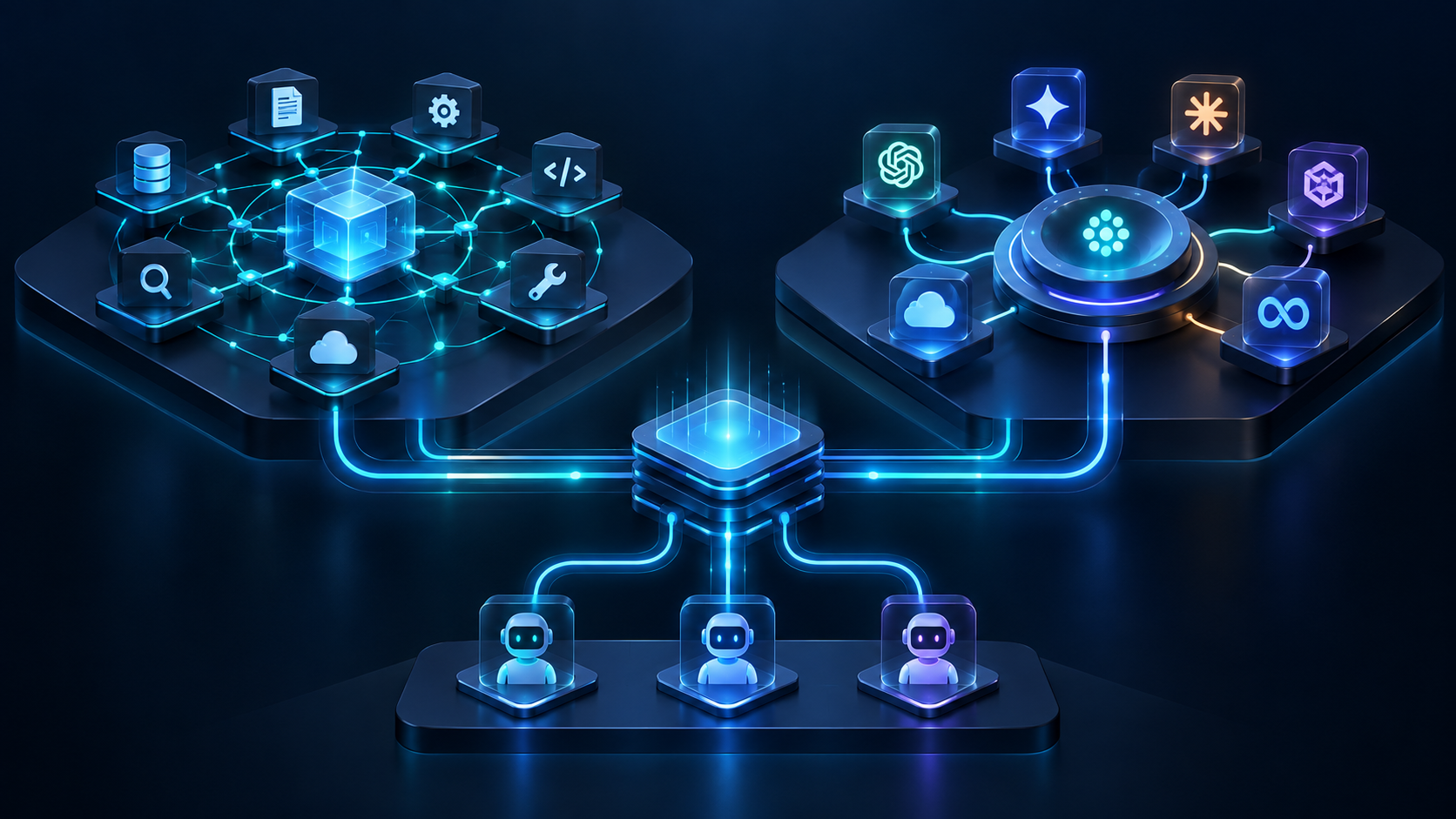
AI service aggregation and capability routing use different catalogs
Eden AI groups provider offerings by AI function. A product team can integrate multiple service categories through standardized endpoints and consolidated access, while still validating category-specific schemas, quality, asynchronous jobs, and provider behavior.
QVeris indexes callable outcomes. Discover ranks candidates for an intent, Inspect exposes schema, cost and operational signals, and Call produces an execution record. A candidate may be an AI service, a business API, a live dataset, or another tool.
QVeris and Eden AI comparison
| Decision surface | QVeris | Eden AI |
|---|---|---|
| Catalog unit | Intent-matched external capability | AI service category, feature, model, and provider |
| Coverage | APIs, tools, services, datasets and live data | Text, image, audio, video, OCR, translation and other AI services |
| Selection | Semantic discovery plus schema and operational signals | Service endpoint and provider/model selection |
| Contract | Capability-specific input/output schema and execution policy | Category-normalized request and response with provider seams |
| Evidence | Search rank, inspection, execution, result and billing | Service request, provider, category result, usage and bill |
| Best fit | Agents selecting actions dynamically | Products consolidating known AI-service integrations |
Choose by the catalog you need to operate
The known requirement is one integration and bill across several AI modalities and providers, with application-owned workflow logic.
The agent must discover an appropriate external function at runtime and inspect schema, cost, region, reliability, and policy before execution.
One agent workflow creates or analyzes media, then queries or changes an external business system with a shared audit trail.
Connect service supply to capability intent
Expose approved Eden AI operations as typed capabilities that QVeris can discover. Preserve the native category schema behind a stable capability contract. Before execution, verify modality, provider constraints, asynchronous lifecycle, data policy, cost unit, callback destination, and quality threshold. Record both QVeris execution IDs and Eden AI service identifiers.
Architecture rule: standardize discovery and audit fields, but keep modality-specific payloads and quality metrics explicit.
A cross-modal capability proof
- Test LLM tools, OCR tables, transcription timestamps, image jobs, translation, and one non-AI business API.
- Compare discovery ranking with a fixed allowlist and verify unsupported fields are visible before execution.
- Force slow asynchronous jobs, provider rejection, callback loss, schema drift, unsafe output, and budget exhaustion.
- Score quality with category metrics rather than one generic success flag.
- Reconcile capability estimates, service usage units, retries, duplicate jobs, and final accepted-output cost.
Publish capabilities one category at a time
Inventory service endpoints, providers, schemas, storage, callbacks, data terms, quality thresholds, price units and failure behavior. Wrap one category in a versioned capability contract, dual-run its native and normalized paths, canary agent discovery, then publish the next category.
QVeris turns a service catalog into an action catalog
Eden AI can be one valuable source of multimodal AI services inside a broader QVeris capability network. QVeris adds intent-based discovery, pre-call inspection and consistent execution evidence across AI and non-AI services.
Continue with related implementation guides
Use these adjacent guides to compare the next architectural decision, implementation boundary, or operating control without starting the research again.
FAQ
No. It discovers, inspects, and calls external capabilities such as APIs, tools, services, and live data. A model gateway governs inference traffic.
Yes. Keep model selection in the gateway and capability selection in QVeris, then propagate trace, session, policy, and cost evidence across both.
Implement the bottleneck that blocks production, but define the shared evidence envelope before either layer becomes hard to replace.
Model route, provider, policy version, usage, QVeris search and execution IDs, chosen capability, schema version, estimated cost, result, and errors.