
COMPETITOR COMPARISON
QVeris vs Requesty: Model and Action Routing
Assess QVeris vs Requesty across routing control, compatibility, observability, and operating cost.
Published: · By the QVeris Team
TL;DR
Use model and provider routing, failover, budgets, sticky cohorts, experimentation, BYOK, and observability to improve model cost and reliability.
Use capability discovery, inspection and governed calls to choose an API, tool, dataset, or service that fulfills the agent's intent.
Model tokens and provider markup belong to inference; API quotas, per-call charges, side effects and accepted results belong to capability execution.
Preserve model policy and cohort decisions, then append capability rank, schema, price estimate, execution ID, downstream receipt, and outcome.
Cost-aware model routing stops before action selection
Requesty's job is model-access optimization. Its gateway positioning covers unified model access, routing and fallbacks, budgets, analytics, observability, prompt-related workflows, BYOK and traffic segmentation such as sticky routing or experiments.
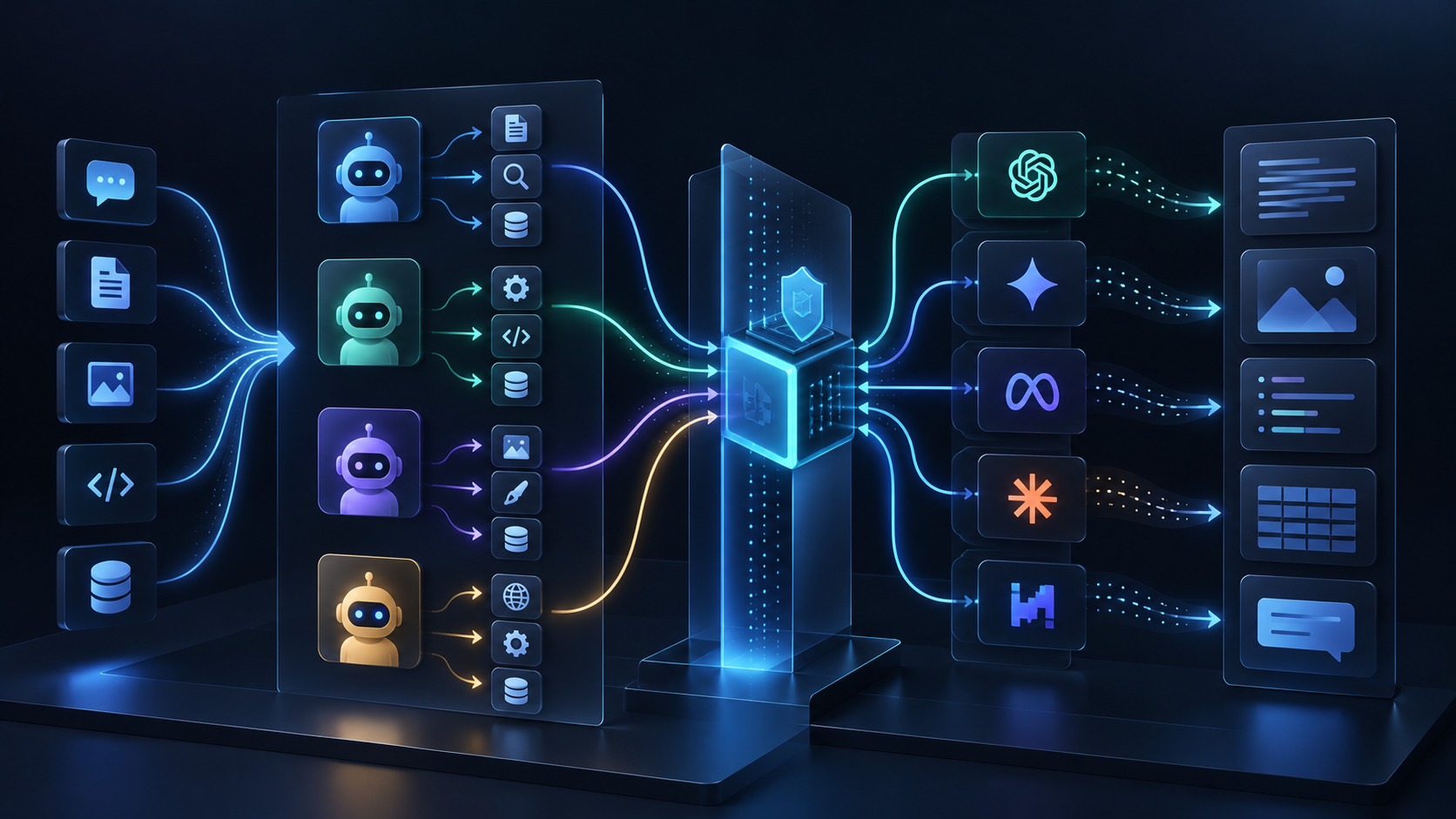
QVeris begins at the next question. Once a model understands the task, Discover finds candidate capabilities, Inspect compares their schemas and signals, and Call executes under a recorded session. The best model route does not determine the best business API.
QVeris vs Requesty side by side
| Decision surface | QVeris | Requesty |
|---|---|---|
| Routing target | External APIs, tools, data and services | Models, providers and inference endpoints |
| Optimization objective | Capability match, contract, policy, reliability, latency and call cost | Inference price, quality, latency, availability, budget and experiment |
| State | Search, execution and workflow session | User/cohort stickiness, routing policy and gateway request |
| Keys | Governed credentials for downstream capabilities | Provider keys or managed model access |
| Failure boundary | Schema, authorization, downstream state, idempotency and result | Provider error, rate limit, timeout, model quality and usage |
| Cost evidence | Estimated and billed capability execution | Model/provider usage and gateway attribution |
Route two decisions with two explicit objectives
Your immediate bottleneck is model spend, provider resilience, cohort consistency, experimentation, BYOK, or inference observability.
The agent needs to find and invoke live external capabilities whose schema, policy, reliability, region, and cost vary.
The workflow must optimize inference spend and still prove why a particular external action was selected and executed.
Keep model cohorts separate from action idempotency
Requesty may keep a user or experiment cohort on a consistent model route. Pass that route evidence into the agent context, but let QVeris independently rank capability candidates. For calls that change state, use action-specific idempotency keys and approval policy; never reuse model request retries as permission to repeat an external action.
Architecture rule: a cheap repeated model call is an efficiency issue; a repeated refund, order, or message can be a business incident.
A cost and side-effect proof
- Run fixed and variable model routes across cost, latency, quality, privacy, cohort and failover policies.
- Execute read-only and state-changing capabilities with explicit approvals, idempotency keys and rollback paths.
- Force a model retry immediately before a capability timeout and prove the downstream action occurs at most once.
- Join inference cost, capability estimate, downstream bill, accepted result, and human-review cost in one record.
- Verify sticky cohorts do not override region, policy, schema, or capability eligibility constraints.
Migrate policy and evidence independently
Export model routes, cohort keys, provider credentials, budgets, usage and traces separately from capability schemas, credentials, search policies and execution records. Define a shared workflow envelope, dual-write both ledgers, then canary inference and action paths independently.
Capability routing completes cost-aware inference
Requesty can lower or stabilize the cost of reaching a useful model response. QVeris carries the workflow into governed external action. Optimize both, but evaluate total cost per accepted business outcome rather than tokens or API calls alone.
Continue with related implementation guides
Use these adjacent guides to compare the next architectural decision, implementation boundary, or operating control without starting the research again.
FAQ
No. It discovers, inspects, and calls external capabilities such as APIs, tools, services, and live data. A model gateway governs inference traffic.
Yes. Keep model selection in the gateway and capability selection in QVeris, then propagate trace, session, policy, and cost evidence across both.
Implement the bottleneck that blocks production, but define the shared evidence envelope before either layer becomes hard to replace.
Model route, provider, policy version, usage, QVeris search and execution IDs, chosen capability, schema version, estimated cost, result, and errors.