
QVeris vs Eden AI
Service Supply or Intentful Action?
QVeris 与 Eden AI:服务供给,还是意图驱动的行动?
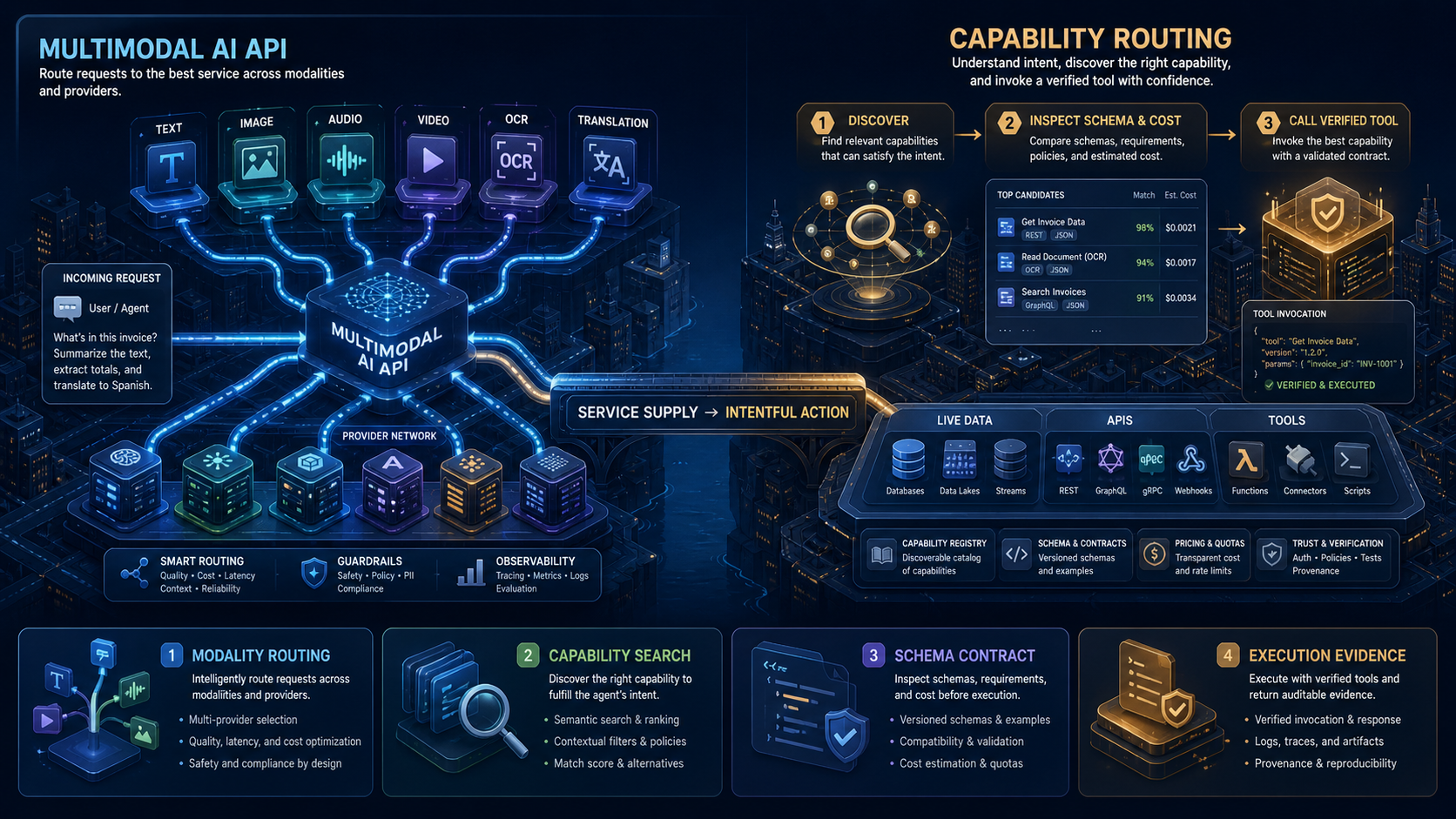
Eden AI unifies access to AI services across modalities and providers. QVeris discovers and invokes whatever external capability can satisfy an agent's intent. The overlap is API access; the difference is whether the organizing unit is an AI service category or a task capability.
Eden AI 统一访问跨模态、跨供应商的 AI 服务;QVeris 发现并调用能够满足智能体意图的外部能力。二者都涉及 API 访问,但组织单位分别是 AI 服务类别与任务能力。
TL;DR
Choose it to consolidate text, image, audio, video, OCR, translation, document and related provider integrations behind a common platform.
Choose it when an agent must search APIs, tools, datasets, or services by intent, inspect the contract and signals, then execute the best candidate.
Generating an image or transcribing audio is an AI service; checking inventory, issuing a refund, or querying live financial data is a broader capability.
Use Eden AI as service supply and QVeris as the discovery and governed-execution layer when workflows mix AI media with business APIs.
当需要在共同平台后整合文本、图像、音频、视频、OCR、翻译、文档及相关供应商集成时使用。
当智能体需要按意图搜索 API、工具、数据集或服务,检查契约与信号,再执行最佳候选时使用。
生成图像或转录音频属于 AI 服务;查询库存、退款或读取实时金融数据则是更广泛的能力。
当工作流混合 AI 媒体与业务 API 时,把 Eden AI 作为服务供给,把 QVeris 作为发现与受治理执行层。
AI service aggregation and capability routing use different catalogs AI 服务聚合与能力路由使用不同目录
Eden AI groups provider offerings by AI function. A product team can integrate multiple service categories through standardized endpoints and consolidated access, while still validating category-specific schemas, quality, asynchronous jobs, and provider behavior.
Eden AI 按 AI 功能组织供应商服务。产品团队可通过标准化端点与统一访问集成多个服务类别,但仍需按类别验证结构定义、质量、异步任务与供应商行为。
QVeris indexes callable outcomes. Discover ranks candidates for an intent, Inspect exposes schema, cost and operational signals, and Call produces an execution record. A candidate may be an AI service, a business API, a live dataset, or another tool.
QVeris 按可调用结果建立索引。Discover 针对意图排序候选,Inspect 展示结构定义、成本与运行信号,调用生成执行记录。候选可能是 AI 服务、业务 API、实时数据集或其他工具。
QVeris vs Eden AI side by side QVeris 与 Eden AI 并排比较
| Decision surface 决策面 | QVeris | Eden AI |
|---|---|---|
| Catalog unit 目录单位 | Intent-matched external capability 与意图匹配的外部能力 | AI service category, feature, model, and provider AI 服务类别、功能、模型与供应商 |
| Coverage 覆盖范围 | APIs, tools, services, datasets and live data API、工具、服务、数据集与实时数据 | Text, image, audio, video, OCR, translation and other AI services 文本、图像、音频、视频、OCR、翻译及其他 AI 服务 |
| Selection 选择方式 | Semantic discovery plus schema and operational signals 语义发现加结构定义与运行信号 | Service endpoint and provider/model selection 服务端点与供应商/模型选择 |
| Contract 契约 | Capability-specific input/output schema and execution policy 能力特定的输入/输出结构定义与执行策略 | Category-normalized request and response with provider seams 按类别标准化的请求响应及供应商边界 |
| Evidence 证据 | Search rank, inspection, execution, result and billing 搜索排序、检查、执行、结果与计费 | Service request, provider, category result, usage and bill 服务请求、供应商、类别结果、用量与账单 |
| Best fit 最适合 | Agents selecting actions dynamically 动态选择行动的智能体 | Products consolidating known AI-service integrations 整合已知 AI 服务集成的产品 |
Choose by the catalog you need to operate 按需要运营的目录选择
The known requirement is one integration and bill across several AI modalities and providers, with application-owned workflow logic.
The agent must discover an appropriate external function at runtime and inspect schema, cost, region, reliability, and policy before execution.
One agent workflow creates or analyzes media, then queries or changes an external business system with a shared audit trail.
已知需求是跨多个 AI 模态和供应商统一集成与账单,工作流逻辑由应用自行负责。
智能体必须在运行时发现合适的外部功能,并在执行前检查结构定义、成本、区域、可靠性与策略。
同一智能体工作流先创建或分析媒体,再查询或修改外部业务系统,并需要共享审计链。
Connect service supply to capability intent 把服务供给连接到能力意图
Expose approved Eden AI operations as typed capabilities that QVeris can discover. Preserve the native category schema behind a stable capability contract. Before execution, verify modality, provider constraints, asynchronous lifecycle, data policy, cost unit, callback destination, and quality threshold. Record both QVeris execution IDs and Eden AI service identifiers.
把获批的 Eden AI 操作以类型化能力暴露给 QVeris 发现,并在稳定能力契约后保留原生类别结构定义。执行前验证模态、供应商约束、异步生命周期、数据策略、计费单位、回调目标与质量阈值,同时记录 QVeris Execution ID 与 Eden AI 服务标识。
Architecture rule: standardize discovery and audit fields, but keep modality-specific payloads and quality metrics explicit.
架构规则:可以标准化发现与审计字段,但必须显式保留模态特定的请求数据与质量指标。
A cross-modal capability proof 跨模态能力验证
- Test LLM tools, OCR tables, transcription timestamps, image jobs, translation, and one non-AI business API.
- Compare discovery ranking with a fixed allowlist and verify unsupported fields are visible before execution.
- Force slow asynchronous jobs, provider rejection, callback loss, schema drift, unsafe output, and budget exhaustion.
- Score quality with category metrics rather than one generic success flag.
- Reconcile capability estimates, service usage units, retries, duplicate jobs, and final accepted-output cost.
- 测试 LLM 工具、OCR 表格、转录时间戳、图像任务、翻译及一个非 AI 业务 API。
- 将发现排序与固定 Allowlist 对比,并验证不支持字段在执行前可见。
- 强制触发异步任务缓慢、供应商拒绝、回调丢失、结构定义漂移、不安全输出与预算耗尽。
- 使用类别特定指标评估质量,而不是单一通用成功标志。
- 核对能力预估、服务用量单位、重试、重复任务与最终可接受输出成本。
Publish capabilities one category at a time 逐类别发布能力
Inventory service endpoints, providers, schemas, storage, callbacks, data terms, quality thresholds, price units and failure behavior. Wrap one category in a versioned capability contract, dual-run its native and normalized paths, canary agent discovery, then publish the next category.
盘点服务端点、供应商、结构定义、存储、回调、数据条款、质量阈值、计费单位与故障行为。先把一个类别封装为版本化能力契约,双轨运行原生与标准化路径,灰度智能体发现,再发布下一个类别。
QVeris turns a service catalog into an action catalog QVeris 把服务目录转为行动目录
Eden AI can be one valuable source of multimodal AI services inside a broader QVeris capability network. QVeris adds intent-based discovery, pre-call inspection and consistent execution evidence across AI and non-AI services.
Eden AI 可以成为更广泛 QVeris 能力网络中的多模态 AI 服务来源;QVeris 则在 AI 与非 AI 服务之上增加基于意图的发现、调用前检查与一致执行证据。
A Production Decision Scorecard for QVeris vs Eden AIQVeris 与 Eden AI的生产决策评分卡
For QVeris vs Eden AI, the useful question is not which product has more checkmarks. It is which design gives the team the right boundary, evidence, operating model, and exit path for a defined workload.
针对“QVeris 与 Eden AI”,真正有价值的问题不是哪款产品拥有更多勾选项,而是哪种设计能为明确工作负载提供正确边界、证据、运营模式和退出路径。
Map capability discovery and action routing versus a unified catalog of AI service APIs, including how tools are found, inspected, called, and governed. Decide which component owns each decision, where policy is enforced, and whether the products are substitutes, complements, or overlapping layers.
梳理能力发现与行动路由和统一 AI 服务 API 目录之间的差异,包括工具如何被发现、检查、调用与治理。明确每项决策由哪个组件负责、策略在哪里执行,以及两者究竟是替代、互补还是部分重叠。
To validate QVeris vs Eden AI, replay simple, long-context, streaming, structured-output, tool-calling, high-concurrency, and failure cases. Measure accepted-result quality, completion, p50 and tail latency, retries, trace completeness, and effective cost.
验证“QVeris 与 Eden AI”时,重放简单、长上下文、流式、结构化输出、工具调用、高并发和失败案例,衡量合格结果质量、完成率、常规与长尾延迟、重试、追踪完整性和实际成本。
When evaluating QVeris vs Eden AI, include hosting, regional capacity, data retention, identity integration, policy maintenance, upgrades, incident response, support, compliance evidence, and the custom adapters the team must keep current.
评估“QVeris 与 Eden AI”时,纳入托管、区域容量、数据留存、身份集成、策略维护、升级、事故响应、支持、合规证据,以及团队必须持续维护的自定义适配器。
Before rolling out QVeris vs Eden AI, version a neutral request and evidence envelope, shadow traffic, classify semantic differences, preserve trace identity, and prove a staged rollback. Prefer the option that keeps policy and workload contracts portable.
上线“QVeris 与 Eden AI”前,版本化中立请求与证据封装,运行影子流量,分类语义差异,保留追踪身份,并证明可分阶段回滚。优先选择能让策略和工作负载契约保持可迁移的方案。
FAQ
No. It discovers, inspects, and calls external capabilities such as APIs, tools, services, and live data. A model gateway governs inference traffic.
Yes. Keep model selection in the gateway and capability selection in QVeris, then propagate trace, session, policy, and cost evidence across both.
Implement the bottleneck that blocks production, but define the shared evidence envelope before either layer becomes hard to replace.
Model route, provider, policy version, usage, QVeris search and execution IDs, chosen capability, schema version, estimated cost, result, and errors.
不是。QVeris 负责发现、检查并调用 API、工具、服务和实时数据等外部能力;模型网关负责治理推理流量。
可以。模型选择留在网关,能力选择交给 QVeris,并在两层之间传递调用链、会话、策略与成本证据。
先解决阻塞生产的瓶颈,但应在任一层难以替换之前定义共享证据封装。
模型路由、供应商、策略版本、用量、QVeris Search/Execution ID、所选能力、结构定义版本、预估成本、结果与错误。