
OpenRouter vs Eden AI
LLM Routing or Multimodal Services?
OpenRouter 与 Eden AI:LLM 路由,还是多模态服务?
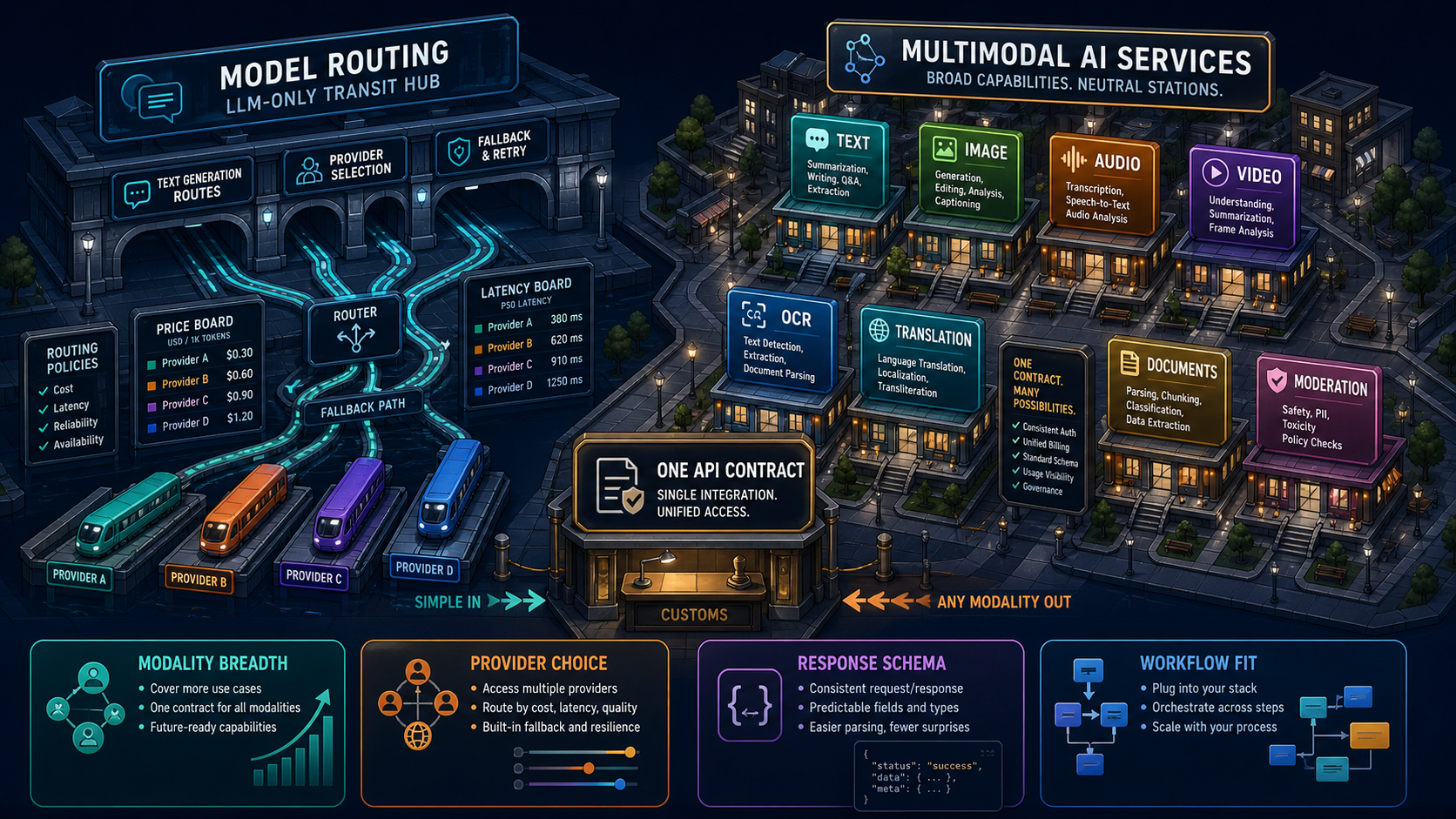
OpenRouter goes deep on model and provider access for generative AI. Eden AI goes broad across AI service categories and providers. The hard part is not counting endpoints; it is preserving the request, response, quality, fallback, and billing contract for each workflow.
OpenRouter 深入生成式 AI 的模型与供应商访问;Eden AI 横跨多个 AI 服务类别与供应商。难点不是数端点,而是为每个工作流保留请求、响应、质量、回退与账单契约。
TL;DR
Its unified API, large model catalog, provider routing, fallbacks, price and performance controls serve text generation and related model workflows.
Its value is a common access and billing layer across providers and categories such as text, image, audio, video, OCR, translation and document processing.
OCR pages, speech timestamps, image dimensions, moderation labels, video jobs and LLM streams cannot share one meaningful response schema.
A narrower API that preserves the exact semantics you use is better than broad catalog coverage with missing fields or opaque provider substitutions.
其统一 API、大型模型目录、供应商路由、回退、价格与性能控制服务于文本生成及相关模型工作流。
其价值是为文本、图像、音频、视频、OCR、翻译和文档处理等类别提供统一访问与账单层。
OCR 页、语音时间戳、图像尺寸、审核标签、视频任务和 LLM 流式响应无法共享一个有意义的结构定义。
能保留真实语义的较窄 API,优于目录广但缺字段或供应商替换不透明的方案。
Model routing and service aggregation solve different problems 模型路由与服务聚合解决不同问题
OpenRouter is optimized around models and providers. Its official API normalizes an OpenAI-like request surface, exposes a large model catalog and metadata, and routes by provider order, fallback, supported parameters, price, throughput, latency, privacy and data-retention constraints.
OpenRouter 围绕模型与供应商优化。其官方 API 标准化 OpenAI 风格请求面,提供大型模型目录与元数据,并可按供应商顺序、回退、支持参数、价格、吞吐、延迟、隐私与数据保留约束路由。
Eden AI aggregates AI service categories. Its documentation and platform emphasize one integration across multiple providers and modalities, unified billing, provider selection and standardized category endpoints. Each service still needs category-level schema and quality validation.
Eden AI 聚合 AI 服务类别。其文档与平台强调一次集成连接多个供应商和模态、统一账单、供应商选择与标准化类别端点;每种服务仍需按类别验证结构定义与质量。
OpenRouter vs Eden AI side by side OpenRouter 与 Eden AI 并排比较
| Decision surface 决策面 | OpenRouter | Eden AI |
|---|---|---|
| Core scope 核心范围 | LLM and generative-model access and routing LLM 与生成模型访问/路由 | Multiple AI service categories and providers 多种 AI 服务类别与供应商 |
| Strongest modalities 优势模态 | Text generation plus supported multimodal model inputs/outputs 文本生成及支持的多模态模型输入/输出 | Text, image, audio, video, OCR, translation, documents and more 文本、图像、音频、视频、OCR、翻译、文档等 |
| Routing unit 路由单元 | Model and hosting provider endpoint 模型与托管供应商端点 | Service category, feature and provider 服务类别、功能与供应商 |
| Schema contract 结构定义契约 | OpenAI-like model request with provider extensions 带供应商扩展的 OpenAI 风格模型请求 | Category-specific standardized endpoints and responses 按类别标准化的端点与响应 |
| Quality evidence 质量证据 | Model output, latency, throughput, price and provider behavior 模型输出、延迟、吞吐、价格与供应商行为 | Category metrics such as OCR fields, transcription timestamps or image quality OCR 字段、转写时间戳或图像质量等类别指标 |
| Best fit 最佳适配 | LLM-heavy applications needing broad model choice 需要广泛模型选择的 LLM 重型应用 | Products consolidating many AI services and bills 整合多种 AI 服务与账单的产品 |
Choose the API contract your workflow needs 选择工作流真正需要的 API 契约
The product is primarily LLM-driven and needs rapid model access, provider routing, explicit performance/privacy filters, and fallback breadth.
One team must integrate several AI categories, consolidate provider accounts, and standardize billing and operational access across modalities.
A critical provider feature, response field, quality control, compliance term, or support path is lost in normalization.
产品主要由 LLM 驱动,需要快速模型访问、供应商路由、明确性能/隐私过滤与广泛回退。
一个团队需要集成多种 AI 类别、合并供应商账户,并跨模态标准化账单与运营访问。
标准化会丢失关键供应商功能、响应字段、质量控制、合规条款或支持路径。
Use a canonical envelope with modality adapters 使用规范信封与模态适配器
Define a shared envelope for identity, tenant, task, trace ID, provider preference, data policy, timeout, budget and billing metadata. Then keep explicit adapters for LLM messages and tools, OCR documents and pages, speech audio and timestamps, image dimensions and seeds, video job lifecycle, translation locale, moderation labels, errors and usage. Log every transformation and unsupported field.
为身份、租户、任务、调用链 ID、供应商偏好、数据策略、超时、预算与账单元数据定义共享信封;再为 LLM Message/工具、OCR 文档/页、语音音频/时间戳、图像尺寸/Seed、视频任务生命周期、翻译 Locale、审核标签、错误与用量保留显式适配器。记录每次转换与不支持字段。
Architecture rule: normalize transport and operations; do not flatten modality semantics.
架构规则:可以标准化传输与运营,但不要抹平模态语义。
A modality-by-modality proof 逐模态验证
- Select production examples for LLM tools, structured output, OCR tables, speech diarization, image generation, video jobs and translation.
- Compare native and normalized requests, responses, events, errors, usage, provider identity and billing records.
- Score task-specific quality: schema validity, character error rate, field accuracy, image acceptance, subtitle timing and moderation consistency.
- Force provider errors, rate limits and slow jobs; verify fallback eligibility and idempotent retries for every category.
- Reconcile price per accepted output, not only provider units.
- 选择生产级 LLM 工具、结构化输出、OCR 表格、说话人分离、图像生成、视频任务与翻译样例。
- 比较原生与标准化请求、响应、事件、错误、用量、供应商身份和账单记录。
- 按任务评分:结构定义有效率、字符错误率、字段准确率、图像接受率、字幕时间和审核一致性。
- 强制供应商错误、限流和慢任务,逐类别验证回退资格与幂等重试。
- 按被接受的输出对账,而不是只看供应商计费单位。
Migrate one modality at a time 一次迁移一个模态
Inventory providers, service features, payload limits, schemas, async callbacks, storage, data terms, quality thresholds, fallbacks and price units. Build golden examples and native baselines. Dual-run a single category, diff structured fields and quality, reconcile billing, test rollback, then repeat for the next modality.
盘点供应商、服务功能、请求数据限制、结构定义、异步回调、存储、数据条款、质量阈值、回退与计价单位;建立 Golden 样例和原生基线。先双轨运行单一类别,对比结构字段与质量、核对账单并测试回滚,再迁移下一模态。
Service APIs still need capability discovery 服务 API 仍需要能力发现
OpenRouter or Eden AI provides model and AI-service supply. QVeris complements that supply by letting an agent discover which API, dataset, or tool satisfies the current intent and invoke it under governed credentials and contracts. Capability metadata can include modality, schema, policy, freshness and cost.
OpenRouter 或 Eden AI 提供模型与 AI 服务供给;QVeris 作为互补层,让智能体发现哪个 API、数据集或工具满足当前意图,并在受治理凭证与契约下调用。能力元数据可包含模态、结构定义、策略、新鲜度与成本。
A Production Decision Scorecard for OpenRouter vs Eden AIOpenRouter 与 Eden AI的生产决策评分卡
For OpenRouter vs Eden AI, the useful question is not which product has more checkmarks. It is which design gives the team the right boundary, evidence, operating model, and exit path for a defined workload.
针对“OpenRouter 与 Eden AI”,真正有价值的问题不是哪款产品拥有更多勾选项,而是哪种设计能为明确工作负载提供正确边界、证据、运营模式和退出路径。
Map LLM aggregation versus broader AI service modalities, request schemas, asynchronous jobs, provider choice, output assets, and billing units. Decide which component owns each decision, where policy is enforced, and whether the products are substitutes, complements, or overlapping layers.
梳理LLM 聚合与更广 AI 服务模态、请求 Schema、异步任务、供应商选择、输出资产和计费单位。明确每项决策由哪个组件负责、策略在哪里执行,以及两者究竟是替代、互补还是部分重叠。
To validate OpenRouter vs Eden AI, replay simple, long-context, streaming, structured-output, tool-calling, high-concurrency, and failure cases. Measure accepted-result quality, completion, p50 and tail latency, retries, trace completeness, and effective cost.
验证“OpenRouter 与 Eden AI”时,重放简单、长上下文、流式、结构化输出、工具调用、高并发和失败案例,衡量合格结果质量、完成率、常规与长尾延迟、重试、追踪完整性和实际成本。
When evaluating OpenRouter vs Eden AI, include hosting, regional capacity, data retention, identity integration, policy maintenance, upgrades, incident response, support, compliance evidence, and the custom adapters the team must keep current.
评估“OpenRouter 与 Eden AI”时,纳入托管、区域容量、数据留存、身份集成、策略维护、升级、事故响应、支持、合规证据,以及团队必须持续维护的自定义适配器。
Before rolling out OpenRouter vs Eden AI, version a neutral request and evidence envelope, shadow traffic, classify semantic differences, preserve trace identity, and prove a staged rollback. Prefer the option that keeps policy and workload contracts portable.
上线“OpenRouter 与 Eden AI”前,版本化中立请求与证据封装,运行影子流量,分类语义差异,保留追踪身份,并证明可分阶段回滚。优先选择能让策略和工作负载契约保持可迁移的方案。
FAQ
Many catalog models support multimodal inputs or outputs, but its organizing unit remains the model/provider API rather than every AI service category.
No. Its platform covers multiple AI service categories and providers; verify the current endpoint and provider list for each modality.
Usually not safely. A text LLM fallback, OCR fallback and video-job fallback require different schemas, idempotency and quality tests.
Coverage depends on whether breadth means models within generative AI or service categories across AI. Define the unit before comparing counts.
目录中的许多模型支持多模态输入或输出,但其组织单元仍是模型/供应商 API,而非所有 AI 服务类别。
不是。其平台覆盖多个 AI 服务类别与供应商;应逐模态核对当前端点与供应商清单。
通常不能安全跨越。文本 LLM、OCR 与视频任务回退需要不同结构定义、幂等和质量测试。
取决于“广度”指生成式 AI 内的模型,还是跨 AI 的服务类别。比较数量前必须先定义单位。