
OpenRouter vs Requesty
Broad Access or Policy-Led Optimization?
OpenRouter 与 Requesty:广泛接入,还是策略驱动优化?
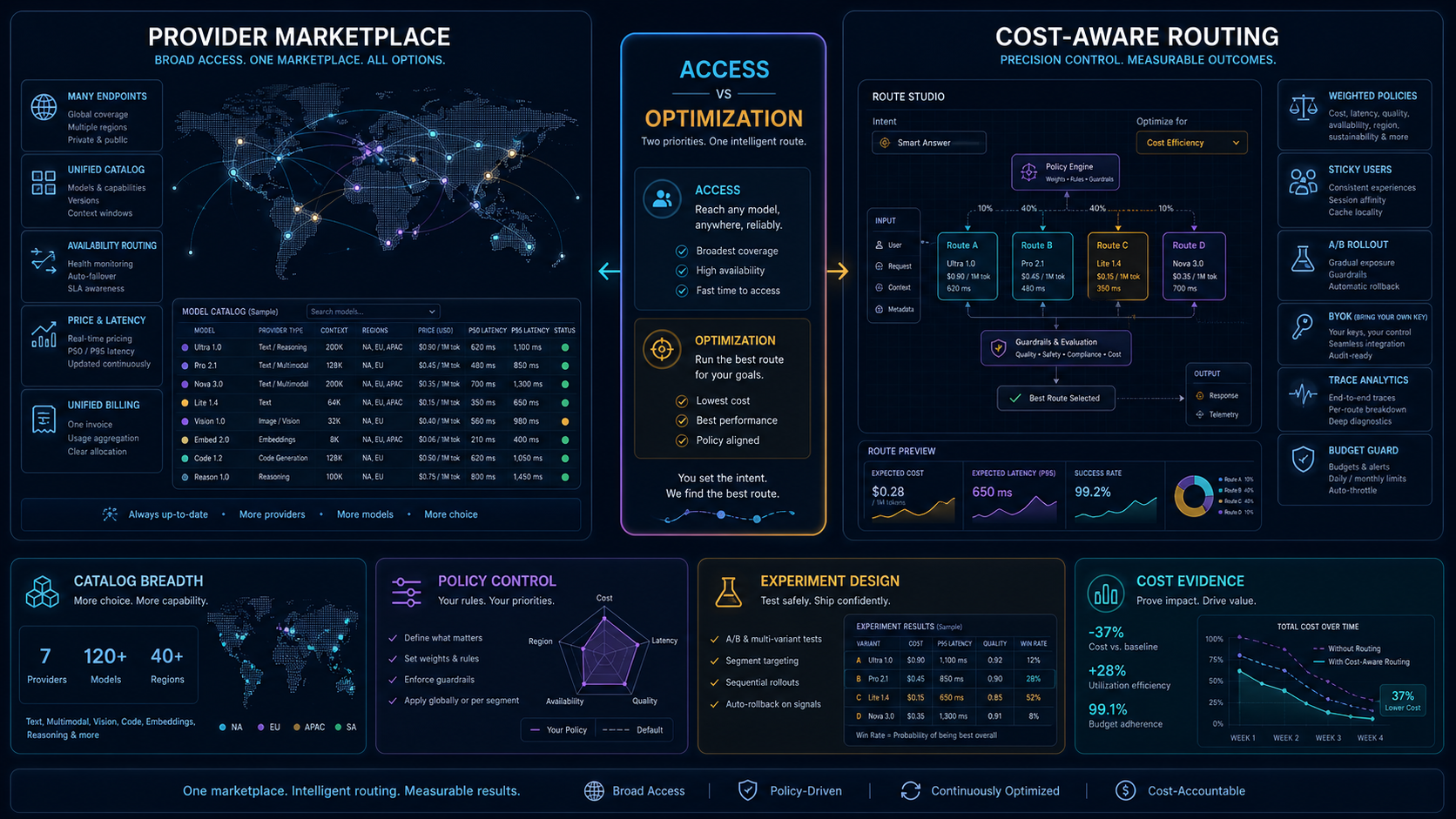
OpenRouter emphasizes broad model and provider access with configurable provider selection. Requesty emphasizes routing policies, weighted rollouts, sticky assignment, BYOK and analytics around cost and performance. The winning router is the one whose decision evidence you can audit.
OpenRouter 强调广泛模型与供应商访问及可配置供应商选择;Requesty 强调路由策略、加权发布、粘性分配、BYOK,以及围绕成本与性能的分析。更好的路由器应能让你审计决策证据。
TL;DR
Choose it when the primary value is fast access to a very broad model/provider network, consolidated billing and rich provider filters.
Choose it when weighted routing, sticky users or traces, A/B rollout, BYOK choice, budget controls and policy analytics are central.
Price per token is not cost per accepted task. Track schema validity, user outcomes, retries, latency, fallback, moderation and rework.
A route that changes model or provider mid-session can alter style, tool behavior, cache, context and safety. Test stickiness and rollback.
当核心价值是快速访问广泛模型/供应商网络、合并账单和丰富供应商过滤时更合适。
当加权路由、粘性用户/调用链、A/B 发布、BYOK 选择、预算控制和策略分析是核心时更合适。
每 Token 价格不等于每个合格任务的成本,应追踪结构定义有效率、用户结果、重试、延迟、回退、审核与返工。
会话中途改变模型或供应商可能改变风格、工具行为、缓存、上下文和安全;应测试粘性与回滚。
Access routing and optimization routing are not identical 访问路由与优化路由并不相同
OpenRouter operates a broad provider marketplace. Current documentation offers one API for hundreds of models and provider selection by order, fallback, required parameters, data collection, ZDR, quantization, price, throughput, latency and BYOK preferences.
OpenRouter 运营广泛供应商市场。当前文档提供一个 API 访问数百模型,并可按顺序、回退、必要参数、数据收集、ZDR、量化、价格、吞吐、延迟与 BYOK 偏好选择供应商。
Requesty organizes routing into explicit policies. Current documentation describes weighted load balancing across models or policies, consistent assignment by trace or user, A/B and gradual rollout, managed keys or BYOK, plus analytics for distribution, latency, cost and success.
Requesty 把路由组织成显式策略。当前文档描述跨模型或策略的加权负载均衡、按调用链/User 一致分配、A/B 与渐进发布、托管密钥/BYOK,以及分布、延迟、成本与成功率分析。
OpenRouter vs Requesty side by side OpenRouter 与 Requesty 并排比较
| Decision surface 决策面 | OpenRouter | Requesty |
|---|---|---|
| Primary job 主要任务 | Broad model and hosting-provider access 广泛模型与托管供应商访问 | Policy-led model routing and optimization workflow 策略驱动模型路由与优化流程 |
| Routing controls 路由控制 | Provider order, allow/deny, fallback, parameters, privacy, price and performance 供应商顺序、允许/拒绝、回退、参数、隐私、价格与性能 | Weighted model/policy distribution, sticky assignment, rollouts and key choice 加权模型/策略分布、粘性分配、发布与密钥选择 |
| Decision unit 决策单元 | Provider endpoint for a selected model, plus model routing options 所选模型的供应商端点,加模型路由选项 | Named routing policy that may include several models or policies 可包含多个模型或策略的命名路由策略 |
| Experiment model 实验模型 | Application or routing configuration controls tests 由应用或路由配置控制测试 | First-class weighted and consistent assignment supports A/B and gradual rollout 一等加权与一致分配支持 A/B 和渐进发布 |
| Evidence 证据 | Activity, usage, selected model/provider and public performance metadata Activity、用量、所选模型/供应商与公开性能元数据 | Policy analytics, distribution, latency, cost, success and trace context 策略分析、分布、延迟、成本、成功率与调用链上下文 |
| Best fit 最佳适配 | Teams prioritizing catalog breadth and provider optionality 优先目录广度与供应商可选性的团队 | Teams prioritizing controlled routing experiments and cost policy 优先受控路由实验与成本策略的团队 |
Choose whether access or optimization is scarce 判断稀缺的是访问还是优化
The hardest problem is discovering and accessing a broad, frequently changing model/provider catalog with configurable performance and privacy constraints.
The hardest problem is expressing, rolling out and auditing routing policies with consistent cohorts, BYOK choices, budgets and performance/cost analysis.
Business quality cannot be inferred from gateway metrics and must be scored using domain outputs, user feedback or offline datasets.
最难问题是发现并访问广泛且频繁变化的模型/供应商目录,同时配置性能与隐私约束。
最难问题是表达、发布并审计带一致 Cohort、BYOK 选择、预算和性能/成本分析的路由策略。
业务质量无法从网关指标推断,必须用领域输出、用户反馈或离线数据集评分。
Separate policy, assignment and evaluation 分离策略、分配与评估
Define an eligible model/provider set, then a versioned policy that chooses among it. Record policy version, cohort key, selected model and provider, fallback chain, price, latency, output, validation result and business outcome on every trace. Sticky assignment must have an expiration and migration rule. Optimization updates should use delayed quality labels, not only immediate cost and latency.
先定义合格模型/供应商集合,再定义在其中选择的版本化策略。每条调用链记录策略版本、Cohort 密钥、所选模型与供应商、回退链、价格、延迟、输出、验证结果和业务结果。粘性分配必须有过期与迁移规则;优化更新应使用延迟质量标签,而不只是即时成本和延迟。
Architecture rule: a routing decision without policy version, cohort key and outcome evidence cannot be improved safely.
架构规则:缺少策略版本、Cohort 密钥与结果证据的路由决策无法安全改进。
A routing-policy proof 路由策略验证
- Create fixed tasks with schema validators, domain quality scores, latency SLOs and maximum accepted cost.
- Run provider selection, model fallback, weighted rollout and sticky user/session assignment under identical traffic.
- Force rate limits, provider errors and slow endpoints; verify correct fallback, cohort consistency and request attribution.
- Compare expected and actual allocation with confidence intervals, then score cost per accepted task and regression rate.
- Roll a policy forward and back while preserving traceability and active conversations.
- 建立带结构定义校验、领域质量评分、延迟 SLO 与最大可接受成本的固定任务。
- 在相同流量下运行供应商选择、模型回退、加权发布和粘性用户/会话分配。
- 强制限流、供应商错误和慢端点,验证正确回退、Cohort 一致性与请求归因。
- 用置信区间比较预期与实际分配,再计算每合格任务成本和回归率。
- 在保留可追踪性和活跃会话的情况下前滚与回滚策略。
Version the routing contract before moving traffic 迁移流量前先版本化路由契约
Export keys, credits, models, provider preferences, policies, weights, stickiness keys, fallbacks, budgets, metadata, usage and traces. Translate them into a neutral routing specification with stable cohort hashing and outcome fields. Shadow production traffic, compare selected routes and costs, then canary by policy version with a reversible cohort migration.
导出密钥、余额、模型、供应商偏好、策略、权重、粘性密钥、回退、预算、元数据、用量和调用链;转成带稳定 Cohort Hash 与结果字段的中立路由规范。Shadow 生产流量并比较所选路径与成本,再按策略版本灰度,并提供可逆 Cohort 迁移。
Model optimization and capability routing can share evidence 模型优化与能力路由可共享证据
OpenRouter or Requesty selects model inference. QVeris complements that layer by helping agents select external APIs, datasets and tools under governed contracts and credentials. A shared trace can show both the model route and capability route, enabling end-to-end cost, latency and outcome analysis.
OpenRouter 或 Requesty 选择模型推理;QVeris 作为互补层,帮助智能体在受治理契约与凭证下选择外部 API、数据集与工具。共享调用链可同时展示模型路由与能力路由,从而分析端到端成本、延迟与结果。
A Production Decision Scorecard for OpenRouter vs RequestyOpenRouter 与 Requesty的生产决策评分卡
For OpenRouter vs Requesty, the useful question is not which product has more checkmarks. It is which design gives the team the right boundary, evidence, operating model, and exit path for a defined workload.
针对“OpenRouter 与 Requesty”,真正有价值的问题不是哪款产品拥有更多勾选项,而是哪种设计能为明确工作负载提供正确边界、证据、运营模式和退出路径。
Map model marketplace access versus gateway optimization, routing control, transformations, analytics, caching, budgets, and provider-account ownership. Decide which component owns each decision, where policy is enforced, and whether the products are substitutes, complements, or overlapping layers.
梳理模型市场访问与网关优化、路由控制、请求转换、分析、缓存、预算和供应商账户责任。明确每项决策由哪个组件负责、策略在哪里执行,以及两者究竟是替代、互补还是部分重叠。
To validate OpenRouter vs Requesty, replay simple, long-context, streaming, structured-output, tool-calling, high-concurrency, and failure cases. Measure accepted-result quality, completion, p50 and tail latency, retries, trace completeness, and effective cost.
验证“OpenRouter 与 Requesty”时,重放简单、长上下文、流式、结构化输出、工具调用、高并发和失败案例,衡量合格结果质量、完成率、常规与长尾延迟、重试、追踪完整性和实际成本。
When evaluating OpenRouter vs Requesty, include hosting, regional capacity, data retention, identity integration, policy maintenance, upgrades, incident response, support, compliance evidence, and the custom adapters the team must keep current.
评估“OpenRouter 与 Requesty”时,纳入托管、区域容量、数据留存、身份集成、策略维护、升级、事故响应、支持、合规证据,以及团队必须持续维护的自定义适配器。
Before rolling out OpenRouter vs Requesty, version a neutral request and evidence envelope, shadow traffic, classify semantic differences, preserve trace identity, and prove a staged rollback. Prefer the option that keeps policy and workload contracts portable.
上线“OpenRouter 与 Requesty”前,版本化中立请求与证据封装,运行影子流量,分类语义差异,保留追踪身份,并证明可分阶段回滚。优先选择能让策略和工作负载契约保持可迁移的方案。
FAQ
Its provider-routing controls include price sorting and maximum price alongside latency, throughput, privacy and other filters.
Current documentation describes weighted load balancing across models or policies with consistent assignment by trace ID or user ID.
It keeps a user or trace on the same assignment so conversations and experiments do not change treatment unpredictably.
The one that lowers cost per accepted outcome after quality regressions, retries, latency, fallbacks and engineering work are counted.
其供应商路由控制包含价格排序与最高价格,同时还有延迟、吞吐、隐私等过滤。
当前文档描述跨模型或策略的加权负载均衡,并可按调用链 ID 或 User ID 保持一致分配。
它让用户或调用链保持同一分配,避免会话与实验处理方式不可预测地变化。
应比较计入质量回归、重试、延迟、回退与工程工作后的每个合格结果成本。