
OpenRouter vs Together AI
Broad Provider Access or Capacity Control?
OpenRouter 与 Together AI:广泛接入,还是算力控制?
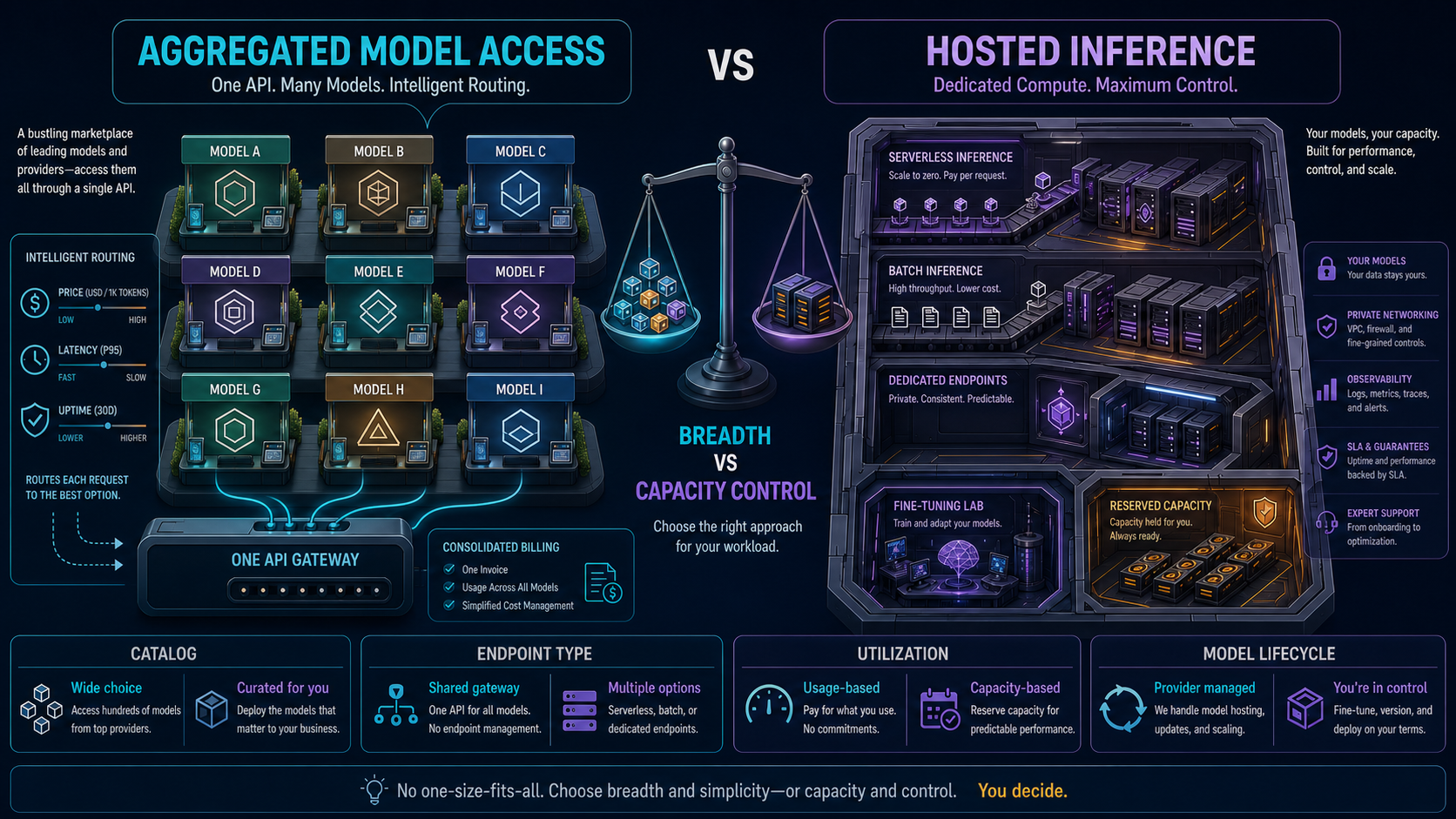
OpenRouter aggregates access and routes across models and providers. Together AI operates inference products from serverless and batch APIs to dedicated endpoints and model customization. Decide whether the scarce resource is catalog breadth or predictable compute.
OpenRouter 聚合并路由跨模型与供应商的访问;Together AI 运营从无服务器、批处理 API 到专用端点和模型定制的推理产品。应判断稀缺资源是目录广度还是可预测算力。
TL;DR
Choose it for one normalized API, broad model discovery, multi-provider routing, consolidated billing, performance and privacy filters, and fast model switching.
Choose it for hosted open-model inference, serverless and batch consumption, dedicated endpoints, model customization, capacity planning, and infrastructure support.
Measure quantization, context, parameters, throughput, batching, cold behavior, data terms, endpoint lifecycle, and support for the exact SKU.
Exploration and long-tail models can use aggregated access while stable high-volume workloads graduate to controlled or dedicated capacity.
适合统一标准化 API、广泛模型发现、多供应商路由、合并账单、性能/隐私过滤和快速切换模型。
适合托管开放模型推理、无服务器与批处理、专用端点、模型定制、容量规划与基础设施支持。
应测量量化、上下文、参数、吞吐、批处理、冷启动行为、数据条款、端点生命周期和具体 SKU 支持。
探索与长尾模型可使用聚合访问,稳定高流量负载则转入受控或专属容量。
Separate marketplace routing from inference operations 区分市场路由与推理运营
OpenRouter normalizes a provider marketplace. Official documentation describes one API for hundreds of models, provider routing by order, fallback, price, throughput, latency, privacy and data-retention requirements, plus BYOK and consolidated usage.
OpenRouter 标准化供应商市场。官方文档描述一个 API 访问数百模型,并可按顺序、回退、价格、吞吐、延迟、隐私和数据保留要求路由供应商,同时支持 BYOK 与合并用量。
Together AI hosts and operates inference. Its product and documentation surface spans serverless inference, batch processing, dedicated endpoints and clusters, fine-tuning and model deployment. The capacity, lifecycle and utilization contract is therefore central.
Together AI 托管并运营推理。其产品与文档覆盖无服务器 Inference、批处理、专用端点/Cluster、微调与模型部署,因此容量、生命周期和利用率契约是核心。
OpenRouter vs Together AI side by side OpenRouter 与 Together AI 并排比较
| Decision surface 决策面 | OpenRouter | Together AI |
|---|---|---|
| Primary job 主要任务 | Aggregate model and provider access 聚合模型与供应商访问 | Host and operate inference capacity 托管并运营推理容量 |
| Catalog model 目录模型 | Many model creators and hosting providers behind one API 一个 API 后的众多模型作者与托管商 | Curated hosted models plus customer workloads and endpoints 精选托管模型与客户工作负载/端点 |
| Routing 路由 | Provider selection, fallback, price, throughput, latency and privacy filters 供应商选择、回退、价格、吞吐、延迟与隐私过滤 | Routing within Together endpoints and deployment products Together 端点与部署产品内部的路由 |
| Capacity 容量 | Pooled provider availability and usage-based access 供应商池化可用性与按量访问 | Serverless, batch, dedicated endpoints and reserved capacity 无服务器、批处理、专用端点与预留容量 |
| Model lifecycle 模型生命周期 | Access models published by the network 访问网络中已发布模型 | Fine-tune, deploy and operate selected models 微调、部署并运营所选模型 |
| Best economics 最佳经济性 | Variable or exploratory multi-model demand 变化或探索型多模型需求 | Sustained workloads that benefit from endpoint and capacity control 可从端点与容量控制获益的持续负载 |
Choose breadth or capacity deliberately 有意选择广度或容量
Teams need immediate broad access, provider-level routing controls, consolidated billing, long-tail models, and minimal endpoint operations.
A smaller model portfolio requires serverless performance, batch economics, dedicated capacity, fine-tuning, private networking, or tighter lifecycle control.
Discovery and fallback breadth differ from the stable workloads that justify dedicated or customized inference capacity.
团队需要立即获得广泛访问、供应商级路由控制、合并账单、长尾模型且不想运营端点。
较小模型组合需要无服务器性能、批处理经济性、专属容量、微调、私有网络或更强生命周期控制。
发现与回退所需的广度,不同于值得使用专属或定制推理容量的稳定负载。
Route by workload maturity 按工作负载成熟度路由
Classify workloads as exploration, bursty production, predictable production, offline batch, custom model, and regulated/private. Keep a canonical request contract and model capability profile. Use aggregated access where breadth and resilience dominate; promote workloads to hosted or dedicated endpoints only after volume, latency, quality and support evidence justify capacity commitments.
把负载划分为探索、突发生产、可预测生产、离线批处理、自定义模型和受监管/私有。保留规范请求契约与模型能力画像;广度与弹性优先时使用聚合访问,只有当流量、延迟、质量与支持证据证明值得承诺容量时,才把负载升级到托管或专属端点。
Architecture rule: the same model slug must never be assumed to have identical weights, quantization, context, parameters, safety behavior, or performance across endpoints.
架构规则:不要假设同一模型 Slug 在不同端点上具有相同权重、量化、上下文、参数、安全行为或性能。
An access-versus-capacity proof 访问与容量验证
- Select representative chat, tool, structured-output, long-context, embedding, image, and batch tasks.
- Pin exact model and endpoint versions; record quantization, context, supported parameters, data terms, and deprecation policy.
- Measure first-token and total latency, throughput, queueing, cold behavior, error rate, and output quality under real concurrency.
- Force one provider failure and one capacity saturation; verify fallback, request IDs, billing, and recovery evidence.
- Compare cost per accepted task, including idle capacity, batch discount, engineering and support.
- 选择代表性的对话、工具、结构化输出、长上下文、Embedding、图像与批处理任务。
- 固定模型与端点版本,记录量化、上下文、支持参数、数据条款和弃用策略。
- 在真实并发下测量首 Token/总延迟、吞吐、排队、冷启动、错误率与输出质量。
- 强制一次供应商故障与容量饱和,验证回退、请求 ID、账单和恢复证据。
- 比较每个被接受任务的成本,包括闲置容量、批处理折扣、工程与支持。
Migrate the model contract, not just the base URL 迁移模型契约,而不只是基础地址(Base URL)
Export model IDs, provider preferences, fallbacks, privacy settings, keys, credits, rate limits, usage and error traces. Build capability tests for every production model. Dual-run on the target endpoint, reconcile output semantics and cost, then canary by workload. Preserve direct rollback until endpoint lifecycle and support are proven.
导出模型 ID、供应商偏好、回退、隐私设置、密钥、余额、限流、用量和错误追踪;为每个生产模型建立能力测试。在目标端点上双轨运行并核对输出语义与成本,再按负载灰度;在生命周期和支持得到验证前保留直接回滚。
Inference supply and external capabilities remain distinct 推理供给与外部能力仍是不同层
OpenRouter or Together AI supplies model inference. QVeris complements that layer by helping the resulting agent discover and invoke external data, APIs, and tools under governed credentials and contracts. Trace both inference selection and downstream actions in one workflow record.
OpenRouter 或 Together AI 提供模型推理;QVeris 作为互补层,帮助生成的智能体在受治理凭证和契约下发现并调用外部数据、API 与工具。应在同一工作流记录中追踪推理选择与下游动作。
A Production Decision Scorecard for OpenRouter vs Together AIOpenRouter 与 Together AI的生产决策评分卡
For OpenRouter vs Together AI, the useful question is not which product has more checkmarks. It is which design gives the team the right boundary, evidence, operating model, and exit path for a defined workload.
针对“OpenRouter 与 Together AI”,真正有价值的问题不是哪款产品拥有更多勾选项,而是哪种设计能为明确工作负载提供正确边界、证据、运营模式和退出路径。
Map multi-provider aggregation versus direct model serving, open-model capacity, dedicated endpoints, fine-tuning, provider transparency, and portability. Decide which component owns each decision, where policy is enforced, and whether the products are substitutes, complements, or overlapping layers.
梳理多供应商聚合与直接模型服务、开放模型容量、专用端点、微调、供应商透明度和可迁移性。明确每项决策由哪个组件负责、策略在哪里执行,以及两者究竟是替代、互补还是部分重叠。
To validate OpenRouter vs Together AI, replay simple, long-context, streaming, structured-output, tool-calling, high-concurrency, and failure cases. Measure accepted-result quality, completion, p50 and tail latency, retries, trace completeness, and effective cost.
验证“OpenRouter 与 Together AI”时,重放简单、长上下文、流式、结构化输出、工具调用、高并发和失败案例,衡量合格结果质量、完成率、常规与长尾延迟、重试、追踪完整性和实际成本。
When evaluating OpenRouter vs Together AI, include hosting, regional capacity, data retention, identity integration, policy maintenance, upgrades, incident response, support, compliance evidence, and the custom adapters the team must keep current.
评估“OpenRouter 与 Together AI”时,纳入托管、区域容量、数据留存、身份集成、策略维护、升级、事故响应、支持、合规证据,以及团队必须持续维护的自定义适配器。
Before rolling out OpenRouter vs Together AI, version a neutral request and evidence envelope, shadow traffic, classify semantic differences, preserve trace identity, and prove a staged rollback. Prefer the option that keeps policy and workload contracts portable.
上线“OpenRouter 与 Together AI”前,版本化中立请求与证据封装,运行影子流量,分类语义差异,保留追踪身份,并证明可分阶段回滚。优先选择能让策略和工作负载契约保持可迁移的方案。
FAQ
It provides a hosted inference platform and model catalog, but the core operating model includes serving, batch, dedicated capacity and customization.
It routes through a network of providers and normalizes their endpoints; provider selection and provenance matter.
Many common calls can, but supported parameters, multimodal behavior, streaming, errors and provider-specific features require tests.
When sustained utilization, latency predictability, privacy, customization or support value outweighs idle and operational cost.
它提供托管推理平台与模型目录,但核心运营模式还包括 Serving、批处理、专属容量和定制。
它通过供应商网络路由并标准化端点,因此供应商选择与来源很重要。
许多常见调用可以,但参数、多模态、流式、错误和供应商专属功能仍需测试。
当持续利用率、延迟可预测性、隐私、定制或支持价值超过闲置与运营成本时。