Why We Didn't Build Another LangChain
A direct answer to the most common question we get from developers — and why the AI agent ecosystem needs infrastructure, not more frameworks.
The world doesn't need another way to chain LLM calls. It needs a routing network that lets agents find and use the right tool — at runtime, at scale.
The Question We Keep Getting
"Why didn't you just build another agent framework like LangChain?"
It's a fair question. LangChain is one of the most starred repositories in AI history. CrewAI, AutoGPT, and dozens of frameworks followed. The pattern is well-established. But when we looked at what the agent ecosystem actually needed — not what was easy to build, but what was missing — the answer wasn't another orchestration layer.
LangChain solves how agents reason. QVeris solves what agents can actually do. These are different problems at different layers.
What Orchestration Frameworks Do Well
To be clear: LangChain is good at what it does.
Chain Management
LangChain excels at managing multi-step reasoning chains — how an agent breaks down a complex task into sequential, executable steps.
Prompt Engineering
Provides abstractions for system prompts, few-shot examples, output parsers, and prompt templates that work consistently across models.
Agent Orchestration
Manages how multiple agents coordinate, hand off tasks, and share results in multi-agent workflows with structured supervision.
These are real problems and LangChain solves them well. The issue isn't that orchestration frameworks are bad — it's that they solve a different problem than QVeris.
What Frameworks Can't Solve
Tool Discovery at Runtime
LangChain can manage the tools you give it. It can't help an agent discover that a tool exists in the first place. If you hardcode 10 tools at build time, your agent knows 10 tools — forever. When new capabilities appear, the agent stays blind.
Provider Quality Signals
Three providers offer the same stock quote API. Which has 99.2% success rate vs 87.3%? Which averages 180ms vs 680ms? Frameworks don't know. They call whatever you wired in — regardless of current performance.
Cross-Framework Compatibility
A tool integration built for LangChain doesn't work in CrewAI. One built for AutoGPT doesn't work in OpenClaw. Every framework re-invents tool integration from scratch. The ecosystem fragments instead of compounding.
Scale Without Context Explosion
Injecting full tool schemas into LLM context works for 5 tools. At 50 tools, you're burning tokens. At 500 tools, the context window overflows. Orchestration frameworks have no answer for tool access at scale.
Two Different Layers. Two Different Problems.
QVeris isn't a LangChain competitor. It's a layer below LangChain — and it works with every framework simultaneously.
Framework vs Infrastructure: Side by Side
| Orchestration Framework | Capability Routing Network | |
|---|---|---|
| Example | LangChain, CrewAI, AutoGPT | QVeris |
| Core job | How agents reason & chain steps | What agents can discover & call |
| Tool access | Hardcoded at build time | Discovered at runtime |
| New tools | Re-deploy required | Automatically available |
| Provider choice | Developer picks one | Routes to best by quality signals |
| Scale | Context overflow at 50+ tools | Designed for 10,000+ capabilities |
| Cross-framework | Framework-specific | Works with any framework |
| Token cost | Full schema injection | ~50–100 tokens per call |
The right answer for most teams: use both. LangChain (or any framework) for orchestration. QVeris for capability discovery and routing.
What We Built Instead
Semantic Discovery Engine
A search engine for tools. Agents describe what they need in natural language — QVeris returns ranked matches across 10,000+ verified capabilities with quality signals. Not another framework. It's Google for tools.
Intelligent Routing Layer
When multiple providers offer the same capability, QVeris routes to the best match — based on success rate, latency, cost, and task context. Not round-robin. Not random. Intelligent.
Universal Protocol
One integration. Every framework. LangChain, CrewAI, OpenClaw, Claude Code, Cursor — all connect to the same QVeris network through CLI, MCP Server, REST API, or Python SDK.
Works With Your Framework — Not Instead of It
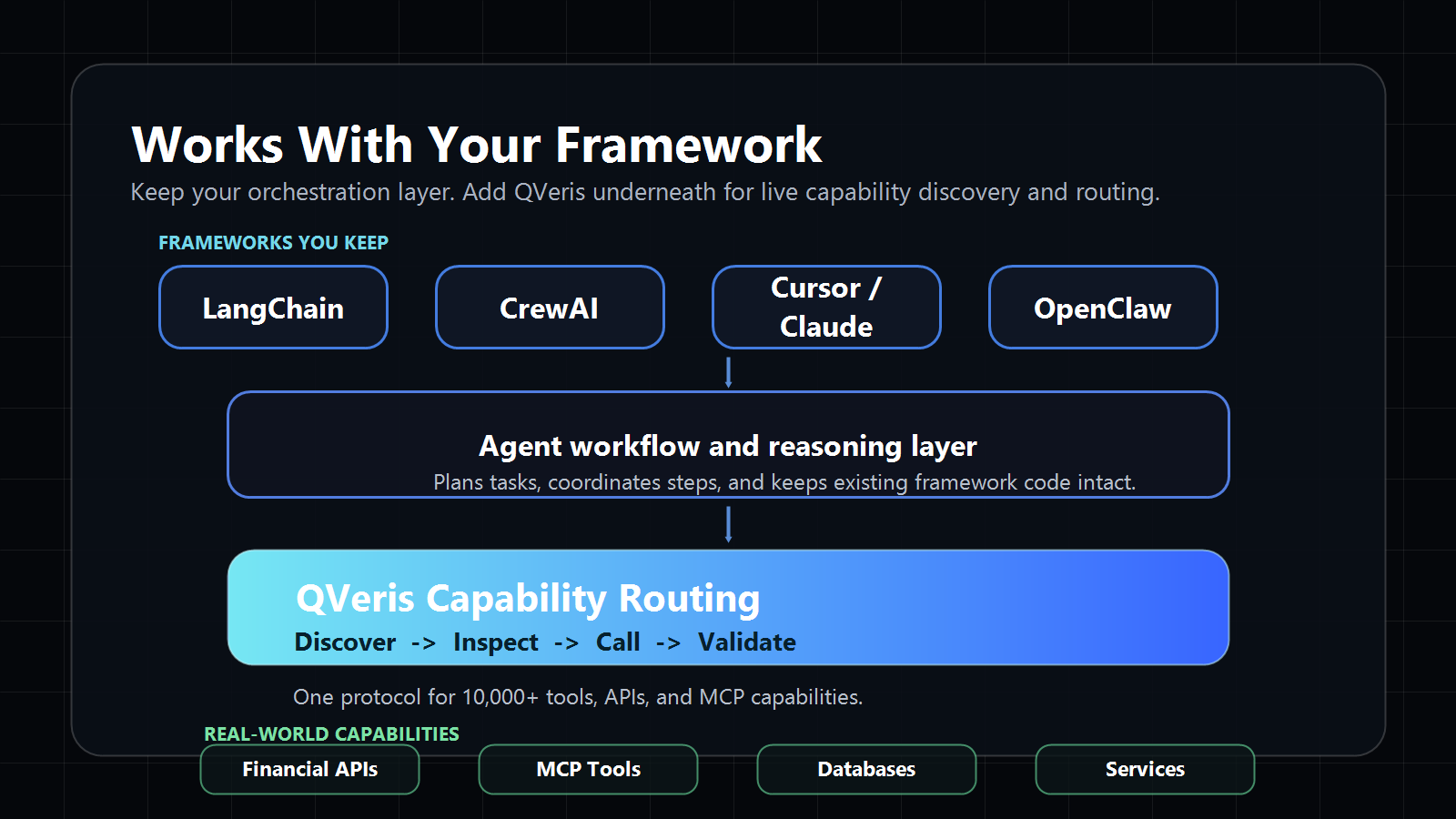
Whatever framework your team already uses — QVeris plugs in as the capability layer underneath.