
Loop Engineering: From "Completing Once" to "Continuously Getting Things Done"
When Agents no longer rely on human prompts for each iteration, the focus shifts from designing just a Prompt to structuring how tasks initiate, validate, remember, and terminate.
The real bottleneck for Agents isn't inability to perform—it's stopping after one run.
Writing code, researching, or calling APIs: the Agent completes a single run and returns results. Success means the task ends; failure means copying errors, adding context, and instructing it to "try another approach." It appears the Agent is working, but humans remain responsible for identifying issues, maintaining state, and deciding the next step.
By late June 2026, a preprint consolidated emerging Loop Engineering practices in the coding-agent community into a structured framework: instead of incrementally prompting Agents, design an external loop that triggers, validates, remembers, and terminates.
01 From a Single Response to Sustained Task Execution
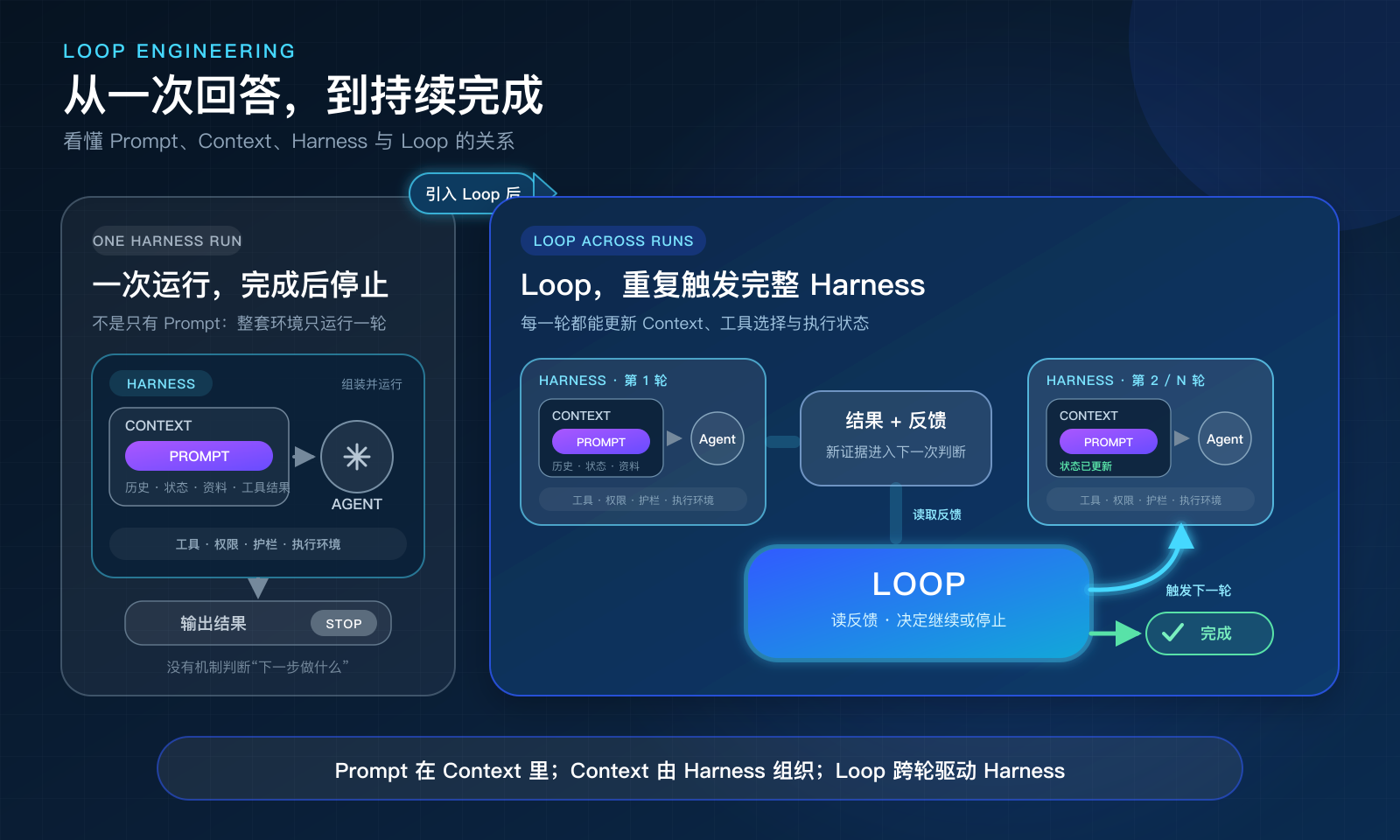
When delegating a task to an Agent, a Prompt is merely the instruction for that iteration. The model actually receives the full Context: the Prompt, existing data, historical results, and newly returned tool outputs.
Harnes assembles this Context with the Agent, tools, permissions, and safeguards to organize and constrain a complete run.
In the external Loop perspective used here, these are not parallel concepts: the Prompt is part of the current Context; Loop reads run results, decides to stop outside Harnes, or triggers the next iteration with updated state.
This is a practical engineering layering approach—not a standardized industry architecture. It shifts focus from "how to get a single good response" to "how to keep a task progressing."
02 Loop Isn't Just Continuous Retrying
A basic loop might simply retry after failure. But without knowing where failure occurred or what constitutes success, retries merely replay the same uncertainty.
For a Loop to be reliable, four elements must be clearly designed.
First, the goal. "Continue optimizing" isn't verifiable; "pass specified tests and generate auditable results" is.
Second, validation. An Agent claiming completion doesn't mean the task is done. Validation can come from deterministic rules, test scripts, another model, or human judgment.
Third, state. What was tried, why it failed, and confirmed evidence must be saved. Otherwise, each iteration starts anew.
Fourth, termination conditions. Completion, ambiguity, insufficient permissions, consecutive failures, or budget exhaustion should trigger a clear state—not endless consumption.
The core of Loop engineering isn't "looping," but deciding whether to continue based on evidence left from the previous iteration.
03 Humans Manage Loops Outside Harnes
Many Agent workflows already incorporate Loops—but humans have always managed them.
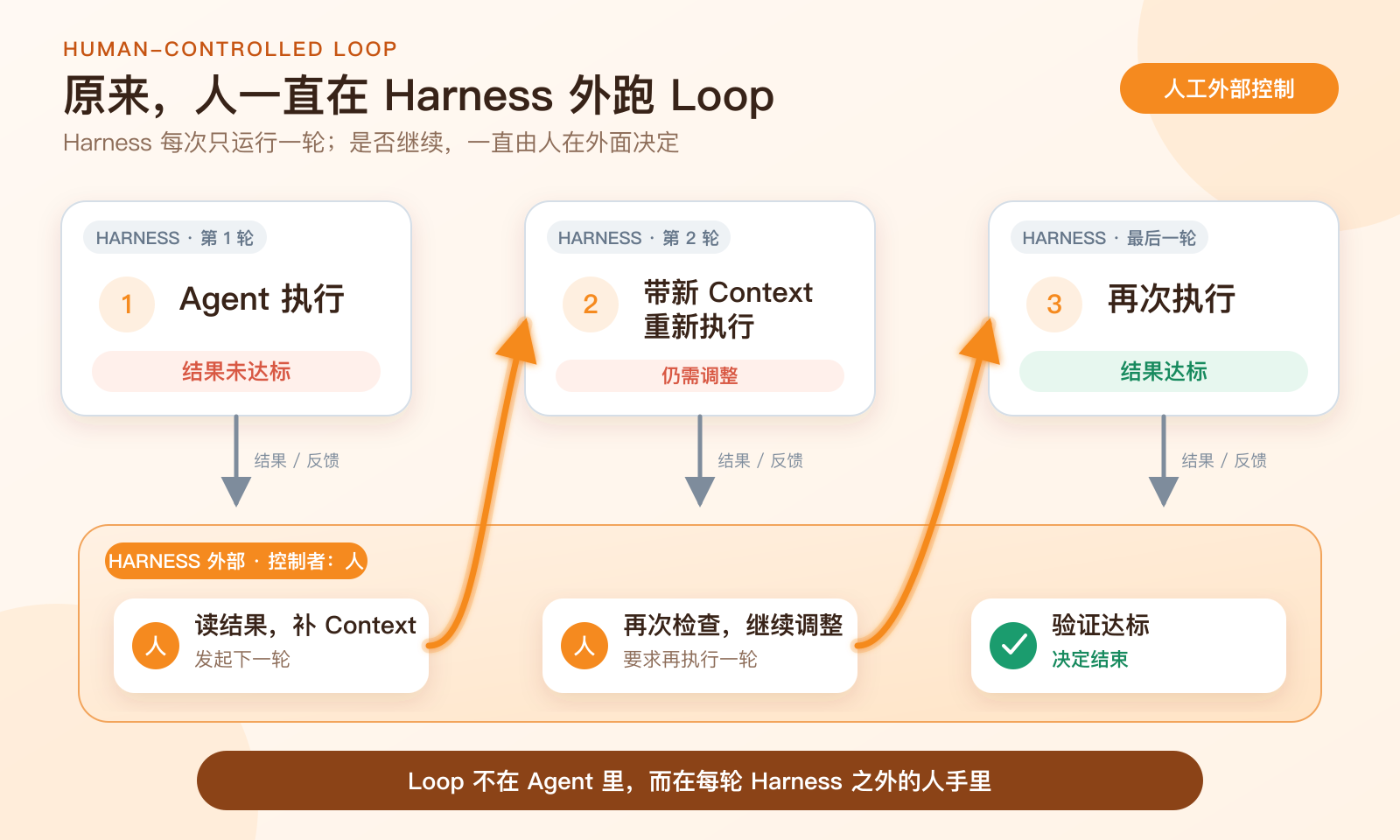
After each Harnes run, the Agent pauses. A human reviews results, assesses success, and—if unsatisfied—adds information, adjusts direction, carries forward results, and initiates a new full run.
In other words, the Loop isn't inside Harnes—it exists between humans and Harnes. Humans remain outside, managing task iterations.
Loop Engineering aims to take over this iterative handoff. Humans then move upward: defining goals, setting boundaries, and handling decisions requiring trade-offs.
04 Tool Calls Are the Clearest Example of Loop Engineering
During a tool call, Agents may encounter branches: non-standard entities, wrong tools, incomplete parameters, successful API responses with incorrect content, or insufficient permissions.
Without Loop, these scenarios typically revert to humans, who then instruct the Agent on next steps.
Designing it as a Loop requires the system to self-categorize:
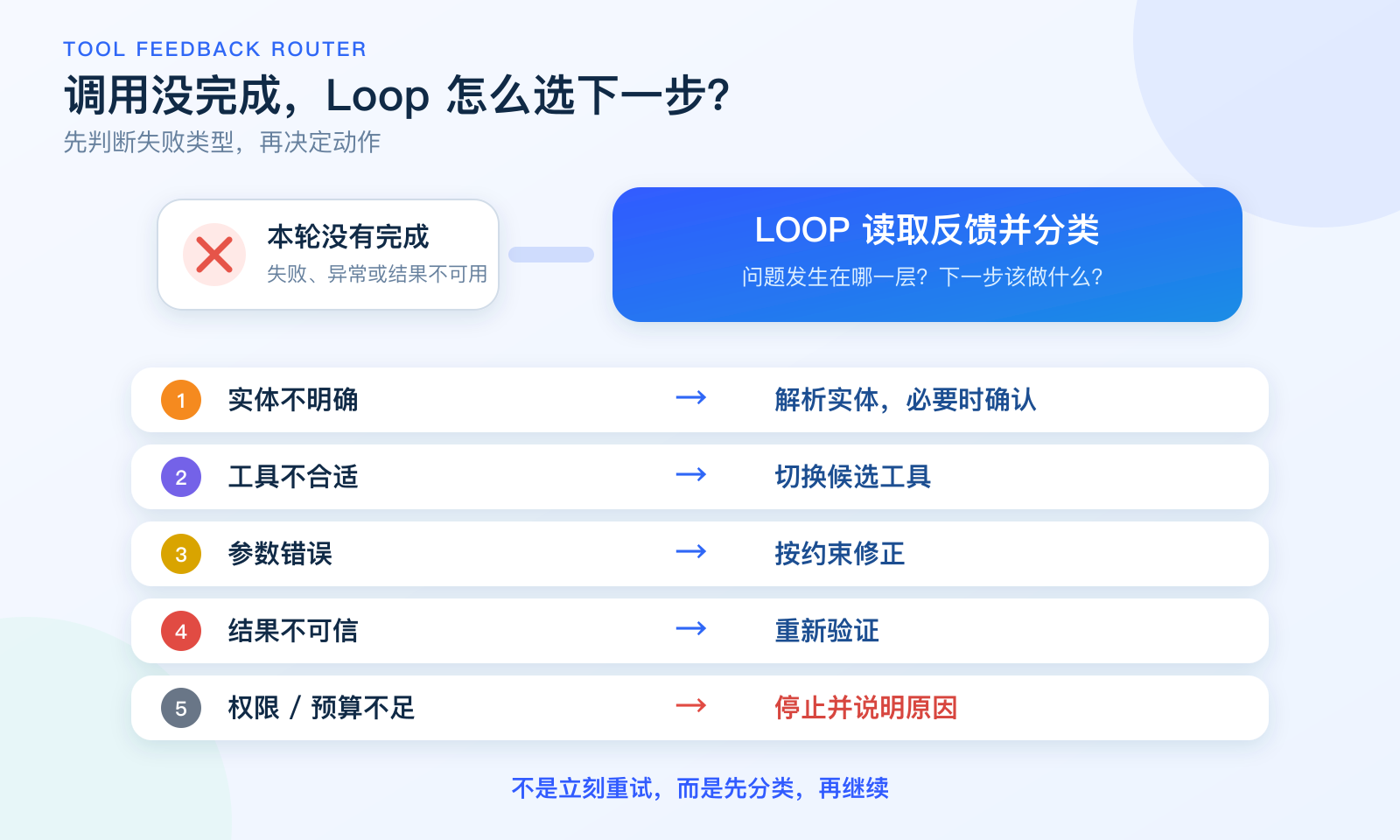
Here, Loop ceases to be abstract—it becomes a control logic operating on real inputs, real tools, and real feedback.
05 QVeris Completes External Loop Feedback
After understanding this concept, we re-examined QVeris's ongoing tool integration and evaluation work. QVeris doesn't take over user tasks but provides tools and structured feedback sufficient for upper-layer Agents to make judgments.
QVeris provides tools and feedback → upper-layer Agent decides to continue, clarify, or stop
For example, QVeris is building entity resolution capabilities. In enterprise query scenarios, it uses fuzzy search tools to resolve abbreviated names, aliases, or near-miss inputs into standardized enterprise names, stock codes, candidate lists, and confidence scores. Missed matches, ambiguities, or permission issues become explicit results. What tool to switch to, how to update Context, and whether to trigger the next iteration remain for the upper-layer Agent to decide. QVeris also continuously tests these tools with real queries, accumulating cross-run experience so each call leaves usable feedback for the next iteration.
Suppose the upper-layer Agent receives: "How's CATL doing lately?"
First Harnes run: System queries directly with "CATL," finds no match for the standard entity, and returns an explicit "entity unresolved" status.
The upper-layer Agent reads this failure, triggers a second full run, and uses QVeris's fuzzy enterprise search tool. If it returns a single high-confidence candidate, it writes "Contemporary Amperex Technology Co. Limited" and "300750.SZ" back into Context; if multiple candidates appear, the upper-layer Agent decides whether to clarify with the user.
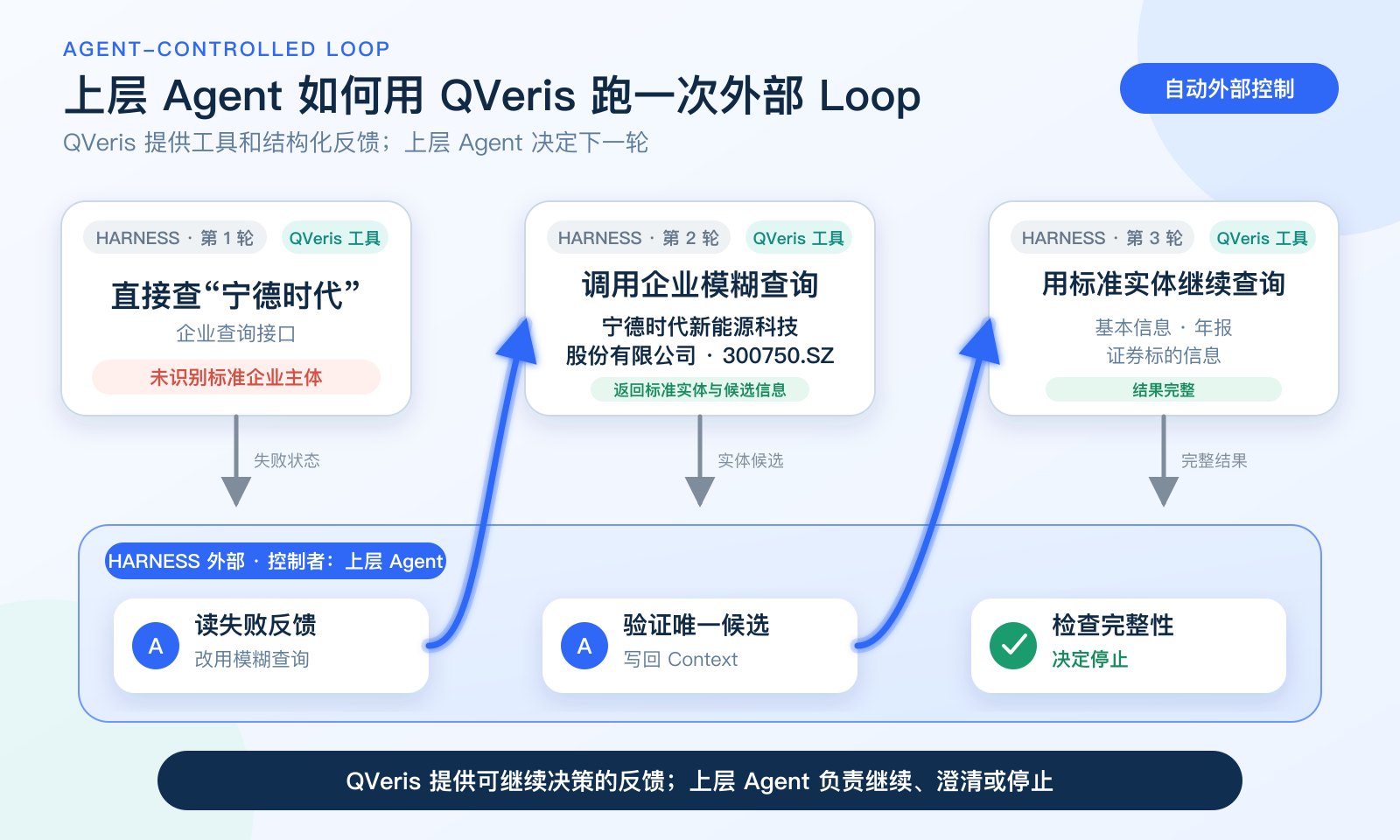
Third Harnes run: System queries enterprise basics, annual reports, and securities data using the standardized entity. Results pass validation, ending the Loop. The actual Loop isn't consecutive tool calls within one run—it's each iteration leaving a verifiable result, then the upper-layer Agent outside Harnes deciding whether to start the next iteration.
06 Sustained Completion Isn't Endless Running
Loop Engineering might evoke fully autonomous, perpetually running Agents. But reliable Loops don't aim for long runtime—they target a verifiable terminal state.
Each iteration should yield new evidence: confirming an entity, ruling out a tool, validating parameters, or identifying issues requiring human judgment. Without new evidence, continued execution is idle.
From "completing once" to "sustaining task completion," the shift isn't about Agents looping—it's about systems saving state, validating results, handling failures, and returning judgment to humans when needed.
Truly reliable agents aren't better at retrying—they know when to continue and when to stop.