
How QVeris Turns Fragmented APIs into a Financial Capability Network for Agents
QVeris · Product Philosophy
Over the past year, many teams have been building agents.
But once you put agents into real financial workflows, you quickly run into a practical problem: a model being able to talk does not mean it can reliably get work done.
For example, when you ask an agent to analyze a company, it needs far more than the ability to “write an analysis.” It has to find market data, company financials, announcements, news, macro indicators, industry data, and more. It also needs to know which tool can query A-shares, which tool covers U.S. equities, which tool supports historical prices, and which tool only returns a company profile.
The harder part is that these capabilities are often scattered across different APIs, providers, documentation, and parameter formats.
For a human, this is API integration work.
For an agent, it is the prerequisite for taking real action.
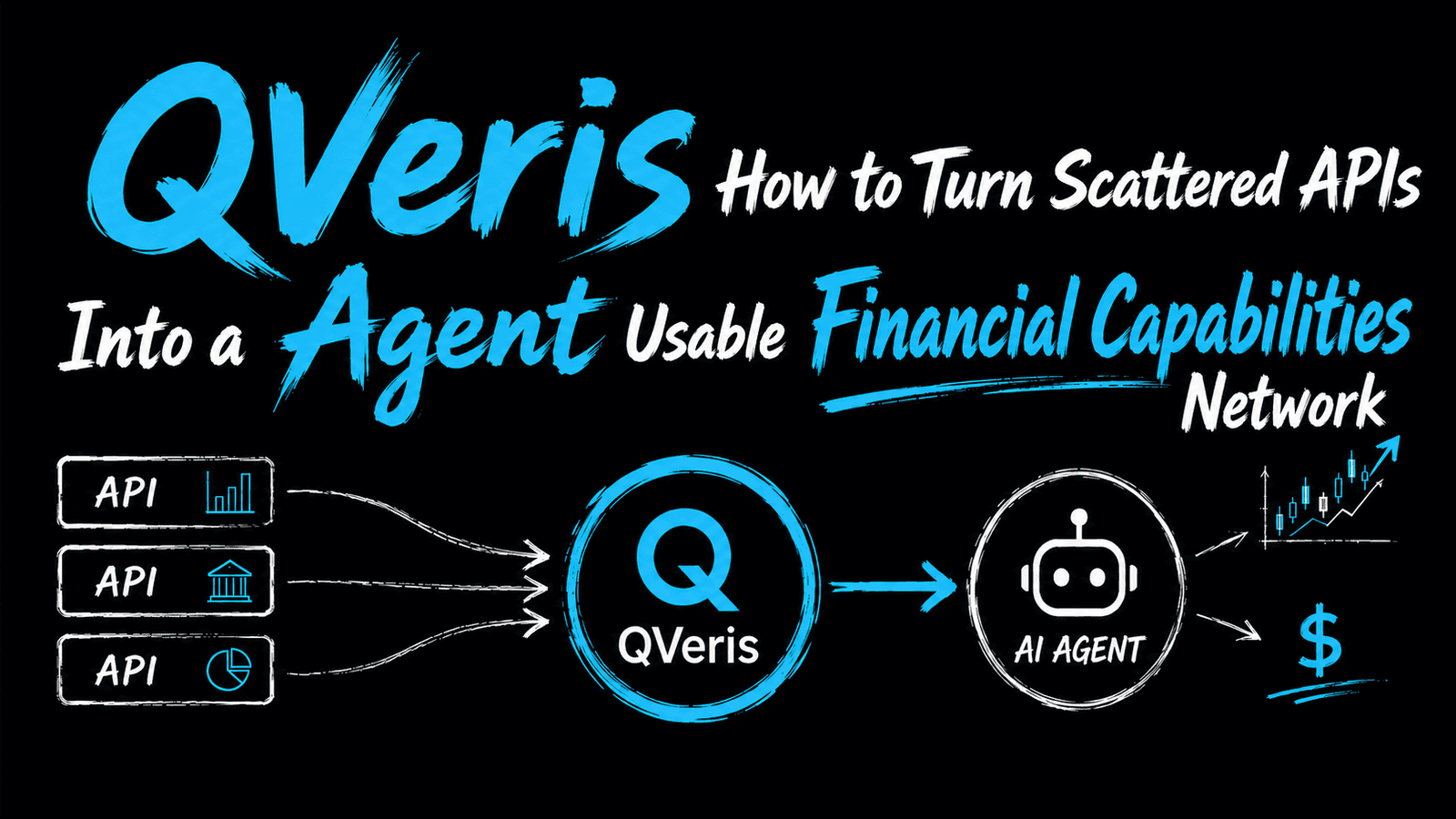
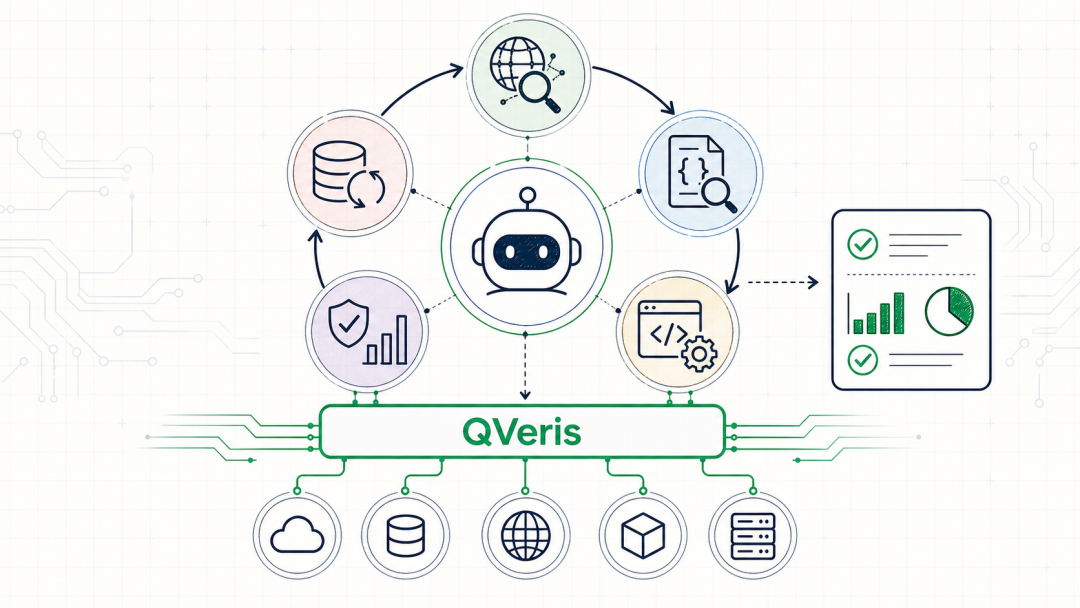
What QVeris has been working on recently is turning these fragmented APIs into a financial capability network that an agent can understand, choose from, call, and verify.
There Are Many APIs, but Agents Need Capabilities
The traditional way to integrate an API is to read a provider’s documentation, then write code that calls a specific endpoint.
But the problem for agents is not “is there an API?” It is:
What kind of financial capability does the user’s question require?
Which tool from this provider can complete the task?
What inputs does it need?
Which fields in the returned result are usable?
If the call fails, was it a parameter error, a permission issue, missing data, or a temporary provider exception?
For the same capability, which provider is more stable, cheaper, and better suited to the current task?
If this information is not structured, the agent can only guess.
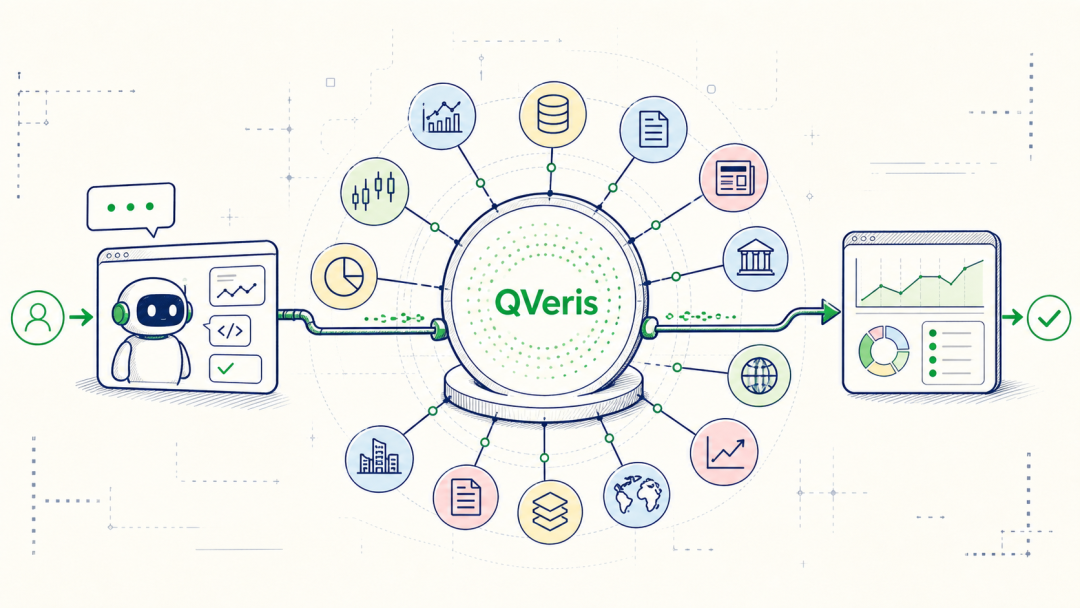
That is why QVeris is not just building “API aggregation.” API aggregation solves the access problem. QVeris goes a step further and solves the capability-understanding problem.
We put each tool through an evaluation process to determine which financial capabilities it actually covers: real-time quotes, historical K-lines, company profiles, financial statement fields, macro indicators, ETF holdings, news events, regulatory filings, and more.
What remains is not a pile of endpoint lists, but a capability network: each capability knows which tools can fulfill it, each tool knows which scenarios it is suited for, and every call can leave behind a verifiable evidence chain.
From Fragmented Tools to Evaluated Capabilities
After a tool is integrated, it is not enough to rely on what the documentation claims it supports.
Real-world API documentation often contains uncertainty: sample parameters may be outdated, field names may be inconsistent, some markets may be supported while others are not, and the same endpoint may return different structures across different providers.
So QVeris needs an evaluation layer.
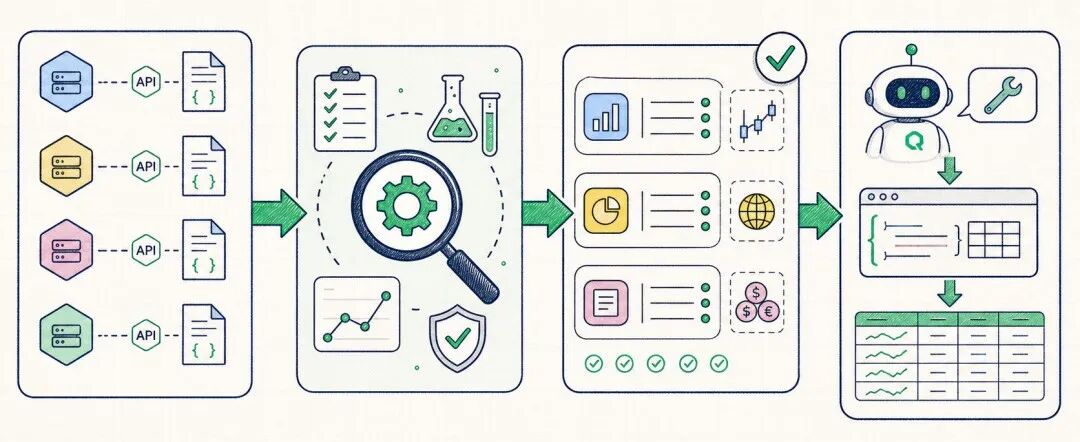
In simple terms, the evaluation process does several things:
First, determine which financial capabilities the tool may match.
Then construct real test parameters and call the tool to obtain results.
Next, check whether the returned data truly covers the fields required by the capability.
Finally, record outcomes such as success, failure, partial success, empty results, and permission restrictions.
This step is critical.
An agent cannot merely know that “there is a tool called company profile.” It needs to know whether the tool can actually return fields such as company name, exchange, currency, industry classification, ISIN, CEO, and IPO date. It also needs to know whether the tool behaves consistently across U.S. equities, A-shares, Hong Kong stocks, and European markets.
That is the key step from a “tool list” to a “capability network.”
In Finance, the Biggest Risk Is Data That Looks Available but Is Actually Unreliable
A typical use case for financial agents is cross-market investment research.
For example, a user might ask:
“Help me compare the fundamentals of Kweichow Moutai and Nestle.”
On the surface, this looks like a comparison between two companies. But to actually execute the task, the agent first has to solve a set of basic problems:
What is Kweichow Moutai’s ticker? Which exchange is it listed on? Is it denominated in RMB or another currency?
For Nestle, should the agent use the Swiss local listing or the ADR?
Can the two companies be compared using the same set of fields?
Are the data definitions consistent across historical prices, company profiles, and financial metrics?
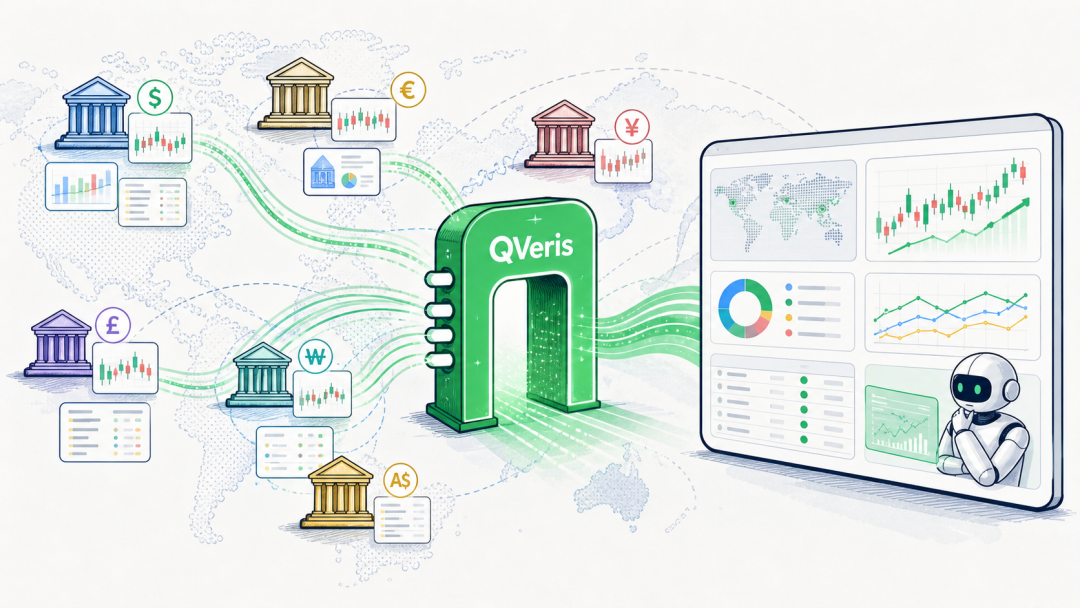
Without a capability layer like QVeris, agents can easily get lost among markets, currencies, tickers, and field structures.
QVeris aims to flatten as much of this complexity as possible: instead of forcing the agent to become a “data source dispatcher” first, it can organize its workflow directly around the research question.
When it needs a company profile, it discovers profile capabilities.
When it needs historical prices, it looks for market data capabilities.
When it needs news or announcements, it calls the corresponding information capabilities.
At every step, it can know the tool source, input parameters, returned fields, call status, and failure reason.
This matters especially in financial scenarios. A smooth-looking analysis with no source, no field validation, and no call record is more dangerous than a clear statement saying, “I could not retrieve this data.”
Callable Does Not Mean Reliably Callable
Failures are common when agents call tools.
Sometimes the parameter format is wrong.
Sometimes the provider returns empty data.
Sometimes permissions are insufficient.
Sometimes the call times out.
Sometimes the API appears to succeed, but actually returns sample data, a paywall notice, or invalid content.
If the system only tells the agent “the call failed,” the agent still has to guess what to do next.
So QVeris also performs structured attribution on call results. For example, it distinguishes between:
A successful call with results;
A partial success;
An empty result, where the agent should not blindly retry with different parameters;
A provider error, where the error message can guide a correction;
An authentication or permission issue that should be escalated to a human;
A rate limit or timeout that can be retried later.
This mechanism allows the agent not only to call tools, but also to understand the result of each call.
It knows when to change parameters, when to switch tools, when to stop, and when to tell the user, “This data source is currently unavailable.”
This is the reliability agents need in order to move from demos to production.
QVeris Aims to Provide the Action Layer for Financial Agents
If large language models are the brain, QVeris is more like the action layer.
It does not make the final judgment on behalf of the model, nor does it promise to “predict whether prices will rise or fall.” It does something more foundational and more stable:
Turn financial APIs into standardized capabilities;
Converge provider differences into descriptions that agents can understand;
Turn the call process into a traceable, verifiable evidence chain;
Structure failure reasons so agents can continue advancing the task;
Capture successful patterns so the next call becomes more reliable.
This is how we understand tool-native AI.
Future agents will not only answer questions in a chat box. They will discover tools, choose tools, call tools, verify results, and bring real-world data back into the reasoning process.
QVeris exists to make this stable, transparent, and scalable enough for financial scenarios.
Between fragmented APIs and a capability network lies more than technical integration. It requires a full operating system for evaluation, standardization, calling, verification, and ongoing operations.
That is the direction QVeris has been continuously refining.