
On this page本文目录
TL;DR: an AI executive dashboard is a governed decision systemTL;DR:AI 高管仪表盘是一套受治理的决策系统
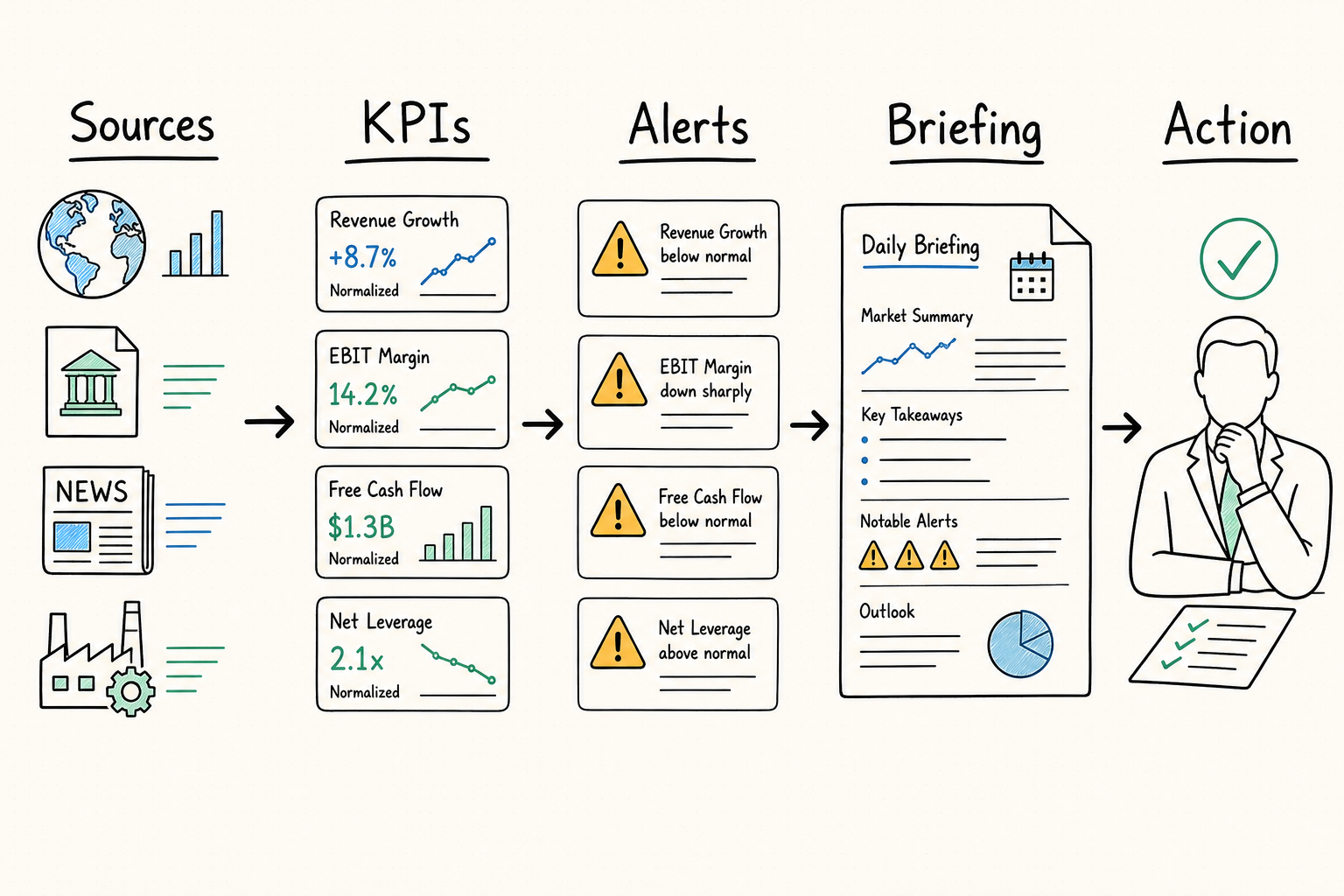
An AI executive dashboard combines a small set of governed KPIs with freshness checks, anomaly detection, evidence-backed explanation, and a scheduled briefing. The dashboard remains the stable view of recurring metrics; AI prioritizes what changed, explains only what the evidence supports, and proposes follow-up questions. The LLM should not calculate board metrics from raw application data or become the source of record.
AI 高管仪表盘把少量受治理 KPI、新鲜度检查、异常检测、证据支持的解释和定时简报组合在一起。Dashboard 继续承担稳定的周期性监控;AI 负责筛选重要变化、只解释证据能够支持的部分,并提出后续问题。LLM 不应直接从原始应用数据计算董事会指标,也不能成为记录源。
Shows recurring metrics using approved definitions, filters, periods, and access rules.
使用批准的定义、筛选、期间和访问规则展示周期性指标。
Ranks exceptions, summarizes evidence, and distinguishes observed facts from hypotheses.
对异常排序、总结证据,并明确区分已观察事实与待验证假设。
Runs bounded follow-up analysis against approved metrics, tools, and read-only sources.
围绕批准的指标、工具与只读数据源执行受控的后续分析。
Every claim links to a metric version, source time, validation result, and query or tool execution.
每个结论都关联指标版本、来源时间、验证结果和 Query/Tool 执行记录。
Who this guide is for—and when not to add AI适用人群,以及何时不该加入 AI
This guide is for founders, chiefs of staff, finance and operations leaders, analytics teams, and engineers building a CEO dashboard, leadership KPI dashboard, or automated daily business briefing. It assumes the organization already has—or is willing to define—metric ownership and source systems.
本指南适合构建 CEO Dashboard、Leadership KPI Dashboard 或自动每日经营简报的创始人、总裁办、财务与运营负责人、分析团队和工程师。前提是组织已经拥有,或愿意建立,指标责任人与数据源定义。
Revenue has three conflicting definitions, source refreshes routinely fail, executives disagree on the reporting period, or access rules are not enforced below the dashboard. AI will make those inconsistencies faster and more persuasive, not more correct.
如果 Revenue 存在三个互相冲突的定义、数据刷新经常失败、高管对报告期间没有共识,或者访问规则没有落实到 Dashboard 下层,AI 只会让这些不一致传播得更快、更像真的,而不会更正确。
Dashboard, daily briefing, BI copilot, and analytics agentDashboard、每日简报、BI Copilot 与 Analytics Agent
| Mode模式 | Best for最适合 | Primary artifact主要产物 | Trust model信任模型 |
|---|---|---|---|
| Executive dashboard高管仪表盘 | Recurring known questions and trend monitoring周期性已知问题与趋势监控 | Curated KPI view精选 KPI 视图 | Approved semantic model and access policy批准的语义模型和访问策略 |
| AI daily briefingAI 每日简报 | Prioritizing changes before a meeting会前筛选重要变化 | Short narrative with citations带引用的短简报 | Accepted metrics plus validated exception rules已接受指标加已验证异常规则 |
| BI copilot | User-driven questions and chart assistance用户驱动问答与图表辅助 | Session answer or suggested visual会话答案或建议图表 | User review inside the BI sessionBI 会话内由用户复核 |
| Analytics agent分析 Agent | Multi-step investigation and cross-source follow-up多步骤调查与跨源追问 | Plan, execution trace, evidence, and answer计划、执行轨迹、证据和答案 | Bounded tools, replay, validation, and approval受控工具、Replay、验证与审批 |
Most leadership teams need all four at different moments. The mistake is replacing a trusted recurring dashboard with a chat box, or calling a generated paragraph an “agent” when it cannot show the metric definitions and execution path behind its claims.
多数管理团队会在不同时间需要这四种模式。常见错误是用聊天框替代可信的周期性 Dashboard,或者把无法展示指标定义与执行路径的生成段落称为“Agent”。
Start from executive decisions, not a wall of KPIs从高管决策出发,而不是堆满 KPI
| Decision domain决策领域 | Core signals核心信号 | Typical decision典型决策 | Common trap常见陷阱 |
|---|---|---|---|
| Revenue and pipeline收入与 Pipeline | ARR/MRR, bookings, pipeline coverage, win rate, forecast gap | Adjust sales capacity, forecast, or deal intervention调整销售能力、预测或重点 Deal 介入 | Mixing booked, billed, and recognized revenue混用 Booked、Billed 与 Recognized Revenue |
| Cash and efficiency现金与效率 | Cash, burn, runway, gross margin, CAC payback | Change spending, hiring, or financing timing调整支出、招聘或融资节奏 | Using stale ledger or plan data使用陈旧账本或计划数据 |
| Customer health客户健康 | NRR, churn risk, support severity, adoption depth | Prioritize retention and executive outreach确定留存与高层客户沟通优先级 | Treating model sentiment as a contractual fact把模型情绪判断当作合同事实 |
| Product and delivery产品与交付 | Activation, retention, incidents, cycle time, roadmap risk | Reallocate engineering or change launch scope重新分配工程资源或调整发布范围 | Counting activity instead of outcomes用活动量替代结果指标 |
| Market and risk市场与风险 | Competitor moves, pricing, policy, concentration, supply risk | Review positioning, exposure, or contingency plans审查定位、风险敞口或应急计划 | Allowing unverified news to change an internal KPI让未经验证的新闻改变内部 KPI |
Define a KPI contract before writing prompts写 Prompt 之前,先定义 KPI 契约
A label such as “revenue growth” is not a metric definition. The contract must specify the formula, grain, dimensions, allowed filters, comparison period, source, freshness target, owner, validation, and change history. This prevents the model from joining incompatible periods or inventing a convenient denominator.
“Revenue Growth”只是标签,不是指标定义。契约必须明确公式、粒度、维度、允许筛选、比较期间、来源、新鲜度目标、责任人、验证和版本历史,避免模型连接不兼容期间或自行选择方便的分母。
metric: net_revenue_retention
version: 3
owner: vp_customer_success
description: Ending recurring revenue from the opening cohort
formula: (opening_arr + expansion - contraction - churn) / opening_arr
grain: month
dimensions: [segment, region]
currency: USD
source_model: finance.customer_arr_monthly
time_field: month_end
freshness_slo: PT12H
comparison: prior_year_same_month
minimum_cohort_size: 20
null_policy: reject
validation:
  - opening_arr > 0
  - 0 <= nrr
  - source_rows_reconciled = true
approval:
  metric_owner: approved
finance: approvedA star or dimensional model gives facts a consistent grain and dimensions predictable filtering behavior. The AI layer should query explicit measures or metric APIs rather than rebuild business logic from denormalized application tables.
星型或维度模型为 Fact 提供一致粒度,为 Dimension 提供可预测筛选行为。AI 层应查询显式 Measure 或 Metric API,而不是从反规范化应用表重新拼接业务逻辑。
Map each source to a decision and freshness class把每个数据源映射到决策与新鲜度等级
| Source class来源类型 | Examples示例 | Typical freshness典型新鲜度 | Control控制 |
|---|---|---|---|
| Finance财务 | ERP, billing, bank, planning model | Daily to monthly close每日到月结 | Reconciliation, currency, accounting period, close status对账、币种、会计期间、关账状态 |
| Commercial商业 | CRM, subscriptions, contracts | Hourly to daily每小时到每日 | Stage history, owner, amount basis, duplicate accounts阶段历史、Owner、金额口径、重复账户 |
| Product and operations产品与运营 | Event warehouse, incidents, delivery systems | Minutes to daily分钟级到每日 | Event version, bot traffic, backfill, outage windowsEvent Version、Bot Traffic、Backfill、故障窗口 |
| Customer voice客户声音 | Support, calls, surveys, account notes | Near real time to weekly近实时到每周 | PII redaction, permissions, sample bias, sentiment confidencePII 脱敏、权限、样本偏差、情绪置信度 |
| External context外部上下文 | Market data, filings, news, competitor changes | Event-driven事件驱动 | Provider identity, timestamp, licensing, corroborationProvider 身份、时间戳、许可与交叉验证 |
Reference architecture for an AI executive dashboardAI 高管仪表盘参考架构
Land source data with source-event time, ingestion time, connector version, account identity, and immutable raw references.
保存 Source Event Time、Ingestion Time、Connector Version、Account Identity 与不可变 Raw Reference。
Standardize entities, currencies, calendars, account mappings, and metric grain in a warehouse or semantic layer.
在 Warehouse 或 Semantic Layer 中统一实体、币种、日历、账户映射和指标粒度。
Evaluate versioned KPI contracts, freshness SLOs, reconciliation checks, null policies, and dimension coverage before publication.
发布前执行版本化 KPI 契约、新鲜度 SLO、对账检查、Null Policy 与 Dimension Coverage。
Use thresholds, forecast variance, seasonality-aware anomaly detection, and business materiality—not model surprise alone.
使用阈值、预测偏差、考虑季节性的异常检测和业务重大性,而不是只依赖模型“惊讶度”。
Give the model accepted facts, evidence IDs, required sections, prohibited claims, and a strict output schema.
只向模型提供已接受事实、Evidence ID、必需章节、禁止结论和严格 Output Schema。
Publish to the dashboard, email, or chat; require review for material claims; preserve the full metric and tool execution chain.
发布到 Dashboard、邮件或聊天;重大结论要求复核;保留完整指标与 Tool Execution Chain。
Use a briefing schema that separates facts, risks, and hypotheses使用区分事实、风险与假设的简报 Schema
Free-form “summarize the business” prompts produce inconsistent emphasis and unsupported causal language. A structured briefing contract makes missing evidence visible and lets the delivery layer reject malformed output.
自由格式的“总结业务”Prompt 会产生不一致的重点和缺乏依据的因果措辞。Structured Briefing Contract 能暴露缺失证据,并允许交付层拒绝格式不合格的输出。
type EvidenceRef = {
  metricId: string;
  metricVersion: number;
  asOf: string;
  sourceRunId: string;
};

type BriefingItem = {
  title: string;
  observedFact: string;
  materiality: "watch" | "important" | "critical";
  comparison: string;
  evidence: EvidenceRef[];
  hypothesis?: string;          // explicitly unverified
  recommendedFollowUp?: string; // question, not an autonomous action
};

type ExecutiveBriefing = {
  briefingId: string;
  generatedAt: string;
  dataThrough: string;
  freshnessStatus: "current" | "partial" | "stale";
  topChanges: BriefingItem[];
  unchangedButMaterial: string[];
  missingData: string[];
  approvalsRequired: string[];
};
Step-by-step implementation: SaaS CEO morning briefing分步实现:SaaS CEO 早间简报
Use one end-to-end scenario instead of connecting every system at once. Start with four governed metrics—MRR growth, pipeline coverage, cash runway, and critical customer risk—plus one external market signal. Run the same briefing every weekday for 30 days.
不要一次连接所有系统,先用一个端到端场景。选择四个受治理指标:MRR Growth、Pipeline Coverage、Cash Runway、Critical Customer Risk,再加一个外部市场信号。连续 30 个工作日生成同一份简报。
Define what the CEO may change after reading: forecast, spending, customer intervention, or launch priority.
定义 CEO 阅读后可能调整的内容:预测、支出、客户介入或发布优先级。
Finance, sales operations, customer success, and product owners sign off definitions and freshness.
财务、销售运营、客户成功与产品 Owner 批准定义和新鲜度。
Begin with business thresholds and forecast variance; add statistical detection only after enough history exists.
先使用业务阈值与预测偏差;积累足够历史后再加入统计异常检测。
Pass compact structured facts to the model, not warehouse credentials or unrestricted natural-language query access.
向模型传递紧凑的结构化事实,而不是 Warehouse Credential 或无限制自然语言查询权限。
Label useful, redundant, wrong metric, stale source, unsupported explanation, and missed material change.
标记有用、重复、指标错误、来源陈旧、解释无依据和遗漏重大变化。
What a useful daily executive briefing looks like一份有用的每日高管简报应该长什么样
1. Pipeline coverage fell from 3.2× to 2.6×. The change is concentrated in enterprise EMEA after two opportunities moved to next quarter. Evidence: pipeline_coverage:v4, CRM snapshot crm_2026_07_30_2300. Follow-up: review the two slips and the regional forecast before Thursday.
1. Pipeline Coverage 从 3.2× 降至 2.6×。变化主要集中在 EMEA Enterprise,两笔 Opportunity 延后到下季度。证据:pipeline_coverage:v4、CRM Snapshot crm_2026_07_30_2300。后续:周四前复核两笔延后 Deal 与区域预测。
2. Cash runway remains 17.4 months. No material change despite higher cloud spend because collections exceeded plan. Evidence: cash_runway:v2, finance close status “preliminary.” Do not publish to the board pack until close is final.
2. Cash Runway 仍为 17.4 个月。尽管云支出上升,但回款高于计划,因此没有重大变化。证据:cash_runway:v2,Finance Close Status 为“Preliminary”。关账完成前不要写入董事会材料。
Missing data: support severity feed has not refreshed for 14 hours; customer-risk conclusions are omitted rather than estimated.
缺失数据:Support Severity Feed 已 14 小时未刷新,因此本次省略客户风险结论,而不是进行估算。
The briefing is short because the evidence model does the heavy lifting. It states data time, identifies material changes, preserves caveats, includes unchanged but important metrics, and refuses to fill a missing source with plausible language.
简报之所以简短,是因为证据模型承担了主要工作。它明确数据时间、识别重大变化、保留限制条件、报告未变化但重要的指标,并拒绝用看似合理的语言填补缺失数据。
Validation checklist before a briefing is delivered简报交付前验证清单
| Gate关卡 | Pass condition通过条件 | Failure action失败处理 |
|---|---|---|
| Source来源 | Expected source identity, successful load, nonzero rows, schema version accepted来源身份正确、Load 成功、非零行、Schema Version 已接受 | Mark source unavailable; do not estimate标记来源不可用,不做估算 |
| Freshness新鲜度 | Event and ingestion times are within the KPI SLOEvent Time 与 Ingestion Time 满足 KPI SLO | Label stale or omit dependent claims标记陈旧或省略依赖结论 |
| Metric指标 | Version approved, grain compatible, dimensions covered, reconciliation passed版本已批准、粒度兼容、维度覆盖、对账通过 | Reject the metric instance拒绝该指标实例 |
| Exception异常 | Threshold or model version documented; materiality above delivery cutoff阈值或模型版本已记录;重大性超过交付门槛 | Keep in analyst queue, not executive briefing保留在分析队列,不进入高管简报 |
| Narrative叙述 | Schema valid, every fact cited, hypotheses labeled, prohibited claims absentSchema 有效、事实均有引用、假设已标记、无禁止结论 | Regenerate once or route to reviewer重新生成一次或转人工复核 |
| Access访问 | Recipient policy permits every metric, row, object, and source excerpt接收者策略允许每个 Metric、Row、Object 与 Source Excerpt | Redact or block delivery脱敏或阻止交付 |
Freshness is part of the answer, not a hidden pipeline setting新鲜度是答案的一部分,不是隐藏的 Pipeline 设置
A dashboard can display a recent tile backed by an older semantic model, and different sources can refresh on different schedules. Store and show at least three clocks: when the business event occurred, when the platform ingested or computed it, and when the briefing was generated.
Dashboard 可能显示刚刷新的 Tile,但底层 Semantic Model 仍然陈旧;不同来源也可能按不同计划刷新。至少保存并展示三个时间:业务事件发生时间、平台采集/计算时间,以及简报生成时间。
Incidents, fraud, availability, and time-sensitive operational risk.
事故、欺诈、可用性和时间敏感的运营风险。
Pipeline changes, high-value account activity, and usage anomalies.
Pipeline 变化、高价值账户活动与使用异常。
Revenue operations, cash movement, product adoption, and support trends.
收入运营、现金变动、产品采用与客服趋势。
Recognized revenue, margin, board metrics, and audited financial conclusions.
确认收入、利润率、董事会指标与审计财务结论。
Security, privacy, and approval controls安全、隐私与审批控制
- Enforce access below the UI: row-level and object-level controls must apply at the semantic model, warehouse, API, or tool boundary—not only by hiding a dashboard card.在 UI 下层执行访问控制:Row-level 与 Object-level Control 应落实在 Semantic Model、Warehouse、API 或 Tool Boundary,而不是只隐藏 Dashboard Card。
- Use read-only identities: briefing workflows should not gain write privileges merely because the final output recommends an action.使用只读身份:简报工作流不能因为最终输出包含行动建议就获得写权限。
- Minimize model context: send only accepted facts needed for the briefing; redact unnecessary customer names, tickets, call transcripts, and credentials.最小化模型上下文:只发送简报需要的已接受事实;移除不必要客户姓名、工单、通话文本和凭证。
- Gate material claims: layoffs, financing, compliance, legal exposure, and board reporting require named human approval.重大结论设审批:裁员、融资、合规、法律风险和董事会报告必须由具名人员批准。
- Test roles: additive roles and imported-versus-live data paths can create unexpected visibility; verify with real recipient identities.测试角色:叠加角色与 Import/Live 数据路径可能产生意外可见性,应使用真实接收者身份验证。
Observe the metric-to-briefing path end to end端到端观察“指标到简报”路径
Use one correlation ID from source refresh through metric computation, anomaly evaluation, model generation, validation, approval, and delivery. Traces reconstruct the path; metrics track availability, latency, and quality; structured events capture validation and approval decisions.
从 Source Refresh、Metric Computation、Anomaly Evaluation、Model Generation、Validation、Approval 到 Delivery 使用同一个 Correlation ID。Trace 还原路径;Metric 追踪可用性、延迟与质量;Structured Event 保存验证和审批决策。
| Signal信号 | Minimum fields最小字段 | Question answered回答的问题 |
|---|---|---|
| Trace | briefing_id, source_run, metric_run, model_run, delivery_run | Where did this briefing spend time or fail?这份简报在哪里耗时或失败? |
| Metric | accepted_rate, freshness_pass, false_positive_rate, latency, cost | Is the system reliable and useful over time?系统长期是否可靠、有用? |
| Event | validation_result, approval, reason, policy_version, actor | Why was a claim delivered, redacted, or blocked?为什么某结论被交付、脱敏或阻止? |
Cost, latency, and noise controls成本、延迟与噪声控制
Materialize accepted metrics and reuse them across dashboard, briefing, email, and follow-up analysis.
物化已接受指标,并在 Dashboard、Briefing、Email 和后续分析中复用。
Do not ask a model to narrate every metric every hour. Rank material exceptions first.
不要让模型每小时叙述每个指标,先对重大异常排序。
Classification, formatting, and citation checks rarely require the most expensive reasoning model.
分类、格式化与引用检查通常不需要最昂贵的推理模型。
Cap daily items, suppress repeated alerts, and escalate only when materiality or confidence changes.
限制每日条目、抑制重复告警,只在重大性或置信度变化时升级。
Common AI executive dashboard failure modes常见 AI 高管仪表盘失败模式
| Symptom现象 | Root cause根因 | Fix修复 |
|---|---|---|
| Revenue differs from financeRevenue 与财务不一致 | Bookings, billing, and recognized revenue mixed; close status ignored混用 Bookings、Billing 与 Recognized Revenue;忽略关账状态 | Version the KPI contract and reconcile to the authoritative ledger版本化 KPI 契约并与权威账本对账 |
| Briefing invents a cause简报编造原因 | Prompt asked “why” but supplied only an observed changePrompt 询问“为什么”,但只提供了观察变化 | Separate fact and hypothesis; require drill-down evidence for causal language分离事实与假设;因果措辞必须有下钻证据 |
| Every day is “critical”每天都是“Critical” | No materiality model, seasonality, deduplication, or alert memory缺少重大性模型、季节性、去重或 Alert Memory | Calibrate thresholds and cap executive delivery volume校准阈值并限制高管交付数量 |
| Dashboard looks current but uses stale dataDashboard 看似最新但数据陈旧 | Visual refresh confused with source or semantic-model refresh把 Visual Refresh 与 Source/Semantic-model Refresh 混淆 | Display source, computation, and briefing timestamps separately分别显示来源、计算和简报时间 |
| Executive sees restricted customer details高管看到受限客户明细 | UI card hidden, but tool or imported model bypassed source policy只隐藏 UI Card,但 Tool 或 Imported Model 绕过来源策略 | Enforce and test row/object policy at every access path在每条访问路径执行并测试 Row/Object Policy |
| Nobody reads the briefing没人阅读简报 | It repeats the dashboard without decision relevance只是重复 Dashboard,没有决策相关性 | Tie each item to a decision, owner, time window, and measurable outcome把每个条目关联到决策、Owner、时间窗口和可衡量结果 |
30-day proof-of-value scorecard30 天 Proof-of-Value 评分表
| Metric指标 | How to measure测量方式 | Healthy pilot signal健康试点信号 |
|---|---|---|
| Metric agreement指标一致率 | Briefing metric values matching approved dashboards简报指标值与批准 Dashboard 一致 | 100% for delivered claims交付结论 |
| Evidence completeness证据完整率 | Claims with metric version, source run, as-of time, and validation拥有指标版本、Source Run、As-of Time 与验证的结论 | 100% |
| Useful exception precision有效异常精确率 | Items executives label useful divided by delivered items高管标记有用的条目 / 交付条目 | Rising weekly; target agreed before pilot每周上升;目标在试点前确定 |
| Time saved节省时间 | Baseline preparation time minus reviewed briefing time基线准备时间减去简报复核时间 | Material reduction without lower trust在不降低信任的情况下显著减少 |
| Missed material changes遗漏重大变化 | Known important events absent from the briefing简报遗漏的已知重大事件 | Zero on the initial decision scope初始决策范围内为零 |
| Action follow-through行动完成率 | Accepted follow-ups completed within the stated window在规定窗口完成的已接受 Follow-up | Measured, not assumed from opens真实测量,不用打开率替代 |
QVeris pattern: add governed external contextQVeris 模式:加入受治理的外部上下文
The warehouse or semantic layer remains authoritative for internal KPIs. QVeris sits beside it when the agent needs external market data, filings, news, public company information, or specialized APIs. Keep the two provenance paths explicit: internal metric evidence and external capability evidence.
Warehouse 或 Semantic Layer 继续作为内部 KPI 的权威来源。当 Agent 需要外部市场数据、Filing、新闻、公开公司信息或专业 API 时,QVeris 位于其旁侧。两条 Provenance Path 必须明确区分:内部指标证据与外部能力证据。
Find a capability by source type, geography, freshness, coverage, and decision need.
按来源类型、地区、新鲜度、覆盖和决策需求发现能力。
Check provider identity, schema, permissions, limits, timestamps, and evidence fields before use.
使用前检查 Provider 身份、Schema、权限、限额、时间戳和证据字段。
Invoke the narrowest tool, validate the response, preserve the raw source reference, and pass only accepted facts into the briefing.
调用最小范围工具,验证响应,保留 Raw Source Reference,只把已接受事实传入简报。
AI executive dashboard FAQAI 高管仪表盘常见问题
What is an AI executive dashboard?什么是 AI 高管仪表盘?
It combines governed business metrics with anomaly detection and a concise narrative briefing. It should show KPI value, comparison, freshness, source, confidence, and recommended follow-up without inventing unsupported explanations.
它把受治理业务指标、异常检测与简洁叙述简报组合在一起,应展示 KPI 数值、比较、新鲜度、来源、置信度和后续建议,不能编造缺乏证据的解释。
How is it different from a BI dashboard?它与普通 BI Dashboard 有什么区别?
A BI dashboard presents curated recurring views. An AI executive dashboard adds controlled explanation, anomaly prioritization, and follow-up questions, while the governed semantic model remains the metric source of truth.
BI Dashboard 展示精选周期性视图;AI 高管仪表盘增加受控解释、异常排序与后续问题,但受治理 Semantic Model 仍是指标记录源。
Which KPIs belong on an executive dashboard?高管仪表盘应包含哪些 KPI?
Use metrics tied to recurring executive decisions: revenue and pipeline, cash and efficiency, customer health, product usage, delivery reliability, and material market or operational risk. Every KPI needs an owner and definition.
选择与周期性高管决策相关的指标:收入与 Pipeline、现金与效率、客户健康、产品使用、交付可靠性,以及重大市场或运营风险。每个 KPI 都需要责任人与定义。
How often should it refresh?应该多久刷新一次?
Match refresh to the decision. Incidents may update in minutes, pipeline hourly, revenue daily, and board metrics weekly or monthly. Display source, metric, and briefing times separately.
刷新频率应匹配决策。事故可以分钟级、Pipeline 小时级、收入每日、董事会指标每周或每月;应分别显示来源、指标和简报时间。
Can an LLM calculate executive KPIs?可以让 LLM 计算高管 KPI 吗?
It should not be the system of record or primary calculation engine. Compute metrics in governed SQL or a semantic layer, validate them, and let the model summarize accepted facts with citations.
LLM 不应成为记录源或主要计算引擎。应在受治理 SQL 或 Semantic Layer 中计算并验证指标,再让模型总结带引用的已接受事实。
How do you prevent hallucinated explanations?如何防止生成虚构解释?
Separate observed facts from hypotheses, require metric and source IDs, validate structured output, limit tools, and mark causal explanations unverified until supported by drill-down evidence.
分离观察事实与假设,要求 Metric/Source ID,验证 Structured Output,限制工具,并在下钻证据支持前把因果解释标为未验证。
What should be logged for audit?审计应记录什么?
Record briefing ID, metric-definition versions, query or tool calls, source timestamps, validation results, model and prompt versions, citations, approvals, and delivery recipients without storing unnecessary sensitive payloads.
记录 Briefing ID、指标定义版本、Query/Tool Call、来源时间、验证结果、模型和 Prompt 版本、引用、审批与接收者,同时避免保存不必要的敏感 Payload。
Where does QVeris fit?QVeris 位于哪里?
QVeris helps the agent discover, inspect, and call external business and market capabilities. The semantic layer remains authoritative for internal KPIs; QVeris adds governed external context.
QVeris 帮助 Agent 发现、检查和调用外部商业与市场能力。Semantic Layer 继续作为内部 KPI 权威来源,QVeris 补充受治理的外部上下文。
Official sources and related guides官方资料与相关指南
Data modeling, access, refresh behavior, and AI risk controls vary by platform. Verify the current documentation for the systems you deploy and test the complete recipient path.
数据建模、访问、刷新行为和 AI 风险控制因平台而异。请核对实际部署系统的当前文档,并测试完整接收者路径。
Build trust before adding more intelligence先建立信任,再增加智能
Start with four decisions, four governed metrics, explicit freshness, deterministic exception rules, and one reviewed daily briefing. Add more sources and agent autonomy only when the evidence chain remains complete.
从四类决策、四个受治理指标、明确新鲜度、确定性异常规则和一份每日复核简报开始。只有证据链保持完整时,才增加更多来源和 Agent 自主性。
Discover business data capabilities发现商业数据能力