
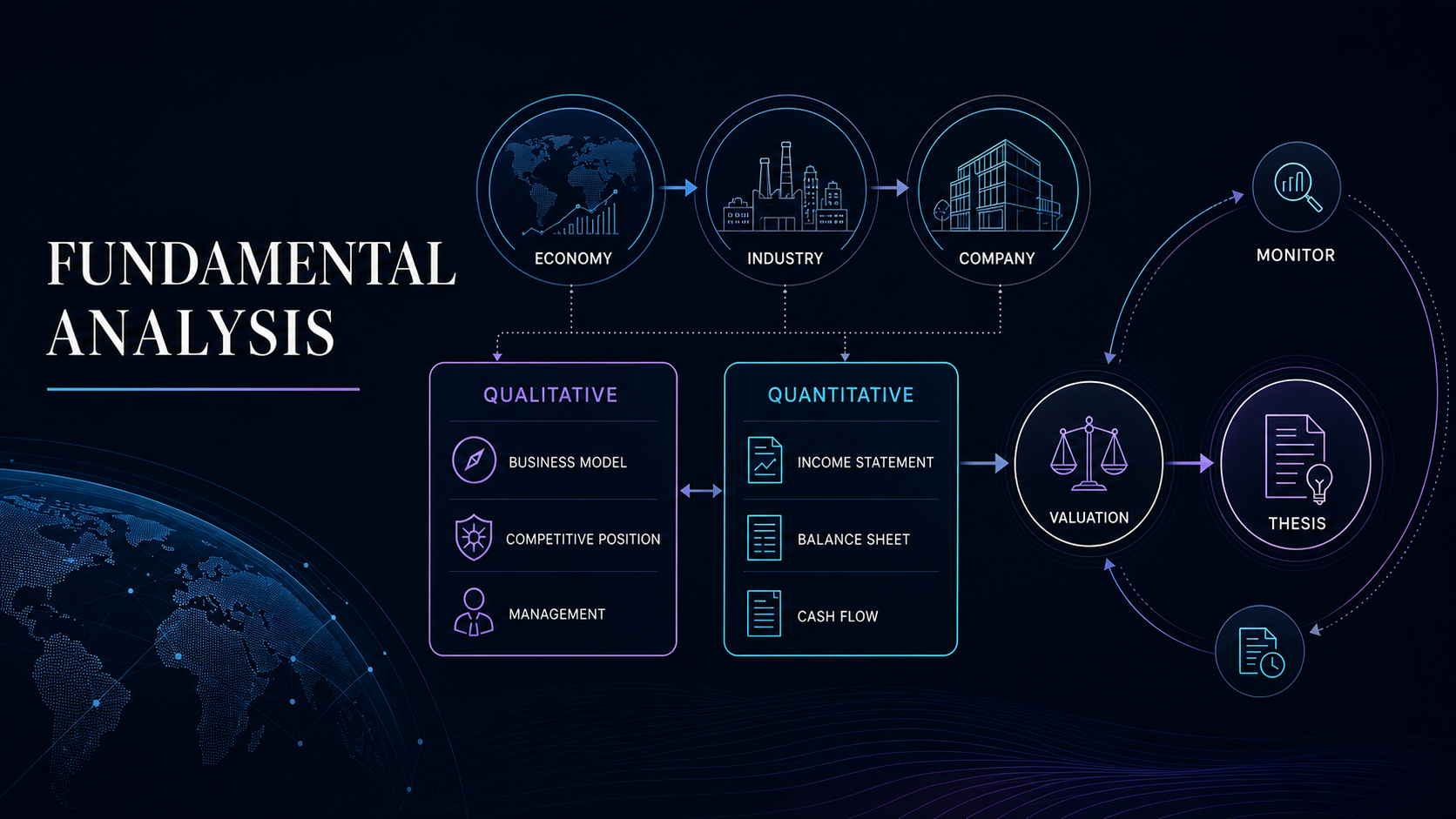
What fundamental analysis actually does基本面分析究竟在做什么
Fundamental analysis is the structured assessment of an asset or business using economic, industry, company, financial, and valuation evidence. Its goal is not to produce a single “correct” number; it is to explain what must be true for the current price and an analyst’s thesis to make sense.
基本面分析是利用宏观、行业、公司、财务与估值证据,对资产或企业进行结构化评估。它不是为了算出一个绝对“正确”的数字,而是解释:当前价格与研究论点成立,需要哪些条件同时为真。
A sound analysis separates observation from interpretation. Revenue, debt, and operating cash flow are reported or calculated evidence; market share durability, reinvestment opportunity, and management credibility are judgments that require context. Price is then compared with a range of plausible values—not confused with business quality itself.
可靠的分析会把事实与解释分开。收入、债务、经营现金流属于已披露或可计算的证据;市场份额能否维持、再投资机会有多大、管理层是否可信,则是需要语境支撑的判断。最后再把价格与一组合理价值区间比较,而不是把“好公司”直接等同于“好价格”。
Top-down and bottom-up fundamental analysis自上而下与自下而上的基本面分析
A top-down process starts with inflation, rates, credit, currencies, regulation, and demand, then narrows to industry economics and individual companies. A bottom-up process starts with a company’s unit economics, statements, competitive position, and valuation, then tests how macro and industry forces could change the result. Neither route excuses missing evidence; they simply change the order of inquiry.
自上而下从通胀、利率、信用、汇率、监管与需求出发,再缩小到行业经济性和具体公司;自下而上从单个公司的单位经济性、报表、竞争位置和估值出发,再检验宏观与行业变化会如何影响结论。两者只是改变提问顺序,并不能替代证据。
Economy and industry宏观与行业
Demand drivers, cycles, regulation, capital intensity, pricing structure, and competitive forces.
需求驱动、周期、监管、资本强度、定价结构与竞争力量。
Company economics公司经济性
Customers, revenue model, cost structure, reinvestment, balance-sheet resilience, and governance.
客户、收入模式、成本结构、再投资、资产负债表韧性与治理。
Value and thesis价值与论点
Scenarios, assumptions, valuation range, risks, catalysts, and observable invalidation signals.
情景、假设、价值区间、风险、催化因素和可观察的失效信号。
Combine qualitative and quantitative analysis把定性分析与定量分析结合起来
Numbers show what has happened; the business model helps explain why and whether it can persist. A strong process forces both layers to agree—or makes the disagreement explicit.
数字说明已经发生了什么,商业模式则帮助解释为什么发生、能否持续。高质量流程要求两层证据相互印证;如果冲突,也要明确记录冲突在哪里。
Qualitative evidence定性证据
- Customer problem, switching costs, and concentration
- Competitive advantages and credible substitutes
- Management incentives, capital allocation, and governance
- Regulatory dependencies, supply constraints, and key-person risk
- 客户问题、转换成本与集中度
- 竞争优势与可信替代方案
- 管理层激励、资本配置与公司治理
- 监管依赖、供应约束与关键人物风险
Quantitative evidence定量证据
- Revenue mix, growth, margins, and earnings quality
- Working capital, leverage, liquidity, and maturity profile
- Cash conversion, capital expenditure, and return on capital
- Share count, dilution, segment trends, and peer-relative metrics
- 收入结构、增长、利润率与盈利质量
- 营运资本、杠杆、流动性与到期结构
- 现金转化、资本开支与资本回报
- 股本变化、稀释、分部趋势与同行指标
Read the statements as one connected system把三张报表当作一个相互连接的系统
The income statement, balance sheet, and cash flow statement answer different questions. Read together, and with the footnotes and management discussion, they reveal whether reported growth converts into cash and whether financing or accounting choices are carrying the result. The SEC’s guide to financial statements explains the role of each statement and why footnotes matter.
利润表、资产负债表和现金流量表回答不同的问题。把它们连同附注及管理层讨论一起阅读,才能判断账面增长是否转化为现金,以及融资或会计选择是否在支撑结果。美国证券交易委员会的财务报表指南说明了各张报表的作用及附注的重要性。
Income statement利润表
Tracks revenue, costs, operating profit, interest, tax, and net income over a period.
Test pricing versus volume, gross-to-operating margin movement, one-offs, and segment mix.
追踪一段时期内的收入、成本、营业利润、利息、税项与净利润。
检验价格与销量、毛利率到营业利润率的变化、一次性项目及分部结构。
Balance sheet资产负债表
Shows assets, liabilities, and equity at a point in time.
Inspect liquidity, debt maturities, working capital, goodwill, leases, and off-balance-sheet commitments.
展示某一时点的资产、负债与所有者权益。
检查流动性、债务到期、营运资本、商誉、租赁和表外承诺。
Cash flow statement现金流量表
Reconciles profit with cash from operations, investing, and financing.
Compare earnings with operating cash, distinguish maintenance from growth capex, and track funding dependence.
把利润与经营、投资和融资活动产生的现金连接起来。
比较盈利与经营现金,区分维持性和增长性资本开支,并追踪融资依赖。
Use fundamental analysis ratios as questions把基本面分析比率当作问题而不是答案
A ratio is most useful when compared across time, peer groups, and accounting definitions. A rising margin can reflect pricing power, favorable mix, deferred spending, or a temporary cost reversal. A low P/E can signal undervaluation—or declining earnings. Normalize unusual items and confirm that numerator, denominator, currency, period, and share basis are consistent.
比率只有放到时间趋势、同行组和会计口径中才有意义。利润率上升可能来自定价能力、产品结构,也可能来自延后投入或暂时性成本回转;低市盈率可能意味着低估,也可能意味着盈利正在下滑。应先规范一次性项目,并确认分子、分母、币种、期间与股本口径一致。
For deeper ratio-specific pages, see QVeris guides to financial ratio analysis, return on equity, and the price-to-earnings ratio.
Turn company analysis into a valuation range把公司分析转化为估值区间
Valuation translates a research story into explicit assumptions. Discounted cash flow focuses on future cash, growth, reinvestment, terminal economics, and discount rates. Multiples compare the company with peers or its own history, but only after adjusting for growth, margins, capital intensity, leverage, and accounting differences. Asset-based approaches may be more relevant when assets, liquidation value, or replacement cost dominate.
估值把研究故事转化为明确假设。现金流折现关注未来现金、增长、再投资、终值经济性与折现率;相对估值把公司与同行或自身历史比较,但必须先校正增长、利润率、资本强度、杠杆与会计差异;当资产、清算价值或重置成本更重要时,资产法可能更合适。
Normalize规范口径
Remove one-offs and align periods, currency, segments, and share count.
剔除一次性项目,统一期间、币种、分部与股本。
Model drivers建模驱动项
Tie revenue, margins, working capital, and reinvestment to operating evidence.
让收入、利润率、营运资本与再投资假设对应经营证据。
Build scenarios建立情景
Use downside, base, and upside cases without hiding uncertainty in one point estimate.
使用下行、基准和上行情景,不用单一数字掩盖不确定性。
Stress the thesis压力测试
Identify assumptions that move value most and define evidence that would change them.
识别对价值影响最大的假设,并定义哪些证据会改变它们。
How to do fundamental analysis step by step如何逐步完成公司基本面分析
| # | Action动作 | Deliverable产出 | Failure check失败检查 |
|---|---|---|---|
| 01 | Define the question定义问题 | Asset, horizon, benchmark, and decision资产、期限、基准与决策 | A broad screen is not a finished thesis宽泛筛选不等于完整论点 |
| 02 | Map the business描绘业务 | Revenue engine, customers, costs, capital needs收入引擎、客户、成本与资本需求 | Do disclosures match economic reality?披露是否符合真实经济性? |
| 03 | Collect primary evidence收集一手证据 | Filings, footnotes, calls, industry and macro data公告、附注、电话会、行业与宏观数据 | Separate company claims from verified facts区分公司表述与已验证事实 |
| 04 | Normalize and compare规范并比较 | Trend and peer dataset with documented definitions有口径记录的趋势与同行数据集 | Check restatements, currencies, periods, and survivorship检查重述、币种、期间与幸存者偏差 |
| 05 | Value and write the thesis估值并写论点 | Scenario range, risks, catalysts, and invalidation rules情景区间、风险、催化与失效规则 | State what evidence would prove you wrong明确什么证据会证明原判断错误 |
| 06 | Monitor change持续监控 | Event calendar, KPI deltas, and revision log事件日历、KPI变化与修订记录 | Do not move the goalposts after new information新信息出现后不要随意移动判断标准 |
Where QVeris fits in fundamental analysisQVeris如何支持基本面分析
Evidence access证据获取
QVeris can help an AI workflow discover and call authorized tools, while Financial Modeling Prep (FMP) can provide financial statements, company profiles, market reference data, and related endpoints where the user’s plan and license permit. Review the FMP developer documentation for current endpoint definitions and availability.
QVeris可帮助AI工作流发现并调用已授权工具;在用户套餐与许可允许的范围内,Financial Modeling Prep(FMP)可提供财务报表、公司资料、市场参考数据及相关端点。当前端点定义与可用性应以FMP开发者文档为准。
What remains human judgment仍需人工判断的部分
Tool access does not verify every source, normalize every accounting difference, choose a valuation model, or turn outputs into investment advice. Analysts remain responsible for data rights, source lineage, adjusted definitions, assumptions, uncertainty, and decision governance.
工具访问不会自动验证所有来源、规范所有会计差异、替用户选择估值模型,也不会把输出变成投资建议。分析者仍需对数据权利、来源链路、调整口径、假设、不确定性与决策治理负责。
For an execution-oriented company checklist, use the narrower stock fundamental analysis guide. For methodology choice, see fundamental analysis vs technical analysis.
如需面向单只股票的执行检查清单,请阅读更聚焦的股票基本面分析指南;如需比较研究方法,请阅读基本面分析与技术分析。
Fundamental analysis FAQ基本面分析常见问题
What is fundamental analysis in simple terms?简单来说,什么是基本面分析?
It is a method for understanding a business or asset through economic context, company quality, financial statements, risks, and valuation rather than relying on price movement alone.
它通过宏观环境、企业质量、财务报表、风险与估值理解一家企业或资产,而不是只依赖价格走势。
What are the main steps in fundamental analysis?基本面分析的主要步骤是什么?
Define the decision, map the business, collect primary evidence, normalize the statements, compare trends and peers, value scenarios, write the thesis, and monitor invalidation signals.
定义决策、理解业务、收集一手证据、规范报表、比较趋势与同行、建立估值情景、写出论点并监控失效信号。
Which financial statements matter most?哪张财务报表最重要?
No single statement is enough. The income statement explains performance, the balance sheet shows financial position, and the cash flow statement tests cash conversion; footnotes and management discussion provide essential context.
没有任何一张报表足够完整。利润表解释经营表现,资产负债表展示财务位置,现金流量表检验现金转化;附注和管理层讨论提供关键语境。
Is fundamental analysis the same as valuation?基本面分析和估值是一回事吗?
No. Valuation is one output of fundamental analysis. The broader process also studies business quality, industry structure, accounting, financial resilience, management, and risks.
不是。估值只是基本面分析的一项产出;完整流程还研究企业质量、行业结构、会计口径、财务韧性、管理层与风险。
Which ratios are best for fundamental analysis?基本面分析应重点看哪些比率?
The useful set depends on the business. Growth, profitability, liquidity, leverage, efficiency, and valuation ratios should be selected to match the company’s economics and compared using consistent definitions.
应根据企业经济性选择。增长、盈利、流动性、杠杆、效率与估值比率都可能有用,但必须保持口径一致并结合行业特点。
What are the limitations of fundamental analysis?基本面分析有哪些局限?
Disclosures are backward-looking and incomplete, accounting judgments vary, estimates are sensitive to assumptions, and markets may disagree for long periods. Scenario analysis and explicit invalidation rules help expose rather than remove uncertainty.
披露往往滞后且不完整,会计判断存在差异,估值对假设敏感,市场也可能长期与判断不一致。情景分析和明确的失效规则只能暴露不确定性,不能消除它。