
LiteLLM vs Portkey
Control or Platform?LiteLLM 与 Portkey
控制力还是平台能力?
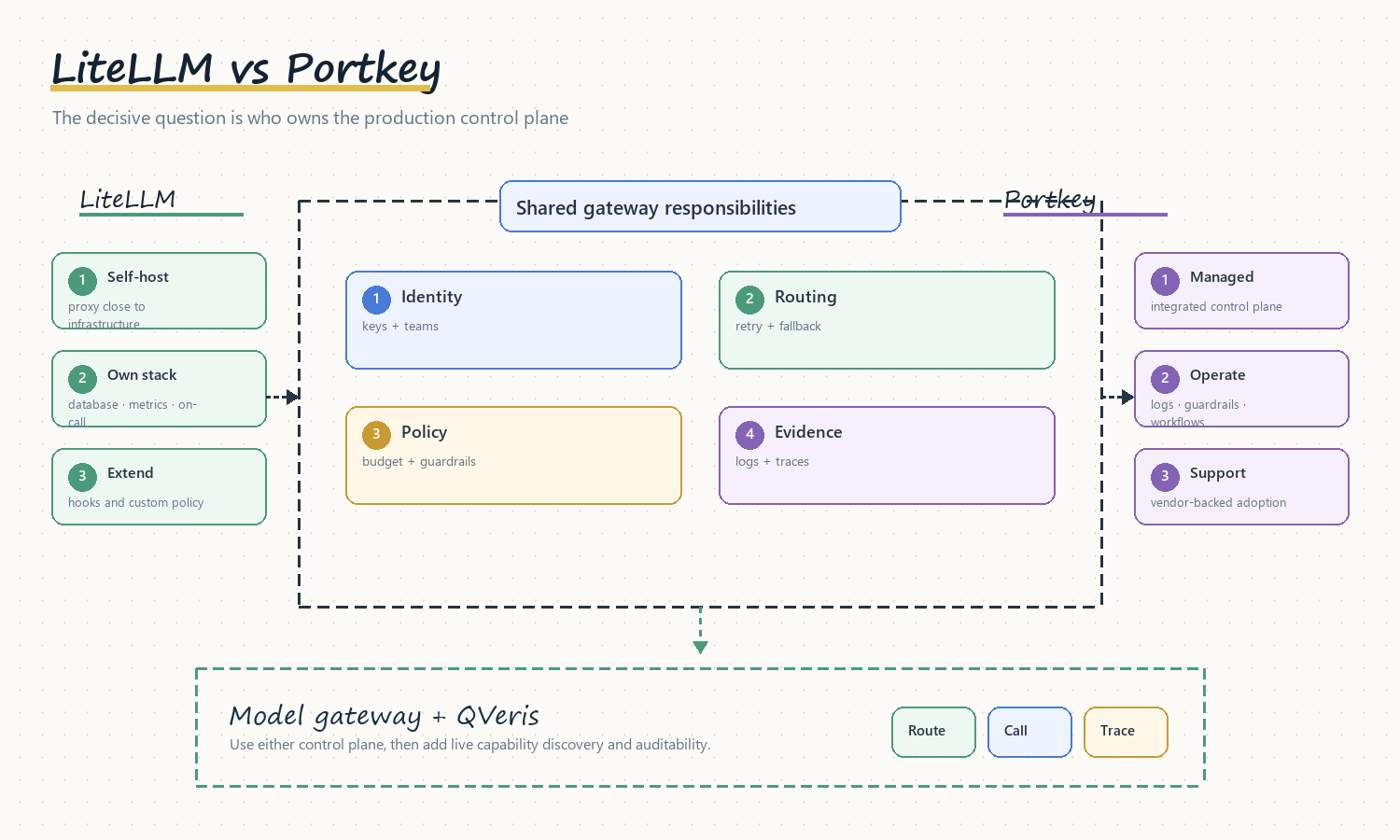
LiteLLM favors infrastructure ownership and an open proxy. Portkey favors an integrated managed platform with gateway, observability, and guardrails.
LiteLLM 更偏向基础设施自主与开放代理;Portkey 更偏向集成式托管平台,把网关、可观测性和护栏放在一起。
TL;DR
Your platform team wants to self-host an OpenAI-compatible proxy, control upgrades, and configure routing close to infrastructure.
You want a more integrated gateway platform with managed observability, guardrails, routing configs, and production workflows.
This is less about model count and more about who operates the control plane, data stores, dashboards, policies, and incident response.
Use either gateway for model traffic, then add QVeris when agents need audited access to live financial data and external tools.
平台团队希望自托管 OpenAI 兼容代理、掌握升级节奏,并让路由配置贴近基础设施。
团队希望获得更集成的网关平台,包括托管可观测性、护栏、路由配置和生产工作流。
差异不主要在模型数量,而在谁负责控制平面、数据存储、仪表板、策略和故障响应。
两者都可治理模型流量;当 Agent 需要审计化访问实时金融数据和外部工具时,再增加 QVeris。
LiteLLM vs Portkey: the short answerLiteLLM 与 Portkey:先看结论
LiteLLM and Portkey overlap across universal model access, routing, fallbacks, budgets, and observability, but they begin from different operating assumptions. LiteLLM is commonly adopted as software your team runs or embeds. Portkey presents a broader platform experience around the gateway, including integrated guardrails and managed operational surfaces.
For a platform engineering team, LiteLLM can be attractive because the proxy and configuration stay close to infrastructure. For a product team trying to reach production without assembling every control plane component, Portkey can reduce integration work. Neither choice eliminates the need to define policy ownership, retention, rollback, and provider-specific testing.
The fastest decision is to ask who should own the gateway after launch. If the answer is your infrastructure team, LiteLLM moves ahead. If the answer is a vendor-backed platform with an integrated console and policy layer, Portkey moves ahead.
LiteLLM 与 Portkey 都覆盖通用模型接入、路由、回退、预算和可观测性,但两者的运行假设不同。LiteLLM 通常被作为团队自行运行或嵌入的软件采用;Portkey 则围绕网关提供更完整的平台体验,包括集成护栏和托管运维界面。
对平台工程团队而言,LiteLLM 的优势是代理与配置更贴近基础设施。对希望尽快进入生产、又不想拼装每个控制平面组件的产品团队而言,Portkey 能减少集成工作。无论选择哪一个,都仍需定义策略所有权、数据留存、回滚和供应商特有测试。
最快的判断问题是:上线后由谁负责网关?如果答案是自己的基础设施团队,LiteLLM 更靠前;如果希望由供应商支持的集成平台承担更多工作,Portkey 更靠前。
Feature-by-feature comparison for production teams生产团队逐项对比
| Dimension维度 | LiteLLMLiteLLM | PortkeyPortkey | Decision signal决策信号 |
|---|---|---|---|
| Operating model运行模式 | Self-hosted proxy or Python SDK自托管代理或 Python SDK | Managed platform plus open gateway options托管平台与开放网关选项 | Who owns operations?谁负责运维? |
| Provider interface供应商接口 | OpenAI-compatible access across many providers跨多供应商的 OpenAI 兼容访问 | Universal API and gateway configs通用 API 与网关配置 | Test parameter parity测试参数兼容性 |
| Routing路由 | Retries, fallback, load balancing, budgets重试、回退、负载均衡、预算 | Fallback, conditional routing, retries, circuit breaking回退、条件路由、重试、熔断 | Expressiveness vs simplicity表达能力与简洁性 |
| Guardrails护栏 | Integrations and hooks集成与钩子 | Integrated request and response guardrails集成请求与响应护栏 | Policy depth required所需策略深度 |
| Observability可观测性 | Logging hooks and spend tracking日志钩子与成本跟踪 | Integrated logs, traces, analytics, and workflows集成日志、追踪、分析与工作流 | Build vs managed console自建还是托管控制台 |
| Infrastructure burden基础设施负担 | Higher but more controllable更高但更可控 | Lower for managed adoption托管采用时更低 | Platform team capacity平台团队能力 |
Total cost of ownership is more than license price总体拥有成本不只是软件价格
Include deployment, database operations, upgrades, dashboards, access control, backups, and incident response. Open source can reduce license cost while increasing platform work.
Track how long it takes to add a provider, change a fallback, create a team budget, redact logs, or roll back a bad config.
Model 429s, timeouts, provider outages, malformed tool responses, and streaming interruptions. The cheaper platform can be the one that recovers faster.
Document model aliases, config formats, virtual keys, and log export paths so a later migration does not become a rewrite.
把部署、数据库运维、升级、仪表板、访问控制、备份和故障响应都算进去。开源可能降低许可成本,但会增加平台工作。
记录增加供应商、修改回退、创建团队预算、日志脱敏或回滚错误配置所需时间。
模拟 429、超时、供应商故障、错误工具响应和流式中断。恢复更快的平台,实际可能更便宜。
记录模型别名、配置格式、虚拟 Key 和日志导出路径,避免下次迁移变成重写。
A practical proof-of-concept scorecard可执行的 PoC 评分方法
Run the same chat, streaming, structured-output, embedding, image, and tool-use test suite through both gateways.
Inject provider errors, latency, rate limits, and malformed responses. Verify fallback order, retry boundaries, and idempotency.
Create per-team keys, budgets, redaction rules, retention controls, and access roles. Ask operators to complete common tasks without developer help.
Compare infrastructure, platform fees, engineering time, incident handling, and expected migration cost using your own traffic distribution.
通过两个网关运行相同的聊天、流式、结构化输出、嵌入、图像和工具调用测试集。
注入供应商错误、延迟、限流和异常响应,验证回退顺序、重试边界与幂等性。
建立团队 Key、预算、脱敏规则、留存控制和访问角色,并让运维人员独立完成常见任务。
使用自己的流量分布,对比基础设施、平台费用、工程时间、故障处理和预期迁移成本。
What comparison tables usually miss普通对比表经常漏掉什么
A long provider list is meaningless if the parameters, modalities, regions, and fallbacks your application needs are not supported consistently.
The daily users of a gateway include security, finance, support, and platform teams, not only developers sending requests.
Inspect where prompts, responses, logs, and metadata travel and how long each copy is retained.
Use the gateway for model calls. Use a capability layer for real-world tools and data where discovery, provenance, and action audits matter.
如果应用所需的参数、模态、地区和回退无法一致支持,再长的供应商列表也没有意义。
网关的日常使用者不仅是发送请求的开发者,还包括安全、财务、支持和平台团队。
检查提示词、响应、日志和元数据经过哪里,以及每份副本保留多久。
模型调用交给网关;需要发现、来源与动作审计的真实工具和数据,则交给能力层。
Which teams should choose LiteLLM or Portkey?不同团队应该选择 LiteLLM 还是 Portkey?
LiteLLM usually fits when a central platform team already operates proxies, databases, secrets, metrics, and deployment pipelines. That team can turn direct infrastructure control into an advantage instead of treating every upgrade, migration, and incident as unexpected product work.
Portkey usually fits when product developers need a production control plane quickly and prefer integrated logs, routing configs, guardrails, and operational workflows. The value comes from reducing assembly and coordination work, not merely from replacing an HTTP endpoint.
Either option requires a data-path review. LiteLLM can support tighter deployment control, but the customer then owns hardening and operations. Portkey can reduce operational burden, but the team must verify hosting, retention, redaction, regional processing, subprocessors, and contract terms.
A managed workflow often wins when the alternative is one product engineer informally owning a critical proxy. If the team still prefers LiteLLM, keep the first deployment deliberately small, use managed backing services, automate backups, and define on-call ownership before production traffic.
当中央平台团队已经负责代理、数据库、密钥、指标和部署流水线时,LiteLLM 通常更合适。这样的团队能把基础设施控制权转化为优势,而不是把每次升级、迁移和故障都当成意外产品工作。
当产品开发者希望快速获得生产控制平面,并偏好集成日志、路由配置、护栏和运维工作流时,Portkey 通常更合适。价值来自减少拼装与协作工作,而不只是替换一个 HTTP 端点。
两种选择都需要审查数据路径。LiteLLM 可以提供更严格的部署控制,但客户要承担加固与运维;Portkey 可降低运维负担,但必须核对托管、留存、脱敏、区域处理、子处理方和合同条款。
如果替代方案是让一名产品工程师非正式维护关键代理,托管工作流通常更稳妥。若仍选择 LiteLLM,应保持首个部署足够小,使用托管配套服务,自动化备份,并在生产流量前明确值班责任。
Production-readiness tests beyond the happy path超越成功请求的生产就绪测试
Verify chat, responses, streaming, embeddings, images, audio, batches, tool calls, JSON schema, cancellation, and usage metadata for the exact providers you need. A universal API claim is not evidence that every modality behaves identically.
Create repeatable 429, timeout, 5xx, broken-stream, invalid-schema, and exhausted-budget scenarios. Confirm retry limits, fallback order, circuit state, error normalization, idempotency, alerts, and what the end user sees after every route fails.
Ask security to revoke a key, finance to explain a cost spike, support to trace one user request, and platform engineering to roll back a route. Measure whether each task can be completed quickly with the available evidence.
Upgrade the gateway in staging, restore its backing data from backup, rotate provider credentials, rebuild dashboards, and rehearse a regional or database outage. The product is production-ready only when recovery is documented and repeatable.
针对实际需要的供应商验证聊天、responses、流式、嵌入、图像、音频、批处理、工具调用、JSON schema、取消和用量元数据。通用 API 的宣传不代表每种模态行为完全一致。
可重复制造 429、超时、5xx、流式中断、schema 无效和预算耗尽场景。确认重试限制、回退顺序、熔断状态、错误归一化、幂等、告警,以及所有路由失败后的用户体验。
让安全团队撤销 Key、财务解释成本飙升、支持团队追踪用户请求、平台工程回滚路由,并衡量每项任务能否基于现有证据快速完成。
在预发布环境升级网关,从备份恢复配套数据,轮换供应商凭证,重建仪表板,并演练区域或数据库故障。只有恢复过程有文档且可重复,产品才算生产就绪。
Prove the operating model, not just the feature set验证运维模式,而不只是功能集合
Name who patches the proxy, rotates secrets, maintains data stores, handles incidents, approves policy, and answers cost questions. The comparison changes when those responsibilities have real teams and response times.
Give security, finance, support, and platform teams realistic tasks in both products. Time key revocation, request tracing, budget investigation, route rollback, and audit export without developer assistance.
Include hosting, databases, telemetry, backups, upgrades, on-call coverage, enterprise support, and compliance work. License price alone does not describe the cost of a self-operated or managed control plane.
Record the assumptions that selected LiteLLM or Portkey, then review traffic, incidents, policy velocity, team capacity, and total cost after six months. Architecture should be revisited when ownership assumptions change.
明确谁负责代理补丁、密钥轮换、数据存储、故障处理、策略审批和成本解释。当这些责任对应真实团队与响应时间时,对比结果会明显不同。
让安全、财务、支持和平台团队在两个产品中完成真实任务,计时撤销 Key、追踪请求、调查预算、回滚路由和导出审计,且不依赖开发者协助。
把托管、数据库、遥测、备份、升级、值班、企业支持和合规工作纳入成本。许可证价格本身不能说明自运维或托管控制平面的真实代价。
记录选择 LiteLLM 或 Portkey 时的假设,并在六个月后复盘流量、故障、策略变更速度、团队能力和总成本。责任假设变化时,架构也应重新评估。
Where QVeris fits: capability routing after model routingQVeris 的位置:模型路由之后的能力路由
A model gateway and QVeris solve adjacent problems. The gateway governs inference traffic: provider credentials, model selection, retries, budgets, rate limits, and logs. QVeris governs the next step when an agent needs a real capability: discovering a suitable tool or dataset, inspecting its contract, calling it, and keeping an auditable record.
For a financial research agent, the gateway might route a planning prompt to the right model. QVeris can then expose the market data, filings, fundamentals, news, or external tools required to complete the plan. This separation keeps model policy and capability policy understandable instead of forcing one gateway to pretend it owns every external action.
The recommended architecture is model gateway plus QVeris, not model gateway versus QVeris. Keep each layer responsible for the traffic it can govern well, then connect them with explicit identity, budget, trace, and audit metadata.
模型网关与 QVeris 解决相邻但不同的问题。网关治理推理流量,包括供应商凭证、模型选择、重试、预算、限流和日志。QVeris 则治理 Agent 需要真实能力后的下一步:发现合适工具或数据集、检查契约、执行调用并保留可审计记录。
以金融研究 Agent 为例,网关可以把规划提示词路由到合适模型;QVeris 再提供完成计划所需的市场数据、财报、基本面、新闻或外部工具。这样可以让模型策略和能力策略保持清晰,而不是让一个网关假装管理所有外部动作。
推荐架构是“模型网关 + QVeris”,而不是“模型网关 vs QVeris”。每一层只负责自己擅长治理的流量,再通过明确的身份、预算、追踪和审计元数据连接起来。
- Send inference requests through the selected gateway or aggregator.
- Attach project, customer, environment, and trace identity to every route.
- Use QVeris discovery and inspection before an agent calls a live capability.
- Measure model cost and capability cost separately, then report the complete task cost.
- 把推理请求发送到选定的网关或聚合器。
- 为每条路由附加项目、客户、环境和追踪身份。
- Agent 调用实时能力前,先使用 QVeris 发现与检查。
- 分别计量模型成本和能力成本,再报告完整任务成本。
FAQ
LiteLLM is often better for infrastructure ownership and self-hosting. Portkey is often better when an integrated managed platform and guardrails reduce operational work.
LiteLLM is widely used as a self-hosted proxy. Portkey documents an open-source gateway and self-hosting options; verify the management features included in your intended deployment.
Both support production routing patterns. The useful comparison is whether your specific fallback, conditional rule, circuit breaker, budget, and provider parameter can be expressed and tested.
A managed Portkey deployment generally shifts more operational work to the platform. LiteLLM gives more direct control but requires your team to operate the surrounding stack.
No. QVeris complements either architecture by giving agents discoverable and auditable access to live data and external capabilities.
Use a four-week proof of concept covering compatibility, failure injection, governance workflows, and total cost with representative production traffic.
LiteLLM 通常更适合基础设施自主与自托管;Portkey 通常更适合集成托管平台和护栏能减少运维工作的团队。
LiteLLM 广泛用于自托管代理。Portkey 也提供开放网关与自托管选项,但应核对目标部署中包含哪些管理功能。
两者都支持生产路由模式。真正应比较的是你的回退、条件规则、熔断、预算和供应商参数能否表达并测试。
托管 Portkey 通常把更多运维工作交给平台;LiteLLM 提供更直接控制,但团队需要运维周边技术栈。
不会。QVeris 通过为 Agent 提供可发现、可审计的实时数据和外部能力访问,补充两种架构。
建议进行四周 PoC,覆盖兼容性、故障注入、治理工作流,以及基于代表性生产流量的总体成本。
Sources, methodology, and update policy来源、方法与更新政策
This guide uses public product documentation and a workload-based decision framework. Product limits, pricing, supported models, and plan boundaries change frequently; verify current terms directly with each provider before procurement or production migration.
QVeris is the publisher of this guide and is described only in its intended complementary role. The comparisons distinguish model-inference routing from agent capability routing so the commercial relationship is visible rather than hidden inside a generic ranking.
本指南使用公开产品文档和基于工作负载的决策框架。产品限制、价格、支持模型和套餐边界会频繁变化;采购或生产迁移前,请直接向各供应商核对最新条款。
QVeris 是本指南的发布方,文中仅按其互补能力层定位进行说明。对比明确区分模型推理路由与 Agent 能力路由,使商业关系保持透明,而不是隐藏在泛化排名中。