
Best LLM API Aggregators
Compared for Production最佳LLM API 聚合器
生产级完整对比
Model marketplaces, self-hosted gateways, and observability platforms all aggregate access differently. Compare the operating model before comparing model counts.
模型市场、自托管网关和可观测平台都能聚合访问,但运行模式不同。比较模型数量前,先比较控制权和责任边界。
TL;DR
OpenRouter offers the clearest managed aggregator experience when the priority is broad model and provider access through one API.
LiteLLM is a strong choice when teams want broad provider normalization while owning the proxy and infrastructure.
Portkey combines universal access with routing, guardrails, observability, and operational controls.
QVeris aggregates agent capabilities and data, not model inference. It complements the model aggregator after the LLM needs to act.
当重点是通过一个 API 获得广泛模型与供应商访问时,OpenRouter 提供最清晰的托管聚合体验。
团队希望统一大量供应商,同时掌握代理和基础设施时,LiteLLM 是强选择。
Portkey 把通用接入与路由、护栏、可观测性和运维控制组合在一起。
QVeris 聚合的是 Agent 能力与数据,不是模型推理;它在 LLM 需要行动时补充模型聚合器。
What counts as an LLM API aggregator?什么才算 LLM API 聚合器?
An LLM API aggregator gives developers one integration path to multiple models or providers. The category includes managed model marketplaces, open-source proxies, enterprise AI gateways, observability platforms with routing, and cloud edge gateways. They may share an OpenAI-compatible endpoint while differing radically in billing, data path, control, and operational responsibility.
A marketplace aggregator resells or brokers model inference and usually centralizes billing. A gateway aggregator lets teams bring provider keys and focuses on policy, routing, and observability. A self-hosted proxy normalizes providers while the customer owns deployment. These products can appear interchangeable in a code sample but behave differently during outages, audits, cost reviews, and migrations.
Choose the category first. Then evaluate model coverage, parameter fidelity, privacy, routing, fallback, cost transparency, quotas, governance, log portability, and support. A raw model count is one of the least useful decision metrics.
LLM API 聚合器为开发者提供一条接入多个模型或供应商的路径。这个类别包括托管模型市场、开源代理、企业 AI 网关、带路由的可观测平台,以及云边缘网关。它们可能都提供 OpenAI 兼容端点,但在计费、数据路径、控制权和运维责任上差异很大。
市场型聚合器通常转售或代理模型推理并集中计费;网关型聚合器允许团队自带供应商 Key,重点是策略、路由和可观测性;自托管代理则由客户掌握部署。代码示例里它们可能相似,但在故障、审计、成本复盘和迁移中会表现出不同特性。
应先选择类别,再评估模型覆盖、参数保真、隐私、路由、回退、成本透明度、配额、治理、日志可移植性和支持。单纯模型数量是最不重要的指标之一。
Best LLM API aggregators by operating model按运行模式对比最佳 LLM API 聚合器
| Option产品 | Category类别 | Strength优势 | Watch closely重点核查 |
|---|---|---|---|
| OpenRouterOpenRouter | Managed marketplace托管模型市场 | Broad catalog and provider routing广泛目录与供应商路由 | Billing, data policy, provider selection计费、数据策略、供应商选择 |
| LiteLLMLiteLLM | Open-source proxy开源代理 | Provider normalization and control供应商归一化与控制 | Operations, upgrades, backing services运维、升级、配套服务 |
| PortkeyPortkey | Integrated AI gateway集成 AI 网关 | Routing, guardrails, observability路由、护栏、可观测性 | Platform scope and plan boundaries平台范围与套餐边界 |
| CloudflareCloudflare | Edge AI gateway边缘 AI 网关 | Edge integration, caching, analytics边缘集成、缓存、分析 | Ecosystem fit and limits生态匹配与限制 |
| HeliconeHelicone | Observability-led platform可观测性优先平台 | Tracing and developer visibility追踪与开发者可见性 | Routing needs and deployment model路由需求与部署模式 |
| QVerisQVeris | Capability aggregator能力聚合层 | Discoverable tools and financial data可发现工具与金融数据 | Complements inference aggregators作为推理聚合器的补充 |
A 12-point evaluation scorecard12 项选型评分表
Check the exact models, providers, regions, modalities, context limits, tools, JSON modes, and parameters used by your workloads.
Score retries, fallback, circuit breaking, load balancing, health signals, model aliases, and the ability to pin versions.
Model provider price, platform fee, credit fee, BYOK fee, caching, failed attempts, rate limits, and support cost separately.
Review virtual keys, budgets, roles, retention, redaction, exports, audit logs, regional routing, and an exit plan.
检查工作负载实际使用的模型、供应商、地区、模态、上下文限制、工具、JSON 模式和参数。
评估重试、回退、熔断、负载均衡、健康信号、模型别名和版本固定能力。
分别计算供应商价格、平台费、充值费、BYOK 费用、缓存、失败尝试、限流和支持成本。
审查虚拟 Key、预算、角色、留存、脱敏、导出、审计日志、区域路由与退出方案。
How to validate an aggregator with real traffic如何用真实流量验证聚合器
Include short chat, long context, structured extraction, tools, images, streaming, and safety-sensitive requests in the same proportions as production.
Capture resolved model, provider, region, latency, tokens, cost, cache status, fallback reason, and output-quality score for every request.
Throttle providers, inject 429 and 5xx errors, break streams, and remove preferred models to observe real fallback behavior.
Export logs and config, reroute one workload directly or through another gateway, and measure the work required.
按生产比例加入短聊天、长上下文、结构化抽取、工具、图像、流式和安全敏感请求。
为每个请求记录实际模型、供应商、地区、延迟、token、成本、缓存状态、回退原因与输出质量分。
限制供应商、注入 429 与 5xx、打断流式,并移除首选模型,观察真实回退行为。
导出日志和配置,把一个工作负载改为直连或经过另一网关,并衡量所需工作。
Aggregator risks to plan for before launch上线前必须规划的聚合器风险
Hundreds of models do not help if the five you need lack stable parameters, regions, throughput, or support.
Automatic fallback without route logs can hide provider changes, cost spikes, and quality regressions.
Separate projects, environments, customers, and teams so budgets, revocation, and incident analysis remain possible.
Inference aggregation and external capability aggregation require different catalogs, permissions, provenance, and audits.
如果真正需要的五个模型缺少稳定参数、地区、吞吐或支持,几百个模型也无济于事。
没有路由日志的自动回退会隐藏供应商变化、成本飙升和质量退化。
应分离项目、环境、客户和团队,确保预算、撤销和故障分析仍然可执行。
推理聚合与外部能力聚合需要不同的目录、权限、来源与审计。
Choose an aggregator by team and workload按团队与工作负载选择聚合器
A managed marketplace can minimize setup when the goal is comparing models quickly. Use separate development keys, strict budgets, non-sensitive test data, and a reproducible evaluation set so experimentation does not become an ungoverned production dependency.
A self-hosted proxy or enterprise gateway can give a platform team consistent identity, policy, routing, and usage attribution across products. The organization must fund ongoing ownership rather than treating the gateway as a one-time integration project.
Prioritize stable capacity, transparent provider routing, predictable fees, caching, route-level telemetry, version controls, and tested fallback. Benchmark with the real distribution of short, long, streaming, tool, image, and failed requests—not an average prompt.
Use the aggregator for model selection and inference. Add a capability layer such as QVeris when the agent must find and call market data, filings, fundamentals, news, or actions with explicit provenance and permissions.
当目标是快速比较模型时,托管模型市场可以减少配置工作。应使用独立开发 Key、严格预算、非敏感测试数据和可重复评测集,避免实验演变为无治理的生产依赖。
自托管代理或企业网关可让平台团队跨产品统一身份、策略、路由和用量归因。组织必须持续投入所有权,而不能把网关当成一次性集成项目。
应优先关注稳定容量、透明供应商路由、可预测费用、缓存、路由级遥测、版本控制和经过测试的回退。基准测试要使用真实的短、长、流式、工具、图像和失败请求分布,而不是平均提示词。
聚合器负责模型选择与推理;当 Agent 必须发现并调用市场数据、财报、基本面、新闻或动作,并要求明确来源与权限时,再增加 QVeris 这类能力层。
Pricing, billing, and commercial review价格、计费与商业条款审查
Model inference, platform subscription, credit purchase, BYOK volume, support, data retention, egress, evaluation, and enterprise minimums may be priced differently. Build a twelve-month model using your actual traffic and growth assumptions.
Ask whether retries, provider fallbacks, cancelled streams, safety rejections, cache misses, and partial outputs are billed. Confirm whether the aggregator's usage record can be reconciled with underlying provider invoices and application traces.
Published request limits rarely describe burst behavior, per-model capacity, account-wide quotas, provider-specific throttling, or enterprise reservations completely. Load-test representative concurrency and inspect both gateway and provider-side rate-limit signals.
Require configuration and log exports, clear credit and refund terms, provider and subprocessor disclosure, model retirement notice, termination assistance, and a documented path for migrating keys, aliases, budgets, and historical usage.
模型推理、平台订阅、充值、BYOK 流量、支持、数据留存、出口、评测和企业最低消费可能分别计价。应使用真实流量与增长假设建立十二个月成本模型。
询问重试、供应商回退、取消流式、安全拒绝、缓存未命中和部分输出是否计费,并确认聚合器用量能否与底层供应商账单和应用追踪对账。
公开请求限制很少完整描述突发行为、单模型容量、账户总配额、供应商特有限流或企业预留。应使用代表性并发做压测,并检查网关与供应商两侧限流信号。
应要求配置与日志导出、明确的余额与退款条款、供应商及子处理方披露、模型下线通知、终止协助,以及迁移 Key、别名、预算和历史用量的文档路径。
Aggregator due diligence before production traffic生产流量接入前的聚合器尽调
Require the actual provider, model version, region, route history, latency, usage, and price basis on every response. A successful request is not auditable if the application cannot explain who served it.
Compare aggregator usage with application traces and underlying provider records. Include retries, partial streams, cache reads, safety rejection, fallback, credit markup, and failed attempts in the reconciliation model.
Export aliases, routing rules, virtual keys, budgets, and logs, then rebuild a representative route elsewhere. Portability is demonstrated by a completed rehearsal, not an OpenAI-compatible endpoint claim.
Map prompt, response, metadata, and log copies across aggregator, provider, observability, and support systems. Verify retention, redaction, region, subprocessors, deletion, and incident-notification terms.
要求每次响应提供实际供应商、模型版本、区域、路由历史、延迟、用量和计价依据。若应用无法解释由谁提供服务,请求成功也不可审计。
把聚合器用量与应用追踪和底层供应商记录核对,并把重试、部分流、缓存读取、安全拒绝、回退、充值加价和失败尝试纳入对账模型。
导出别名、路由规则、虚拟 Key、预算和日志,并在其他位置重建代表性路由。可移植性需要通过完整演练证明,而不是依靠 OpenAI 兼容端点的宣传。
绘制提示词、响应、元数据和日志在聚合器、供应商、可观测系统与支持系统中的副本路径,并核对留存、脱敏、区域、子处理方、删除和故障通知条款。
Where QVeris fits: capability routing after model routingQVeris 的位置:模型路由之后的能力路由
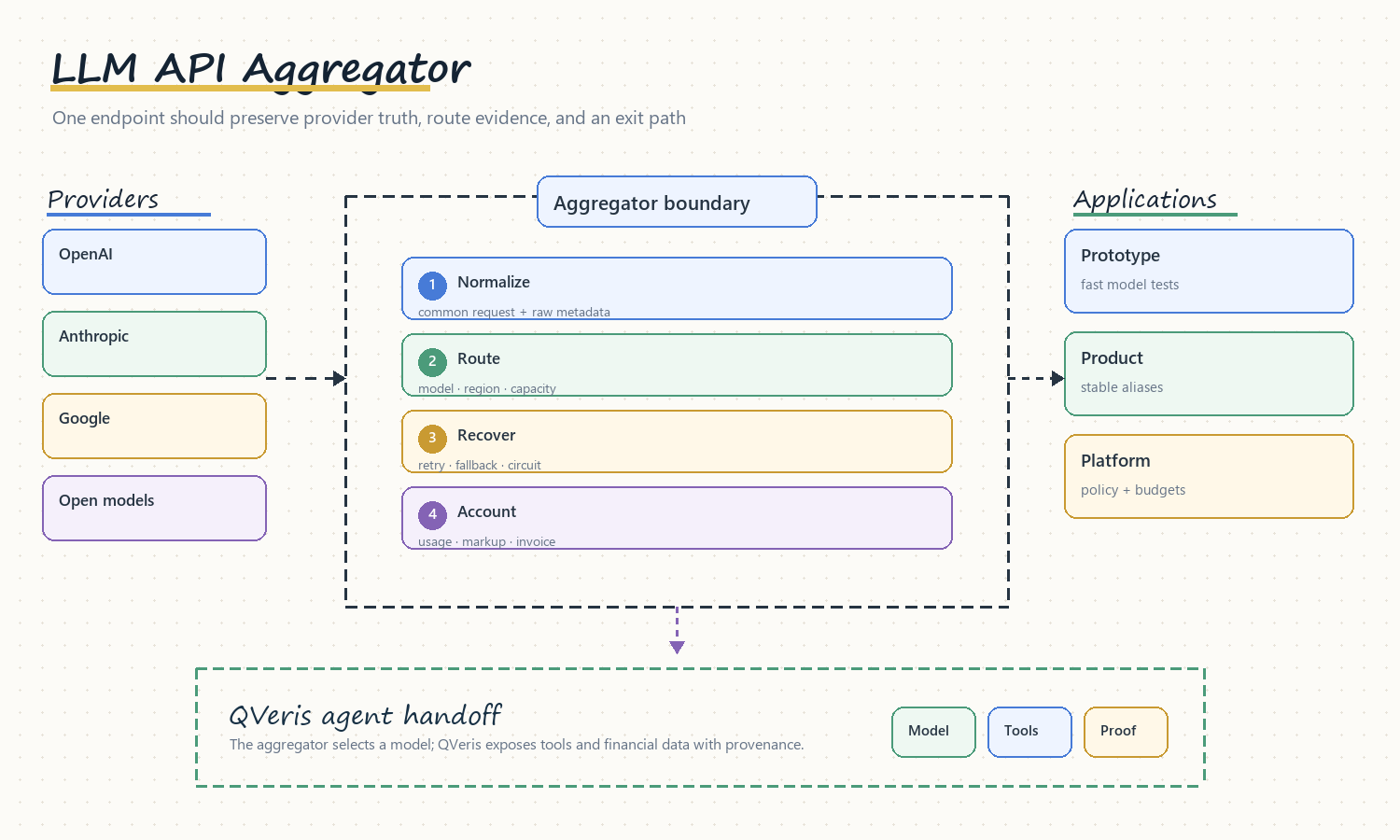
A model gateway and QVeris solve adjacent problems. The gateway governs inference traffic: provider credentials, model selection, retries, budgets, rate limits, and logs. QVeris governs the next step when an agent needs a real capability: discovering a suitable tool or dataset, inspecting its contract, calling it, and keeping an auditable record.
For a financial research agent, the gateway might route a planning prompt to the right model. QVeris can then expose the market data, filings, fundamentals, news, or external tools required to complete the plan. This separation keeps model policy and capability policy understandable instead of forcing one gateway to pretend it owns every external action.
The recommended architecture is model gateway plus QVeris, not model gateway versus QVeris. Keep each layer responsible for the traffic it can govern well, then connect them with explicit identity, budget, trace, and audit metadata.
模型网关与 QVeris 解决相邻但不同的问题。网关治理推理流量,包括供应商凭证、模型选择、重试、预算、限流和日志。QVeris 则治理 Agent 需要真实能力后的下一步:发现合适工具或数据集、检查契约、执行调用并保留可审计记录。
以金融研究 Agent 为例,网关可以把规划提示词路由到合适模型;QVeris 再提供完成计划所需的市场数据、财报、基本面、新闻或外部工具。这样可以让模型策略和能力策略保持清晰,而不是让一个网关假装管理所有外部动作。
推荐架构是“模型网关 + QVeris”,而不是“模型网关 vs QVeris”。每一层只负责自己擅长治理的流量,再通过明确的身份、预算、追踪和审计元数据连接起来。
- Send inference requests through the selected gateway or aggregator.
- Attach project, customer, environment, and trace identity to every route.
- Use QVeris discovery and inspection before an agent calls a live capability.
- Measure model cost and capability cost separately, then report the complete task cost.
- 把推理请求发送到选定的网关或聚合器。
- 为每条路由附加项目、客户、环境和追踪身份。
- Agent 调用实时能力前,先使用 QVeris 发现与检查。
- 分别计量模型成本和能力成本,再报告完整任务成本。
FAQ
OpenRouter is strong for a managed model marketplace, LiteLLM for self-hosted provider normalization, and Portkey for an integrated gateway platform.
They overlap. An aggregator emphasizes access to multiple models; a gateway emphasizes traffic policy, security, routing, budgets, and observability.
BYOK can preserve provider accounts and negotiated terms, but platform fees, routing behavior, quota handling, and support differ. Verify the complete policy.
Models vary: inference markup, credit-purchase fees, platform subscriptions, usage fees, enterprise contracts, or fees on BYOK volume.
Yes, if it monitors provider health and performs tested fallback. Poorly configured fallback can instead create inconsistent output or unexpected cost.
QVeris aggregates callable capabilities such as data and tools for agents. It is designed to complement, not replace, the model inference aggregator.
托管模型市场可优先看 OpenRouter,自托管供应商归一化可看 LiteLLM,集成网关平台可看 Portkey。
两者有重叠。聚合器强调多模型接入;网关强调流量策略、安全、路由、预算和可观测性。
BYOK 可以保留供应商账户与议价条款,但平台费、路由行为、配额处理和支持会不同,应核对完整政策。
常见模式包括推理加价、充值费、平台订阅、用量费、企业合同或 BYOK 流量费用。
可以,前提是监控供应商健康并执行经过测试的回退。配置不当则可能导致输出不一致或意外成本。
QVeris 聚合的是 Agent 可调用的数据和工具能力,定位是补充而不是替代模型推理聚合器。
Sources, methodology, and update policy来源、方法与更新政策
This guide uses public product documentation and a workload-based decision framework. Product limits, pricing, supported models, and plan boundaries change frequently; verify current terms directly with each provider before procurement or production migration.
QVeris is the publisher of this guide and is described only in its intended complementary role. The comparisons distinguish model-inference routing from agent capability routing so the commercial relationship is visible rather than hidden inside a generic ranking.
本指南使用公开产品文档和基于工作负载的决策框架。产品限制、价格、支持模型和套餐边界会频繁变化;采购或生产迁移前,请直接向各供应商核对最新条款。
QVeris 是本指南的发布方,文中仅按其互补能力层定位进行说明。对比明确区分模型推理路由与 Agent 能力路由,使商业关系保持透明,而不是隐藏在泛化排名中。