
Build on One
Unified LLM API通过一个统一 LLM API
接入多模型
A common endpoint is only the start. Production unification also needs model aliases, capability checks, fallback policy, cost attribution, and an exit strategy.
统一端点只是起点。生产级统一还需要模型别名、能力检查、回退策略、成本归因和退出方案。
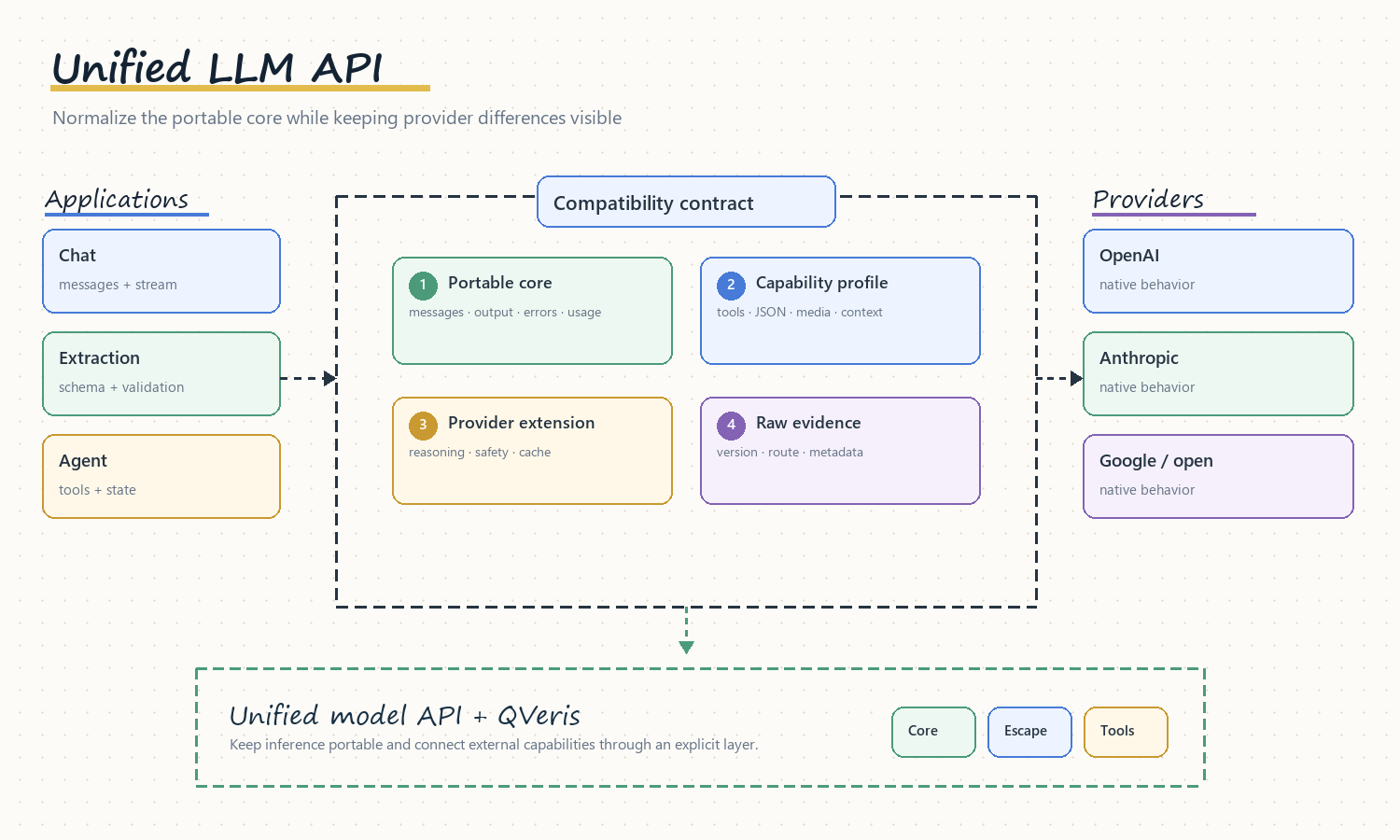
TL;DR
A unified LLM API gives applications one request and response contract across multiple model providers.
It is not perfect provider parity. Models differ in parameters, context, modalities, tool use, errors, and safety behavior.
Use aliases, capability negotiation, fallbacks, budgets, tracing, evaluations, and contract tests around the common API.
The unified model API handles inference. QVeris can handle discoverable external tools and financial data calls after the model decides to act.
统一 LLM API 为应用提供跨多个模型供应商的一套请求与响应契约。
它不等于供应商完全一致。不同模型在参数、上下文、模态、工具调用、错误和安全行为上仍有差异。
围绕统一 API 建立别名、能力协商、回退、预算、追踪、评测与契约测试。
统一模型 API 处理推理;模型决定行动后,QVeris 可处理可发现的外部工具与金融数据调用。
What a unified LLM API actually unifies统一 LLM API 真正统一了什么
At its simplest, a unified LLM API translates a common request into the provider-specific format expected by OpenAI, Anthropic, Google, Azure, open-model hosts, or internal inference services. The application keeps one client shape while the adapter or gateway handles endpoint, authentication, and response normalization.
The production value is larger than syntax. A mature unified layer also centralizes model aliases, provider selection, fallback, budgets, rate limits, logging, and usage attribution. That prevents every product team from rebuilding the same provider integration and gives operators one place to change policy.
The abstraction must remain honest. A common chat schema cannot erase differences in tool calling, JSON guarantees, image input, audio, embeddings, context windows, reasoning controls, safety filters, token accounting, and error behavior. Good architecture exposes capabilities explicitly instead of silently dropping unsupported fields.
最简单的统一 LLM API 会把通用请求翻译成 OpenAI、Anthropic、Google、Azure、开源模型托管商或内部推理服务所需的格式。应用保持一套客户端结构,由适配器或网关处理端点、鉴权和响应归一化。
生产价值远不止语法统一。成熟的统一层还会集中管理模型别名、供应商选择、回退、预算、限流、日志和用量归因,避免每个产品团队重复构建供应商集成,也让运维人员能在一个位置修改策略。
但抽象必须诚实。通用聊天 schema 无法抹平工具调用、JSON 保证、图像输入、音频、嵌入、上下文窗口、推理控制、安全过滤、token 计费和错误行为的差异。优秀架构会显式暴露能力,而不是静默丢弃不支持的字段。
Unified API architecture: six layers that matter统一 API 架构:真正重要的 6 层
| Layer层级 | Responsibility职责 | Production decision生产决策 | Evidence to capture需要记录的证据 |
|---|---|---|---|
| Client contract客户端契约 | Common request, response, streaming, and errors通用请求、响应、流式与错误 | Strict core plus explicit extensions严格核心与显式扩展 | Contract-test results契约测试结果 |
| Identity身份层 | Virtual keys, users, projects, environments虚拟 Key、用户、项目、环境 | Ownership and least privilege归属与最小权限 | Request owner and policy请求归属与策略 |
| Model catalog模型目录 | Aliases, capabilities, versions, regions别名、能力、版本、地区 | Stable product names稳定业务名称 | Resolved provider and version实际供应商与版本 |
| Routing路由层 | Selection, retry, fallback, circuit breaking选择、重试、回退、熔断 | Cost, latency, quality, privacy成本、延迟、质量、隐私 | Route and fallback reason路由与回退原因 |
| Governance治理层 | Budgets, rate limits, redaction, retention预算、限流、脱敏、留存 | Policy by team and workload按团队与工作负载执行策略 | Decision and violation logs决策与违规日志 |
| Capabilities能力层 | External tools, data, and actions外部工具、数据与动作 | Separate from inference traffic与推理流量分层 | Provenance and action audit来源与动作审计 |
Design a stable contract without hiding model differences设计稳定契约,但不要掩盖模型差异
Standardize messages, model alias, streaming, usage, finish reason, errors, and tool-call envelopes. Keep the core easy to test across providers.
Let callers ask whether a route supports JSON schema, images, audio, embeddings, tool use, regional processing, or a minimum context size.
Provider-specific controls should live in a namespaced extension object, not leak unpredictably into the portable contract.
Expose a stable error taxonomy while preserving provider code, retryability, rate-limit reset, and raw diagnostic metadata.
统一消息、模型别名、流式、用量、结束原因、错误和工具调用封装,让核心易于跨供应商测试。
允许调用方查询路由是否支持 JSON schema、图像、音频、嵌入、工具调用、区域处理或最低上下文长度。
供应商特有控制应放在命名空间扩展对象中,而不是不可预测地泄漏进可移植契约。
提供稳定错误分类,同时保留供应商代码、是否可重试、限流重置时间和原始诊断元数据。
Implementation roadmap from prototype to production从原型到生产的实施路线
Create the common client around the provider you already use and freeze behavior with contract tests before adding routes.
Replace provider model names in product code with workload names such as fast-chat, deep-analysis, or structured-extract.
Test successful calls and failure behavior, then enable controlled fallback for one low-risk workload.
Add virtual keys, budgets, rate limits, retention, redaction, traces, cost attribution, and route-quality dashboards.
围绕当前供应商创建通用客户端,并在增加路由前用契约测试冻结行为。
把产品代码中的供应商模型名替换为 fast-chat、deep-analysis、structured-extract 等工作负载名称。
测试成功调用与失败行为,再为一个低风险工作负载启用受控回退。
增加虚拟 Key、预算、限流、留存、脱敏、追踪、成本归因和路由质量仪表板。
Failure modes of a unified LLM API统一 LLM API 的失败模式
Over-normalization removes useful model features and makes every provider look equally weak.
Ignoring unsupported fields can produce a valid response with incorrect behavior. Validate capabilities before routing.
A backup model may return different schemas, safety behavior, tool calls, or language quality even when the HTTP request succeeds.
Keep provider metadata, portable logs, and a documented direct-provider path for incidents and future migrations.
过度归一化会移除有价值的模型能力,让所有供应商都显得同样弱。
忽略不支持字段可能返回格式正确但行为错误的结果。路由前必须验证能力。
即使 HTTP 请求成功,备用模型也可能产生不同 schema、安全行为、工具调用或语言质量。
保留供应商元数据、可移植日志,以及用于故障与未来迁移的直连供应商路径。
Where a unified LLM API creates the most value统一 LLM API 在哪些场景最有价值?
A shared API prevents every product team from maintaining separate provider clients, credentials, retry logic, usage parsers, and dashboards. The organization gains one policy surface while products retain workload-specific aliases and evaluation thresholds.
A portable contract makes it easier to test another provider, shift volume, respond to model retirement, or use negotiated capacity. The benefit appears only when provider-specific behavior is recorded and contract tests prevent silent regressions.
A unified layer can route around provider outages and rate limits, but fallback must be workload-aware. The backup route needs compatible tools, schemas, context, privacy, latency, and quality—not merely a successful HTTP status.
Centralized model aliases, budgets, quotas, and usage attribution let finance and engineering manage spend together. Teams can route routine work to smaller models while reserving premium capacity for tasks that pass a documented value threshold.
共享 API 避免每个产品团队分别维护供应商客户端、凭证、重试逻辑、用量解析和仪表板。组织获得统一策略界面,同时产品仍可保留工作负载别名和评测阈值。
可移植契约使测试其他供应商、转移流量、应对模型下线或使用议价容量更容易。只有记录供应商特有行为,并通过契约测试防止静默回归,收益才会真正出现。
统一层可以绕过供应商故障和限流,但回退必须感知工作负载。备用路由需要兼容工具、schema、上下文、隐私、延迟和质量,而不只是返回成功 HTTP 状态。
集中模型别名、预算、配额和用量归因,让财务与工程共同管理支出。团队可把常规工作路由到小模型,只把高价容量用于达到明确价值阈值的任务。
API contract checklist for long-term portability面向长期可移植性的 API 契约清单
Specify message roles, content parts, system instructions, model aliases, sampling, stop behavior, cancellation, timeouts, and streaming event order. Mark every field as portable core, optional capability, or provider extension.
Normalize output text, content parts, tool calls, finish reasons, citations, safety results, token categories, cached usage, reasoning usage, provider identity, model version, and estimated cost without discarding raw metadata needed for audits.
Define stable categories for authentication, quota, rate limit, validation, policy, timeout, provider failure, and capacity. Preserve the original code, retry-after signal, route history, and whether the request may be replayed safely.
Publish contract versions, capability changes, model retirement dates, migration guidance, and test fixtures. Applications should be able to pin a contract or model alias during a controlled upgrade rather than inheriting breaking changes immediately.
明确消息角色、内容部分、系统指令、模型别名、采样、停止行为、取消、超时和流事件顺序,并把每个字段标记为可移植核心、可选能力或供应商扩展。
归一化输出文本、内容部分、工具调用、结束原因、引用、安全结果、token 类别、缓存用量、推理用量、供应商身份、模型版本和估算成本,同时保留审计所需原始元数据。
为鉴权、配额、限流、验证、策略、超时、供应商故障和容量定义稳定分类,并保留原始代码、retry-after、路由历史,以及请求是否可安全重放。
发布契约版本、能力变化、模型下线日期、迁移指南和测试夹具。应用应能在受控升级期间固定契约或模型别名,而不是立即继承破坏性变化。
The compatibility contract that prevents lock-in防止锁定的兼容性契约
Label each request and response field as portable core, optional capability, or provider extension. Applications can depend on the core while explicitly opting into non-portable features when their value is worth it.
Resolve model aliases into a declared capability profile for tools, JSON, modalities, context, region, privacy, and streaming. Reject incompatible routes before sending a request instead of silently dropping fields.
Normalize common output but retain provider identity, model version, original finish reason, usage categories, safety results, citations, route history, and raw metadata needed for debugging and audits.
Replay fixtures across every supported route when providers change models, SDKs, schemas, or streaming behavior. Version the unified contract and let applications pin it during controlled migrations.
把每个请求和响应字段标记为可移植核心、可选能力或供应商扩展。应用可依赖核心,并在价值足够时明确选择非可移植功能。
把模型别名解析为工具、JSON、模态、上下文、区域、隐私和流式能力档案,在发送请求前拒绝不兼容路由,而不是静默丢弃字段。
归一化通用输出,同时保留供应商身份、模型版本、原始结束原因、用量类别、安全结果、引用、路由历史和调试审计所需原始元数据。
当供应商更改模型、SDK、schema 或流式行为时,在所有支持路由上回放测试夹具。为统一契约建立版本,并允许应用在受控迁移期间固定版本。
Where QVeris fits: capability routing after model routingQVeris 的位置:模型路由之后的能力路由
A model gateway and QVeris solve adjacent problems. The gateway governs inference traffic: provider credentials, model selection, retries, budgets, rate limits, and logs. QVeris governs the next step when an agent needs a real capability: discovering a suitable tool or dataset, inspecting its contract, calling it, and keeping an auditable record.
For a financial research agent, the gateway might route a planning prompt to the right model. QVeris can then expose the market data, filings, fundamentals, news, or external tools required to complete the plan. This separation keeps model policy and capability policy understandable instead of forcing one gateway to pretend it owns every external action.
The recommended architecture is model gateway plus QVeris, not model gateway versus QVeris. Keep each layer responsible for the traffic it can govern well, then connect them with explicit identity, budget, trace, and audit metadata.
模型网关与 QVeris 解决相邻但不同的问题。网关治理推理流量,包括供应商凭证、模型选择、重试、预算、限流和日志。QVeris 则治理 Agent 需要真实能力后的下一步:发现合适工具或数据集、检查契约、执行调用并保留可审计记录。
以金融研究 Agent 为例,网关可以把规划提示词路由到合适模型;QVeris 再提供完成计划所需的市场数据、财报、基本面、新闻或外部工具。这样可以让模型策略和能力策略保持清晰,而不是让一个网关假装管理所有外部动作。
推荐架构是“模型网关 + QVeris”,而不是“模型网关 vs QVeris”。每一层只负责自己擅长治理的流量,再通过明确的身份、预算、追踪和审计元数据连接起来。
- Send inference requests through the selected gateway or aggregator.
- Attach project, customer, environment, and trace identity to every route.
- Use QVeris discovery and inspection before an agent calls a live capability.
- Measure model cost and capability cost separately, then report the complete task cost.
- 把推理请求发送到选定的网关或聚合器。
- 为每条路由附加项目、客户、环境和追踪身份。
- Agent 调用实时能力前,先使用 QVeris 发现与检查。
- 分别计量模型成本和能力成本,再报告完整任务成本。
FAQ
It is one application-facing API that normalizes access to multiple language-model providers while centralizing routing and policy.
It is a useful starting point, but production systems must also handle provider-specific capabilities, streaming, errors, tools, multimodality, and token accounting.
Build when the abstraction is strategically unique and you have platform capacity. Buy or adopt open source when standard gateway work is not a differentiator.
Aliases keep provider names out of product code, allowing operations teams to change the resolved model without redeploying every application.
Yes, when it enables cost-aware routing, caching, budget controls, usage attribution, and lower-cost models for suitable workloads.
The unified LLM API handles model inference. QVeris complements it by giving agents a common way to discover and call real-world tools and data.
它是一套面向应用的 API,用于统一访问多个语言模型供应商,并集中管理路由与策略。
这是有用起点,但生产系统还必须处理供应商特有能力、流式、错误、工具、多模态和 token 计费。
当抽象本身具有战略独特性且有平台能力时可自建;标准网关工作不是差异化能力时,应采购或采用开源。
别名避免在产品代码里写死供应商模型名,让运维团队无需重新部署每个应用即可改变实际模型。
可以,前提是它支持成本感知路由、缓存、预算控制、用量归因,并把合适工作负载交给更低成本模型。
统一 LLM API 处理模型推理;QVeris 则为 Agent 提供统一发现与调用真实工具和数据的能力。
Sources, methodology, and update policy来源、方法与更新政策
This guide uses public product documentation and a workload-based decision framework. Product limits, pricing, supported models, and plan boundaries change frequently; verify current terms directly with each provider before procurement or production migration.
QVeris is the publisher of this guide and is described only in its intended complementary role. The comparisons distinguish model-inference routing from agent capability routing so the commercial relationship is visible rather than hidden inside a generic ranking.
本指南使用公开产品文档和基于工作负载的决策框架。产品限制、价格、支持模型和套餐边界会频繁变化;采购或生产迁移前,请直接向各供应商核对最新条款。
QVeris 是本指南的发布方,文中仅按其互补能力层定位进行说明。对比明确区分模型推理路由与 Agent 能力路由,使商业关系保持透明,而不是隐藏在泛化排名中。